|
Oregon Science Educator Update September 4, 2025
|
|

Welcome to the New School Year
We hope you found time this summer to rest, relax, and do the things that bring you joy. As we kick off another school year, we’re stepping into opportunities to inspire curiosity, spark new ideas, and connect with our students in meaningful ways. As Joe Krajcik, NGSS writing team leader, reminds us, “Science is not a luxury, but fundamentally important to understand and participate in the society and world we live in.” Here’s to a great year full of learning, discovery, and making science come alive for our students!
|

ODE Science Ignite Sessions
Looking for resources to elevate your science teaching and learning strategies but are limited on time? Join ODE Science Education Specialist, Jamie Rumage, and Science Assessment Specialist, Dr. Mariela Salas Bao, for dynamic 30-minute sessions packed with resources, practical insights and innovative approaches to science teaching and learning.
The first session will be held on Wednesday, September 10th. All other sessions will take place on the first Wednesday of each month from 4:00 PM to 4:30 PM.
Register here and don’t miss this opportunity to ask questions, learn about helpful resources, connect with fellow educators, and enhance your science classroom experience!
|
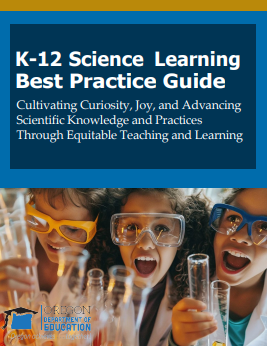
ODE K-12 Science Learning Best Practice Guide
Oregon Department of Education’s K-12 Science Education Best Practice Guide supports the implementation of a high-quality science education program. This resource outlines best practices for three-dimensional learning, strategies for student and community engagement, selections for instructional materials, and approaches to a balanced assessment system. By incorporating these elements, educators and administrators can create meaningful and equitable learning experiences each and every day that fosters scientific understanding and critical thinking.
This and other K-12 science education resources can be found on the ODE Science Resources webpage.
|
Get ready to “Dig into Science!”
This STEM Teaching Tool platform provides an introduction to current best practices in science education through practice briefs and learning modules.
The Dig into Science modules are self-guided resources designed to help you explore what you need, at your own pace. The modules serve as an entry point for:
- K-12 educators seeking a refresher on instructional shifts and practices,
- new K-12 science educators,
- administrators supporting science educators,
- paraprofessionals assisting science learning,
- or anyone involved in supporting science learning outside of school.
|

OSAS Science Interim Assessments
Science Interim Assessments. The Oregon Statewide Assessment System (OSAS) science interim assessments will be available at the end of September.
If you're new to interim assessments, start with this practice brief from STEMTeaching Tools which offers guidance on how to effectively integrate interim assessments into your instructional practice.
To further support educators, ODE in collaboration with Southern Oregon ESD has developed a new on-demand course: Implementing the OSAS Interim Assessments - On-Demand Online Course, the course will equip participants with the tools to determine which specific interim assessments are best aligned to instructional opportunities for collecting evidence of learning and then modifying or scaffolding additional instruction.
Did you know? OSAS interim assessments (cluster items only) can also be used to meet your district’s local performance assessment requirements. To support this work, ODE has created a concise two-page ODE Practice Brief provides educators and leaders with a student-centered approach to fulfilling these requirements, highlighting the benefits of performance-based assessments. For more details please visit the ODE Interim Assessment and the Local Performance Assessment Requirement webpages.
Please contact Dr. Mariela Salas Bao, Science Assessment Specialist, with questions or support needs.
|
NASA TechRise Student Challenge
The NASA TechRise Student Challenge empowers teams of sixth to 12th-grade students to design, build, and launch experiments on NASA-supported test flights. Guided by an educator, student teams affiliated with U.S. public, private, and charter schools can submit ideas for experiments to test on a suborbital flight. Winning teams will be selected to build their proposed experiment. Each winning team will be awarded:
- $1,500 to build their experiment
- A flight box in which to build it
- An assigned spot to test their experiment on a NASA-sponsored flight
- Technical support during the experiment build phase from Future Engineers advisors, who will help students learn the skills they need to turn their experiment idea into reality.
The next NASA TechRise Student Challenge is expected to open for entries in September 2025. Pre-register now to receive challenge updates!
|
Engineering is Elementary
In collaboration with the Museum of Science in Boston and Engineering is Elementary, Youth Engineering Solutions (YES) units were developed to present authentic engineering challenges that build critical thinking and innovation skills.
These free* K–5 enrichment resources use the engineering design process to make STEM connections through student-driven investigations and are designed for easy integration into adopted school curricula.
* All YES resources are freely available in both English and Spanish. By clicking “Download Unit then, Continue to Download”, you can access the unit resources directly.
|
OSTA 63rd ANNUAL CONFERENCE
Oregon Science Teachers Association is hosting its2025 Conference: Tides of Discovery: Bridges to the Future. The conference will be held at Newport Middle School, in Newport Oregon on Saturday, October 11, 2025.
This year’s theme emphasizes sustainability, interconnectedness, and the transformative power of knowledge, innovation, and collaboration. Whether you're an educator, community leader, scientist, or advocate, this conference offers opportunities to connect, learn, and lead.
OSTA welcomes keynote speaker Dr. Mark Windschitl, professor of Science Teaching and Learning at the University of Washington and author of Teaching Climate Change: Fostering Understanding, Resilience, and a Commitment to Justice (2024, Harvard Ed Press).
|
Oregon’s Adolescent Literacy Framework: Disciplinary Literacy in Science
Oregon’s Adolescent Literacy Framework builds upon Oregon Early Literacy Framework, integrating enhanced language and literacy capabilities and strategies to meet adolescents’ evolving cognitive, emotional, academic, social and cultural needs.
The framework is organized in six sections, each reinforcing responsive practice and reading science as essential components of adolescent literacy and multilingual development in Science secondary classrooms.
|
Climate Change Education Engagement Opportunities
Fall 2025 School Community Resilience Challenge: Join educators across Oregon to strengthen their communities’ capacity to respond to change. Subject to Climate invites all educators, administrators, and school staff to join the statewide challenge between August 25–October 31, 2025.
- Challenge 1: Build Your Climate Education Toolkit Create a free account on the Oregon Climate Education Hub to access high-quality, standards-aligned resources.
- Challenge 2: Learn Something New Complete one of the Hub’s free, self-paced professional development modules on climate change and teaching strategies.
Fall 2026 Climate Study: SubjectToClimate is looking for middle and/or high schools (or districts) to participate in a grant-funded study on the intersection between climate change, education, and mental health. This study will be conducted starting in Fall 2026 with external university partners (Seattle Children’s Research Institute/University of Washington) and will have IRB approval. All letters of agreement need to be solidified by September 15, 2025. Please feel free to reach out to Dr. McKenna Parnes, project lead for additional information.
|
Grade 6-12 Science PLC - Curriculum Implementation
Multnomah ESD is hosting monthly PLC engagement sessions from 4:30–5:00 pm PT on the first Thursday of each month, October through May. These sessions are open to grades 6–12 PLC leaders, science department chairs, science teacher leaders, TOSAs, and administrators. The focus will be on exploring the Collaboration Guide for 6–12 Science Teams, which provides activities and frameworks to help your team align, engage in shared learning, and plan for effective change.
Register here and join the kickoff event on September 18 from 4:30–5:00 pm PT (the session will be recorded).
|
Oregon Science Leaders - Join Today!
Oregon Science Leaders is a free, regional network for K-16 science educators and science leaders. This organization is co-led by multiple Oregon ESDs and school districts. Join the next conversation on the key topic or review the OSL's Action Guide.
To join, click this link and "ask to join".
|
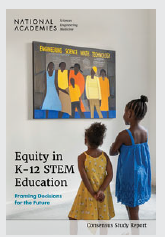
How can we better understand and work toward equity in STEM education?
To support classroom and district leaders as well as others involved in STEM education in evaluating current systems and developing and implementing equity goals, the STEM Teaching Tool practice brief #101, "How can we better understand and work toward equity in STEM education?", offers valuable guidance.
This resource is based directly on the National Academy of Science Report: Equity in K-12 STEM Education: Framing Decisions for the Future. The interactive overview and full report puts forth five equity frames to guide decision makers short- and long-term goals for equity and to make decisions about policy and practice.
|
|
|

if you have any questions or concerns, please do not hesitate to reach out to:
|
The materials contained in the Department of Education’s Oregon Science Educator Update are drawn from both internal and external sources and inclusion of external materials does not necessarily indicate Oregon Department of Education endorsement.
|
|
|
|
|