|
Updates from the Oregon Department of Education
1. Migrant Education Subgrant Formula Update
2. Team Highlights from COSA MEL 2025
3. Exciting Release: Oregon MEP’s New Service Delivery Plan
News and Resources for Multilingual and Migrant Education
1. Protecting Every Student’s Right to Education
Upcoming Events, Training & Conference Opportunities
1.Dual Language Immersion Program Job Fair, March 6, 2025
2. IDRC March Monthly Webinar: Spring Eligibility Scenarios Review, March 11, 2025
1. Migrant Education Subgrant Formula Update
The Oregon Multilingual and Migrant Education team, in partnership with the Migrant Education Program and an advisory committee, have streamlined the state’s subgrant allocation formula to enhance efficiency and flexibility in funding. Previously, Oregon used three separate allocations—for the regular school year, pre-K, and summer programs—creating administrative challenges for districts and ESDs.
To address these issues, an advisory committee of migrant leaders, including representatives from school districts and ESDs, collaborated to develop a single, consolidated allocation formula. In January, the Oregon Department of Education (ODE) met with a subgrant workgroup three times to review key factors, analyze funding scenarios, and draft a revised model aimed at reducing administrative burden while ensuring equitable resource distribution. MEP leaders also tested funding scenarios using a mock-up spreadsheet to assess potential impacts and provide recommendations.
Additionally, ODE consulted with the Title I-C State Parent Advisory Committee (SPAC) to gather parent input on educational priorities, helping shape the formula to better meet the needs of migratory students and their families.
This new approach simplifies the funding process, increases flexibility for regional programs, and ensures a more equitable distribution of resources. In collaboration with ODE, regional Migrant Education programs, and SPAC, the revised formula was designed to maintain stability while strengthening services for migratory students. Find the new formula below or click here to access the PDF.
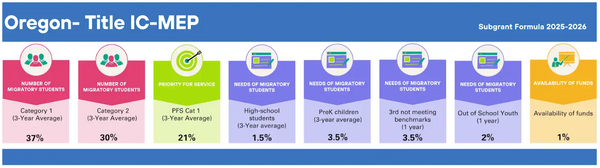 For questions or feedback, please submit them via the Title IC Subgrant Allocation Formula form, and the ODE team will address comments during the next MEP Coordinators’ quarterly meeting.
If you have any additional questions, please contact Natalia Piar, Multilingual and Migrant Education Coordinator at ODE.
Back to top
Our Multilingual Education team had the opportunity to present at the 2025 COSA Multilingual & English Learner conference, where we shared key updates and strategies to support multilingual learners across Oregon. In our presentation on the new ML/EL District Plan Template, we provided an in-depth look at how this tool, launching in the 2025-26 school year, aligns with the Oregon Multilingual Learner Strategic Plan and the English Learner Outcome Program. We walked participants through each section of the plan, highlighting how it helps districts ensure multilingual learners have equitable access to grade-level core content and language development opportunities. You can find the presentation on the District Local Plans for Title III page.
We also led a session on the implementation of the Oregon Multilingual Learner Strategic Plan, featuring insights from Eugene School District on expanding Dual Language programs and ensuring equitable access for students. Engaging with educators and leaders in these discussions allowed us to connect state-level priorities with local initiatives, fostering a shared commitment to multilingual student success.
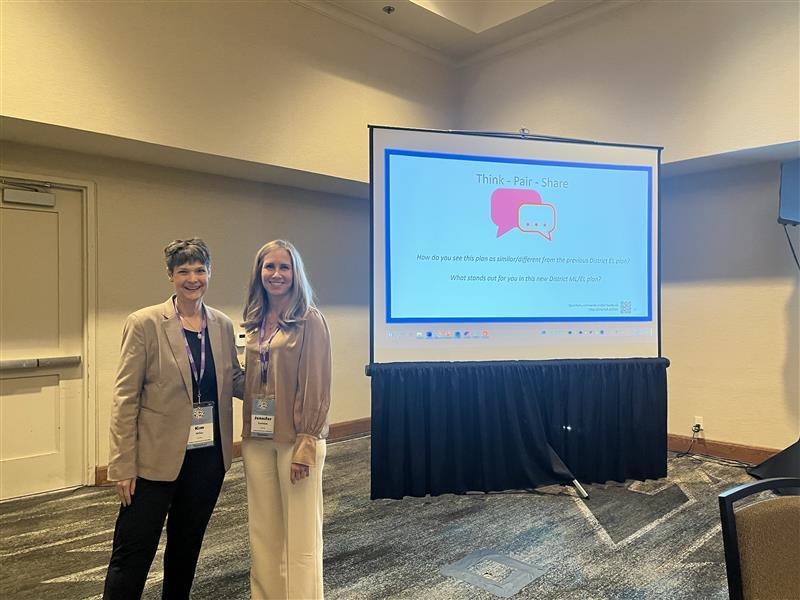 Starting left: Kim Miller, Education Specialist and Jennifer Fontana, Multilingual Education Specialist
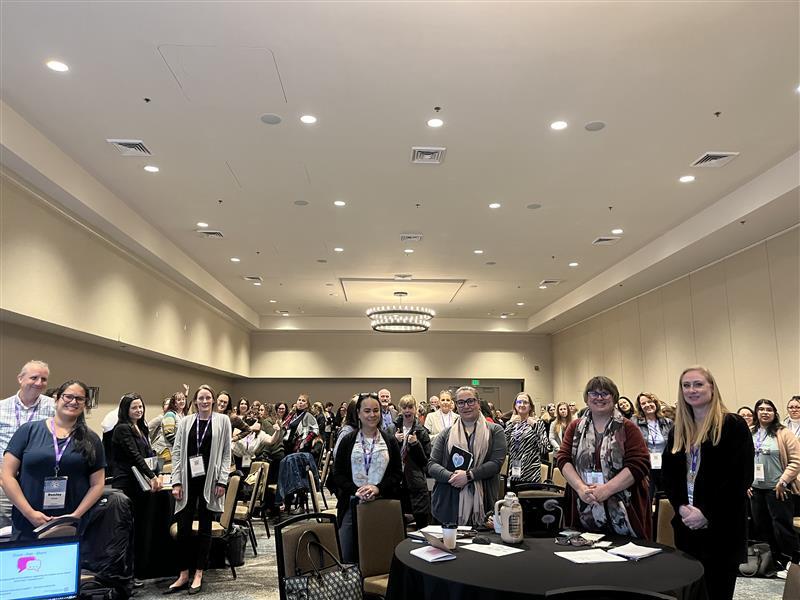 COSA MEL 2025 workshop attendees

We are thrilled to announce the release of the updated Oregon Migrant Education Program 2024-2029 Service Delivery Plan (SDP)! This comprehensive plan will guide our collective work over the next five years, driving key actions and laying out goal areas that will enhance educational outcomes for migratory students across the state. Built on the foundation of Oregon’s Comprehensive Needs Assessment (CNA), the SDP reflects the voices and lived experiences of our migratory families while aligning with the U.S. Department of Education’s National Performance Measures and Oregon’s State Performance Targets. The SDP provides the strategies, resources, and progress measurements that will shape the work of regional MEPs as they design and implement services that meet the diverse and unique needs of their local migratory populations.
We invite you to explore the SDP and bring it into conversation with your local teams. This is an opportunity to align your regional plans with Oregon’s statewide vision, ensuring that we are collectively working toward impactful and equitable outcomes for our migratory students. As we move forward on this five-year journey, ongoing evaluation will help us assess progress, celebrate successes, and adapt as needed. Your engagement is vital—study the SDP, reflect on how it informs your work, and join us in making this roadmap a tool for continuous improvement across Oregon’s MEP.
For more information about the Continuous Improvement Cycle or support in using the SDP, contact Yuliana Kenfield, Migrant Education Specialist or Hector Aguirre, Migrant Education Specialist.
Image by Ubaid E. Alyafizi on Unsplash.
|
4. ELPA Testing Updates
Future K ELPA Screener
The test window for the Future K ELPA Screener is now open as of March 3, 2025. This screener is administered to students testing before or early in their Kindergarten year, prior to the opening of the Grade K ELPA Screener window.
For questions about ELPA testing, contact Ben Wolcott, ELPA Specialist.
ELPA Summative Test
The statewide administration window for the remote ELPA Summative Test is now open as of March 4, 2025. Before testing, verify that student accommodations and supports are correctly set in TIDE. Refer to the Oregon Accessibility Manual for more information about accommodations and supports.
For test administration inquiries, reach out to your District Testing Coordinator or Regional ESD Partner.
Back to top

The Oregon Department of Education (ODE) is seeking passionate individuals—including students, educators, and community members—to serve on this advisory group. Members will help guide the implementation of the Immigrant/Refugee Student Success Plan, ensuring that policies, programs, and investments effectively support immigrant and refugee students across Oregon.
Who Should Apply?
Per ORS 329.849, the advisory group must include:
- Individuals who identify as immigrant/refugees
- Students who identify as immigrant/refugees
- Representatives of community-based organizations serving immigrant/refugee communities
- Education partners, including representatives from the Department of Early Learning and Care, Youth Development Oregon, and the Higher Education Coordinating Commission
Applicants from diverse backgrounds, roles, and lived experiences are encouraged to apply.
Commitment & Meeting Schedule
- Virtual monthly meetings (third Thursday of each month, 1:00–3:00 PM PST)
- First meetings: May 22 & June 19, 2025 (resumes in September)
- Annual in-person retreat (between school years)
- Term length: 2-3 years
How to Apply
Submit your application by Wednesday, April 9, 2025, at 5:00 PM (PST) via the Immigrant/Refugee Student Success Advisory Group Application - 2025 form.
If you prefer to apply via phone, video call, written letter, or need translation services or accommodations, please contact ODE.ImmigrantRefugee.Success@ode.oregon.gov.
Image by MOMO Studio on Unsplash.
|
6.
With the help of the Seal of Biliteracy Workgroup, the Oregon Department of Education has confirmed ACTFL equivalencies for tests rated using the CEFR scale. Beginning immediately, the following CEFR ratings may be used to support an OSSB/M claim.
- Reading and Listening: CEFR rating B1.1 or higher.
- Speaking and Writing require CEFR rating B1.2 or higher.
- If a score report does not differentiate to this level of specificity (i.e. score report reads only B1 and there is no information whether this meets or exceeds B1.1 or B1.2), a B1 is acceptable.
This information will be added to the 2026 OSSB_M Manual.
Contact Ben Wolcott, Seal of Biliteracy coordinator, with questions or concerns.
Back to top
2. EdTrust Updated FAFSA Guidance
The FAFSA Simplification Act has introduced important updates to the financial aid application process, making it easier for more students to qualify for assistance. The latest FAFSA changes aim to expand access, with an estimated 610,000 additional students becoming eligible for Pell Grants and 1.5 million students qualifying for the maximum award.
To ensure a smooth process, the Department of Education has refined the 2025-26 FAFSA application and provided targeted guidance for students from mixed-status families, justice-impacted youth, and those experiencing homelessness or in foster care.
For more details and resources, visit EdTrust’s updated Navigating the Better FAFSA page.
Back to top

3. Identifying English Learners in Pre-K: State Approaches and Practices
Uncover how states are shaping the future of English learner identification in Pre-K. This blog post delves into state policies, screening methods, and the impact of bilingual mandates. See how Illinois, Texas, and others are leading the way. Read the full blog post here.
Image by Karacis Studio on Unsplash.
|
4. Recording Available: Science of Reading for Emergent Bilinguals and English Learners
The National Committee for Effective Literacy (NCEL) and the Center for Applied Linguistics (CAL) recently hosted a webinar to launch Voices from the Field: The Impact of the Implementation of Science of Reading Instruction and Policy on Emergent Bilingual/English Learner Literacy Programs and Teachers. This insightful session explored how state Science of Reading policies are shaping literacy instruction for Emergent Bilinguals and English Learners.
Esteemed researchers Dr. Kathy Escamilla and Dr. Kimberly Strong led the presentation, while educators shared their real-world experiences. If you were not able to attend, you can now view the webinar recording here and click here to view the webinar slides.

1. Dual Language Immersion Program Job Fair, March 6, 2025
The Gresham-Barlow School District is seeking bilingual educators for its Dual Language Immersion (DLI) Program. Join their job fair on March 6, 2025, from 5:00–7:00 PM at Highland Elementary School to learn more about elementary and middle school teaching opportunities. A dual language stipend is available, and non-local applicants are welcome. Walk-ins encouraged. For details, explore Gresham-Barlow School District's Facebook.
Contact Manpreet Sadhal, Dual Language Immersion Instructional Coach.
Photo by Evangeline Shaw on Unsplash.
Back to top
|
2. IDRC March Monthly Webinar: Spring Eligibility Scenarios Review, March 11, 2025
Join IDRC March Monthly Webinar on March 11, 2025, at 11:00 AM. In this interactive session, they will review a variety of eligibility scenarios designed for all skill levels. Participants will have the opportunity to share their insights and discuss eligibility determinations in real-time. Click here to register for this event.

3. Save the Date: 2025 WABE Annual Conference, May 1-3, 2025
Join the 2025 WABE Annual Conference, where the theme “Ignite Students Linguistic Power” will take the stage. This conference will feature Dr. José Medina and Jo Napolitano as keynote speakers. Dr. Medina’s pre-conference session is limited to 100 participants, so be sure to register early to secure your spot! Click here to register for this event.
Image by MOMO Studio on Unsplash.
|

If you have content or stories you’d like featured in our newsletter, we want to hear from you! Whether it’s an article, event, or an inspiring story, your contributions add depth to our discussions. Please send your submissions and ideas to Estephany Membreno, Administrative Specialist, and you may see your content in an upcoming publication.
Back to top
|

For questions or assistance, the Multilingual and Migrant (MME) team is available to support you. Please contact us via email for further information.
|
You were added to this newsletter if you are part of the Migrant Education Program and/or the Title III English Learner listserv. Migrant Ed and Title III leaders, staff, and interested members of the public may subscribe to this newsletter through ODE's QuickSubscribe portal at any time. We thank you for serving Oregon's multilingual and migrant students.
|