New: Learning Standards for K-5 Web Page
The Learning Standards web page for K-5 is specifically designed to support K-5 educators with the implementation of Oregon’s content standards. While the Oregon Department of Education’s (ODE) content area web pages for English Language Arts, English Language Proficiency, Math, Science, Social Science, Physical Education, Health, The Arts, Social and Emotional Learning, and Talented And Gifted provide links to K-12 standards, guidance, and resources, this new webpage provides elementary educators with a single location to access grade-level learning standards. Educators can use the links on this web page to quickly access standards across the grade level in preparation for horizontal integration of learning or to review the standards in previous or future grades to better understand vertical learning progression. An additional resource on the “bundling” of standards is available.
NEW: Birth through 5 Literacy Plan Report to the Legislature
The Department of Early Learning and Care (DELC) just released the Birth through 5 Literacy Plan report to the legislature. DELC developed the plan as a comprehensive framework aimed at improving early literacy outcomes for children from birth through age five. Grounded in the goals of the Early Literacy Success Initiative (HB3198), the plan emphasizes equity, cultural responsiveness, inclusivity, and addresses disparities in access to quality literacy programs and services.
Birth Through Five Literacy Plan Executive Summary
Birth Through Five Literacy Plan Report
ODE Launches Instructional Frameworks Website
Exciting news! ODE launched Oregon’s Early Literacy Instructional Frameworks Website in August, featuring a wealth of k professional learning resources. Here are some highlights of resources that will be especially valuable for instructional coaches:
-
Collaborative Learning Session Guides: These guides facilitate engaging professional learning sessions.
-
Interactive Slide Decks: The "Reflecting on Our Practice" slide decks offer informative, interactive content for self-study or professional learning.
-
Online Modules: Explore our self-paced, asynchronous learning modules that delve into key literacy topics, allowing you to enhance your understanding at your own pace.
Check out the website for these resources and more to support early literacy in Oregon!
Coming Soon: Additional Resources to Support Implementation of the Early Literacy Success School District Grants
ODE is excited to announce additional resources to support districts in implementation of the Early Literacy Success School District Grants (ELSSDG)! This week, ODE will be publishing criteria for districts to use in the 2025-2027 biennium to evaluate and continuously improve the quality of High-Dosage Tutoring and Extended Learning programming to ensure they meet the requirements of the Early Literacy Success School District Grant. Additionally, beginning in the 2025-2027 biennium, Oregon Administrative Rule (OAR 581-017-0811) requires that districts who use ELSSDG funds to contract with external providers of Professional Development, Coaching, or High-Dosage Tutoring select from the ODE-Approved Provider List. ODE will publish Approved Provider Lists and criteria on the Early LIteracy Success School District Grant Webpage on January 15,2025.
For any questions on the ODE-Approved Provider Lists or the criteria for High-Dosage Tutoring and Extended Learning, please email your District Grant Manager or the Literacy Team at: K12.literacy@ode.oregon.gov.
Literacy Leaders’ Network Meeting: February 13 -- Save the Date!
Our Mission: To build a literate society of readers, writers, thinkers, and listeners
Purpose: The goal of the Oregon Literacy Leaders’ Network is to build a diverse community of language arts and literacy practitioners working together to share inclusive literacy practices–reading, writing, speaking, and listening–that align to the needs of all students (i.e. multilingual learners, students experiencing disabilities, etc.).
Who we are: Collectively we are individuals who support literacy development for students.
When do we meet?
- Meet virtually every Second Thursday on Zoom, from 3:30-5:00 p.m.
What to Expect in Monthly Meetings:
- Meet and connect with other literacy practitioners from across Oregon
- Share a “Bulletin Board” of opportunities
- Collaborate through self-selected breakout rooms to go deeper on topics of interest
- Read, write, and think about language arts and literacy together, occasional featured speakers
- Highlight high-leverage instructional practices
Link to Professional Learning Goals:
- Tie your attendance and participation in the LLN to your professional learning goals, particularly for goals 9 & 10, with local administrator approval.
- Receive professional learning and build a professional network during LLN meetings.
- Earn PDUs for your attendance and participation in the LLN.
Meeting Facilitation: Co-hosted by Oregon Council of Teachers of English (OCTE), Oregon State Literacy Association (OSLA), Oregon Association of School Libraries (OASL) and the Oregon Department of Education Language Arts, Literacy, Assessment, and Multilingual and Migrant Education teams, Office of Indian Education, and Teacher Standards and Practices Commission.
K-5 Newsletter
The Oregon Department of Education’s (ODE) Office of Teaching, Learning, and Assessment is launching a new quarterly newsletter for K-5 educators. This newsletter provides resources, opportunities, guidance, and ODE updates tailored specifically to support the integrated and well-rounded instruction that elementary education entails. It aims to streamline information related to K-5 academic standards and instruction into one convenient communication.
To sign up for the newsletter, click here
January 20 is Dr. Martin Luther King, Junior Day
January marks the time set aside to celebrate the life and legacy of Dr. Martin Luther King Jr. It is an opportunity to explore how Dr. King’s beliefs evolved over time, to appreciate the broader significance of his work and the movement he led, and to recognize the ongoing efforts needed to address today’s injustices. Now is the time to engage with an honest history and consider the work still to be done in fulfilling Dr. King's vision. Below are some resources to support your work with students as you reflect on what Martin Luther King, Jr. Day means and how we can help students understand the complexities of Dr. King and the civil rights movement.
-
The National Education Association has curated numerous resources, by grade band, that include lesson plans, activities, and book lists, as well as links to additional resources.
-
PBS NewsHour Classroom looks at the I Have a Dream speech in a detailed lesson plan geared towards grades 6-12.
-
PBS NewsHour Classroom also has a variety of lesson plans covering the life and work of Dr. King.
-
ReadWriteThink shares a K-2 lesson: “Martin King, Jr. and Me: Identifying with a Hero,” that could easily be adapted for older students. The lesson “explores ways to help students identify with Dr. King—an American hero who lived and died long before they were even born—through reading, writing, listening, and speaking activities that provide a glimpse into Dr. King's life.”
February is Black History Month
February is Black History Month; this month is set aside to pay tribute to the achievements, celebrations, and contributions of African Americans and the challenges they endured in their quest to achieve full citizenship in this society. One event that helps lift African American voices is the National Council of Teachers of English (NCTE)-sponsored African American Read-In. Established by the Black Caucus of NCTE in 1990, the goal of the Read-In is to bring communities together around reading by centering both African American authors and books. Reading Rockets created a list of authors and lessons to celebrate the culture and contributions of African American authors, illustrators, and storytellers. The National Education Association (NEA) also created several lessons that highlight the culture and contributions of African Americans in various areas–from music, to art, to literature, to science, and social science, and more. And, of course, there are book lists included, too!
For some considerations about teaching Black History Month, check out Learning For Justice’s Do’s and Don’ts of Teaching Black History, and Black History Month Is Over. Now What?
Additionally, Student Achievement Partners curated the following list of resources for Black History Month:
-
28 Days of Black History – Sign up for daily emails that will include ways to celebrate Black History. You’ll also receive discussion questions to drive conversation and learning with students and colleagues.
-
Black History in Two Minutes (or so) – Described as “fast, accurate U.S. history,” these free videos introduce well-known (and less-well-known) topics in Black history. Topics range from Barack Obama’s 2008 election to school integration to the first Black patent holders in the U.S.
-
New York Times Race, Racism, and Racial Justice Resources – This instructional collection from The New York Times includes lessons, writing prompts, and other text-based activities that address current-day topics related to race.
-
CommonLit Black Heritage Collection – CommonLit’s Black Heritage text set features over 40 high-quality texts that center on important Black people from the past and present. A login is required to access this text set; however, it’s free to sign up.
State Library Offers Small Grants to Fund Library Internships
The State Library is offering small grants to libraries in Oregon to fund library internships for local high school juniors or seniors (approximately 16–19 years old), to be completed in the summer months. This project was inspired by Public Library Association's Inclusive Internship Initiative and has been adapted for Oregon library needs. If you’d be interested in mentoring a teen intern in your school library this summer, check out the State Library LibGuide. Contact Tamara Ottum and Greta Bergquist with any questions.
Oregon Response to Instruction and Intervention 2024 Virtual Literacy Symposium Video Links Available
In case you missed the actual event, Oregon Response to Instruction and Intervention has shared video links to their 2024 Virtual Literacy Symposium. You can access the digital program with links to videos and resources at this link.
Building a Strong Foundation in Literacy
Eastern Oregon University and Public Consulting Group (PCG) are pleased to offer the launch of “Building a Strong foundation in Literacy,” a new online training program for in-service educators. With a focus on reading science, “Building a Strong Foundation in Literacy,” equips Oregon educators with the knowledge and skills necessary to foster proficient readers in their classrooms and schools. Click here to Enroll.
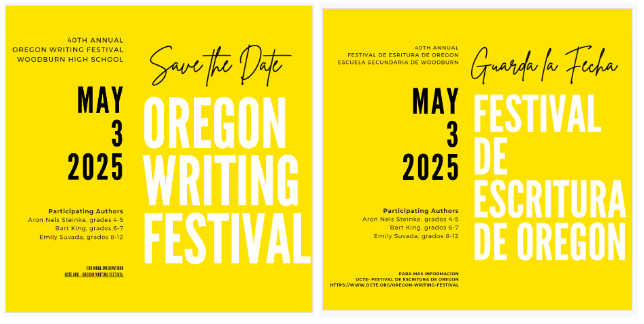
Oregon Writing Festival: Save the Date!
Write the World Writing Competitions for Students
Write the World helps “students develop the writing skills they need to succeed and make an impact” on their world. There are seven writing competitions currently available.
If you have ideas for the newsletter or want to contact the ODE Language Arts and Literacy specialists, please reach out:
Tina Roberts -- Language Arts Education Specialist
Tony Bertrand -- English Language Arts / Social Sciences Assessment Specialist
Sody Fearn -- K-2 Balanced Assessment Specialist
Sarah Thorud -- Early Language and Literacy Intervention Specialist
Mindi Helmandollar-Armatas -- PreK-3rd Grade Coordinator
Jennifer Fontana -- Multilingual and Migrant Education Specialist
Katie Trader -- Literacy Specialist
|