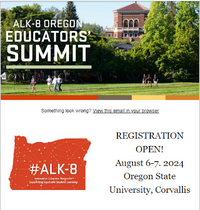
Oregon Educators are invited to register for the Educators’ Summit in Corvallis, August 6-7, 2024.
Working group projects and learnings will be featured, and you will be able to:
- Learn about innovative, field-initiated, and piloted classroom-based resources and professional development through interactive sessions
- Engage with inspirational plenary speakers (Speaker announcements coming soon!)
- Network with Oregon teachers and educational leaders
- Receive a PDE certificate, or register (at a low cost) for one to two transcript visible graduate credits for participation.
With Summit registration of an eligible Oregon educator, Summit participation includes*:
- Meals provided at the conference site
- One lodging night booked through the conference registration process
- A flat fee for travel dependent on distance from Corvallis
- A $1,000 stipend for participation in the 2-day conference
*OSU/ODE have the right of final approval for the disbursement of funds related to Summit attendance and participation. If you have any questions, please contact Martha Ahrendt.
Register here
|
Many Tribal History/Shared History lessons, activities, and materials are now available. A selection of 4th grade ELA, health, social science, math, and science lessons and resources can be found in Spanish. Fifth grade science lessons and materials are also available in Spanish.
Health Education
April is Stress Awareness Month. The 2023 Oregon Health Education Standards offer an opportunity for teachers to make connections to stress awareness month with K-5 standards, such as K.WHP.4- Identify three wellness practices that help one feel good and have energy and 4.SEM.2- Identify ways of dealing with stress, anxiety, social isolation, and depression that contribute to the well-being and mental health of self and others.
K-5 Educators: Apply for the Health Instructional Materials Evaluation Committee
The Oregon Department of Education is accepting applications for the 2024 Health Education Instructional Materials Evaluation Committee. Individuals on this committee will be responsible for evaluating and recommending health education instructional materials for adoption by the Oregon State Board of Education. ODE values and needs the voices of K-5 teachers for the committee.
You can find information on the application form. Those selected to participate will receive professional development and an honorarium for their work. The application is open through May 22, 2024. For more information or questions, contact the Instructional Materials Coordinator at ode.instructionalmaterials@ode.oregon.gov.
Science
Young children are naturally curious about the world around them. They enjoy exploring science concepts and engaging in engineering. At an early age, all children have the capacity and propensity to observe, explore, and discover the world around them (NASEM, 2012). Leveraging the wonder and joy students experience as they ask questions, investigate real-world phenomena, and design solutions to problems that matter to them can help lay a foundation that will support students in future learning and opportunities.
- The National Academies of Sciences, Engineering, and Medicine has put together an elementary practitioners guide with specific K-5 classroom examples in their recent release of Rise and Thrive with Science. The guides’ classroom examples and cases come from studies of classroom practice and research-based curricula. Cases are labeled within each chapter with the heading “Ready, Set, Investigate!” or “Get Set, Design.” Each of these extended cases are followed by an “inspiration board” where key insights are discussed.
Rise and Thrive with Science is available to read free online showcasing grade-level, phenomena driven instruction to enhance science exploration in elementary classrooms.
|
April is National Poetry Month. Reading Rockets shares about the history of National Poetry Month, the benefits of celebrating it, and includes several lessons you can use in your K-5 classrooms to get students writing poetry.
Social Science
Social science instruction happens alongside Art, Language Arts, Health, Transformative Social Emotional Learning, and more. Please share your thoughts on the new Social Science Standards via this opportunity for public comment: Draft 2024 Standards & Public Survey
April is Arab American History Month and May is Jewish American Heritage Month and also Asian American & Pacific Islander Heritage Month. The following resources provide an integrated approach to learning more about these groups in the elementary classroom:
Arab American History Month Resources
Jewish American Heritage Month
Asian American & Pacific Islander Heritage Month
Math

Data science and data-driven decision-making is a crucial skill that can begin to be explored by our youngest learners. Here are practical ways to incorporate data reasoning, a K-12 progression in the 2021 Oregon Math Standards, into your elementary curriculum:
Connect Data with Students’ Lives: As students learn to count, introduce real-world data tasks. For instance, have them collect rocks on the playground, sort them by color or shape, and create displays to represent each group. This contextualizes counting concepts.
Integrate Data Across Subjects: Data literacy need not be confined to math or science classes. Explore opportunities to leverage data in various subjects:
-
Social Studies: During a transportation unit, survey students on their modes of travel to school (walking, car, bus, etc.). Visualize the differences using tally charts or graphs. Students’ interest grows when information directly relates to their lives.
-
Language Arts: Collect data on topics such as book genres or favorite characters students are interested in. Create pie charts or word clouds to visualize student responses to support analysis.
Data science isn’t just for older students—it starts early! By integrating data tasks seamlessly into math instruction, educators can empower young learners with essential skills for the future. These additional resources may be helpful in creating data-rich experiences in your classroom:
|
Physical Education
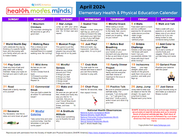
Research shows that healthy students are better learners, and that physical activity improves academic achievement and improves physical, social, emotional, and mental health. SHAPE AMERICA produces monthly Health & Physical Education Activity Calendars that can be used within your classroom, and students can take them home to increase self and/or family activities that focus on health and well-being. The activity calendars are also great for school staff wellness. The calendars contain additional information on monthly health related observances, and are available in English and Spanish.
|
Sexuality Education
In April, educators and partners come together to recognize Child Abuse Prevention Month & Sexual Assault Action Month. For local educators and schools, this is an opportunity to link arms with the many partners who share a vision of violence-free schools and communities in the collective and integrated effort to prevent violence and abuse.
K-5 educators can use this month to deepen fundamental prevention skills related to Erin’s Law and the Healthy Teen Relationships Act. For example, in elementary school, educators can turn moments from recess, community circle, and group projects into learning and practice opportunities related to prevention – and to meet Health Education standards, such as 4.HRVP.6- Discuss communication skills to build healthy relationships and manage conflict. Lessons that explore these topics are identified on page 24 of the Sex Ed Open Learning Project’s User Guide.
In May, states across the country observe Youth Sexual Health Awareness and Sex Education for All Month. In Oregon, sexuality education begins in elementary school, centering around safety, communication, bodies, and healthy relationships. Amaze jr has many resources for educators, parents, and K-2 students that cover a broad range of sexuality education topics. Sign up for ODE’s Sexuality Education Newsletter for more timely resources to uplift Sex Education for All Month in May.
Arts
Arts for Learning Northwest is collaborating with Oregon teaching artists on the development of a series of four arts courses designed for K-5 students called Arts, Care & Connection, with integrated social emotional learning content in the areas of dance, visual arts, theater, and music. Check out this featured resource for an example of the Arts, Care & Connection content included in the Oregon Arts Group!
This lesson is part of a pilot project, and will be shared in its final version in an Oregon Open Learning Lesson Collection. Oregon teachers are encouraged to provide feedback on the form included in the lesson resources, to inform the development of this project.
|
This newsletter does not replace ODE’s K-12 content-specific newsletters. If you are subscribed to these newsletters, they will continue to arrive in your inbox. You can also adjust subscription settings at the ODE subscription page.
|



