NEW: K-5 Newsletter
ODE’s Office of Teaching, Learning, and Assessment is launching a new quarterly newsletter for K-5 educators. This newsletter will provide resources, opportunities, guidance, and ODE updates tailored specifically to support the integrated and well-rounded instruction that elementary education entails. It aims to streamline information related to K-5 academic standards and instruction into one convenient communication.
Meaningful Inclusion Begins with Access
Oregon is one of seven states in partnership with the National AEM Center to develop a statewide system for the equitable and timely provision of AEM, Accessible Educational Materials. Universal access to curriculum in all environments empowers learners with diverse needs to get the same information, engage in meaningful participation, and enjoy the same services as their peers, with the same ease of use. It provides options for learners who “read” in non-traditional ways.
As district teams prepare to purchase new textbooks, create supplemental materials, develop web content and most importantly, to determine AEM needs for individual learners, think accessibility. The Oregon AEM Cohort is developing resources to support accessibility considerations and conversations across stakeholder groups in the OER Commons Accessible Educational Materials Group on the Oregon Open Learning Hub.
For additional information about partnering in the commitment to equitable access for inclusion, contact Debra Fitzgibbons, Coordinator for Oregon Technology Access Program (OTAP).
Oregon Response To Instruction and intervention (ORTIi) Virtual Reading Symposium Resources Now Available
If you missed Oregon Response to Instruction and Intervention's (ORTIi) Virtual Reading Symposium, or if you want to check out additional sessions, the recordings are ready. The interactive sessions may be helpful as a platform for professional development in your building or district. Access to the videos is free, and you can share them widely. You can find the videos by clicking the WATCH button for each session on the digital program.
Check out the video resource page HERE.
Engaging Equity Professional Learning Series - New Modules Now Available!
Engaging Equity: Equitable Mindsets, Practices, and Systems is an openly licensed professional learning series developed in partnership by the Oregon Department of Education’s Office of Education Innovation and Improvement and WestEd. The series is designed for participation in teams, PLCs, or other groups, and also available to individuals. Learners can access the content through a public Canvas course, or the modules can be imported into your organization's Canvas LMS.
Culturally Responsive and Sustaining Practice, the second of four soon to be available clusters within this professional learning series, focuses on strategies for creating culturally responsive and sustaining learning environments and experiences for students. The four modules in this cluster examine how adults’ social and emotional learning and well-being are fundamental to creating culturally responsive and sustaining learning environments. The first four modules of cluster 1 focus on Racial Equity Foundations. Cluster 1 & 2 are available on the Oregon Open Learning Hub in the PK-12 Professional Learning Group. For more details, view the full scope and sequence for the professional learning series.
|
From WestED: 6 Strategies for Effective School-Based Family Engagement Events
School-based family engagement centers on the activities and communications that schools share with families. WestEd offers six strategies for effective school-based family engagement.
Culturally Sustaining English Language Development in Grades 6-12: a WestEd Webinar
In this webinar, Dr. Christine Snyder shares how teachers can design and implement a comprehensive approach to English Language Development (ELD), which includes integrated and designated ELD, that benefits all students. Dr. Snyder, who works on the WestEd team led by Dr. Pam Spycher, a primary author of the ELD Standards and ELA/ELD Framework, also addresses how school and district leaders can create the conditions necessary for successful implementation. This session includes videos from recent work in classrooms.
The News Literacy Project Shares Opportunities for News Literacy Week
News Literacy Week is January 22-26, and The News Literacy Project is hosting several events that week. One of these events is How to Find Local News You Can Trust, a free webinar that will provide an overview of the news literacy concepts and skills people need to be informed. Presenters will share how quality, ethical journalism is done and how it seeks to inform audiences in a fair and accurate manner. Click the link above to register.See the Library Corner update below for an additional opportunity on teaching informational literacy to students.
AllSides Provides Balanced News from the Left, Center, and Right
The AllSides website provides articles from different perspectives in an effort to help sift through media bias, misinformation, and disinformation. Check it out here.
Student Success Plan Integration
Oregon’s Early Literacy Framework: A Strong Foundation for Readers and Writers (K-5)
In May of last year, the Oregon Department of Education published Oregon’s Early Literacy Framework: A Strong Foundation for Readers and Writers (K-5). While the Framework isn’t a Student Success Plan (SSP) in and of itself, it does relate to all of the SSPs, as it centers student belonging, students’ funds of knowledge, their oral language development, and cultural relevance and responsiveness in literacy instruction. The overview flier says that the vision for the Framework is:
Children must have access to consistent, culturally responsive, and research-aligned literacy instruction that guarantees reading and writing proficiency in at least one language. Parents and caregivers must be supported as full partners in their children’s literacy development. Elementary teachers must be prepared and supported to identify individual student strengths and needs, and to teach reading and writing in research-aligned ways. This includes creating the conditions for students to effectively learn.
There are immediate ways to connect the framework to Oregon’s English Language Arts and Literacy Standards. Some are:
- Every student must be taught to read and write: Thoughtfully designed literacy instruction– rooted in reading and writing research, reflective of culturally responsive and inclusive practices, aligned to Oregon standards, supported with high-quality instructional materials, and inclusive of targeted supports—ensures all students learn to read and write (p. 5).
- Families and communities play an important role: Children’s literacy learning is deepened through their lived experiences, where language, culture, and identity are affirmed by families and caregivers who serve as important first teachers (p. 5).
- Culturally Responsive Practices: Culturally responsive practices help students engage with learning and see the relevance of reading and writing to their own lives… Culturally responsive teachers value their students' social identities, including their race, ethnicity, ability, gender, home language, and lived experiences…By affirming multiple identities and histories of students’ lives, students can show up authentically and meaningfully engage in their educational experience. (p. 8).
- High Expectations with Responsive Support: While instructional strategies may vary in the approach to teaching with high expectations and high support, the message is the same: Every child in the classroom can achieve at high levels and participate in the cognitive richness and depth of knowledge required to meet grade-level standards. (p. 8).
- Diverse Texts: Culturally responsive literacy instruction includes the selection of a high-quality literacy curriculum and supplemental materials that include characters, settings, and authors that are diverse and reflective of the abilities, identities, and cultures of the students and those in the student’s community. When materials reflect and honor student identity, home language, and culture, they contribute to a welcoming and affirming classroom environment. (p. 9).
- Culturally responsive instruction in literacy builds awareness of the author’s perspective, addressing the experiences of diverse populations, while also exposing and disrupting any negative stereotypes that may be present in materials (p. 9).
- Children come to school in the full dimension of their humanity (inclusive but not limited to their culture, gender, language, and religion). When schools, therefore, see students through a single lens, they see a partial picture of their lived experiences. For students to feel known, it is important that educators learn to see and acknowledge our students' intersectional identities, especially when they do not reflect the dominant culture. When educators understand and teach about identity and intersectionality, they are more likely to embrace students’ multiple identities and recognize that a single social identity does not fully represent or define a child. By affirming multiple identities and histories of students’ lives, students can show up authentically and meaningfully engage in their educational experience. Most importantly, when instruction and engagement are paired by leveraging what educators know about a child and honoring intersectionality, it fundamentally shifts access to literacy learning (p. 8).
- Elevate student assets and re-rewrite destructive narratives about the academic capacity of children historically marginalized by the system (p. 10).
Tribal History/Shared History Professional Development Courses
Oregon Department of Education’s Tribal History / Shared History webpage, includes several professional development resources. These courses support educators in building a foundation for teaching, training, and serving as a source of support, knowledge, and advocacy within their school, district, or organization for the Senate Bill 13 Tribal History/Shared History curriculum. You can also find these professional development resources on this Oregon Open Learning page, by clicking on the green “View Resource” box.
Fighting Fake News through Public Libraries
Once a political catchphrase, fake news has become part of our daily lives. The American Library Association has published a webinar on fighting fake news by using your local, public library. In this free, on-demand webinar, originally published in April of 2022, participants learn strategies for using information literacy as a gateway to teach about misinformation and disinformation (and have it actually sink in). Some of these strategies may be relevant for school libraries and classrooms, as well.
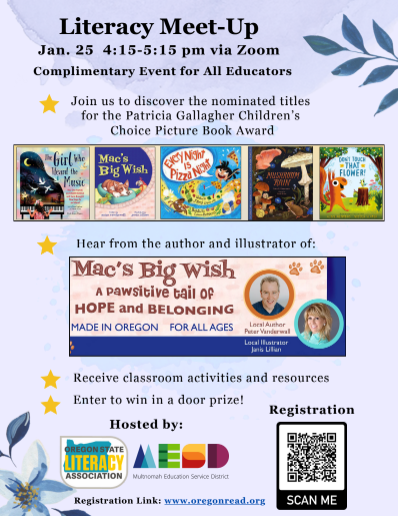
Literacy Meet-Up:
Patricia Gallagher Children's Choice Picture Book Award
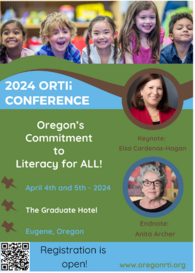
Oregon Response to Instruction and Intervention (ORTIi) 2024 Conference Registration is Open
The 2024 ORTIi Annual Conference registration is now open. The conference will be held at The Graduate in Eugene, OR on April 4th and 5th.
More details about the lineup of presenters will be available this month.
Scan the QR Code in the image above or click here to register.
Plan ahead now for two learning filled days on April 4th and 5th. Topics include:
- The Science of Reading
- Effective Instruction
- Multi-Tiered Systems of Support
- Leadership
- Social, Emotional, and Behavioral Supports
- District Implementation Journeys
|
KATE Reading Comprehension Research Study
WestEd (a nonprofit education organization) and researchers at Texas A&M University are seeking districts to participate in a fully funded reading comprehension research study. The groups have been funded to expand the use of the evidence-based reading comprehension program Knowledge Acquisition Transformation Expansion (KATE). Four studies of this program have found it to have a strong, positive impact on reading comprehension for 4th and 5th grade students. Many districts are looking for ways to accelerate learning in response to learning losses due to the COVID-19 pandemic. Federal funding for KATE offers a way to do just that, FREE of charge. (Participating teachers will earn a stipend of $1,000 for participation).
The comprehensive reading comprehension intervention consists of practice-based professional development for teachers, teacher-led reading comprehension instruction, and a web-based tutoring platform to improve reading instruction and student comprehension. The great thing about this program is that it can be used with any texts and curriculum currently in use. WestEd and Texas A&M are looking for school districts to participate in this study (funded by the U.S. Department of Education) starting in Fall of the 2024-25 school year. Interested districts can contact kate_literacy_study@wested.org or visit https://literacy.io/projects/kate to learn more.
Oregon ASCD Early Learning Conference Registration is Open
The 2024 Oregon Association for Supervision and Curriculum Development (ASCD) Early Learning Conference is April 10-12, 2024 at the Sheraton Portland Airport Hotel. The keynote speakers include national leaders in Early Learning including Dr. Charlene Williams, Dr. Rosemarie Allen, and Dr. Rick Solomon. The goal of the conference is to serve PreK-2 programs in Oregon with presentations on cutting-edge research and best practices from educators throughout the state. Join teachers, coordinators, principals and other early learning professionals. Click here to view more details and to register.
|
Oregon Council of Teachers of English (OCTE) Recognizes
Teacher Excellence and Innovation with Grants and Awards
Annual grants of $150-$300 are awarded to assist teachers in developing curriculum, purchasing materials, or otherwise enhancing instruction in language arts/literacy. Submit your grant application here. Grant submission deadline is February 15, and recipient decisions are named by March 15.
Any Oregon school is invited to nominate one outstanding English language arts educator for the prestigious Oregon Excellence Awards in Teaching the English Language Arts. Submit your nomination here. Nomination deadline is April 6.
The Roland Bartel scholarship is awarded to early service teachers (within the first three years of their career) to attend OCTE’s Fall or Spring Conference. Apply here prior to any conference.
National Council of Teachers of English (NCTE) recognizes students and teachers of English/language arts in areas of writing, teaching, and more. See NCTE Awards for a detailed list of competitions and awards including dates and requirements.
Apply for 2024 Book Love Foundation Grants
The Book Love Foundation has grants available for “teachers who demonstrate a passion for promoting a hunger for books.” Three types of grants are available: Classroom Library grants, Book Club grants in honor of Dr. Teri Lesesne, and new this year, they will be offering Preservice Teacher grants. Check out the requirements and find applications for grants here.
Free Screening of The Right to Read Film
The Right to Read, a documentary produced by LeVar Burton, will be available to watch free online all day on Thursday, 2/1 to anyone who registers. Or, access the film on that day by visiting the website. Otherwise, the only way to view it is if there is a screening in your area. (Or, you can request a screening for your area.) For more information, see the About and Learn More pages, the latter of which includes a discussion guide.
Essay Opportunity: What Do Your Students Think About Diversity and Social Justice?
Conversations around diversity, equity, inclusion, and social justice dominate education today. The ongoing challenges about which books should be allowed in classroom libraries make that clear. But what do students think about such topics?
The International Literacy Association (ILA) has partnered with the American Educational Research Association (AERA) on a student writing project to share their perspectives on these important issues.
This unique opportunity is open to K–12 students nationwide; selected responses will be featured at the 2024 AERA Conference reflecting the theme, “Dismantling Racial Injustice and Constructing Educational Possibilities.”
Educators may submit student responses of up to 1,000 words between now and January 17, 2024. Visit www.literacyworldwide.org/AERA for full details.
Write the World Writing Competitions for Students
Write the World helps “students develop the writing skills they need to succeed and make an impact” their world. There are seven writing competitions currently available. Check them out here.
If you have ideas for the newsletter or want to contact the ODE ELA specialists, please reach out:
Tina Roberts -- Language Arts Education Specialist
Tony Bertrand -- English Language Arts / Social Sciences Assessment Specialist
Sody Fearn -- K-2 Balanced Assessment Specialist
Sarah Thorud -- Early Language and Literacy Intervention Specialist
Mindi Helmandollar-Armatas -- PreK-3rd Grade Coordinator
Jennifer Fontana -- Multilingual and Migrant Education Specialist
|