 Happy New Year! We wish you a wonderful 2024

-
January 29, 2024 - November 2023 claims are due
-
February 1, 2024 - On-Site Monitoring is Due
-
February 1, 2024 - Verification collection reporting due
-
March 4-9, 2024 - National School Breakfast Week
-
March 15-16, 2024 - OSNA State Conference

Program Announcements
Verification Reporting SY 2023-24
Now that the verification process is complete, Sponsors must submit The FNS 742 Verification Collection Report in CNPweb. It must be completed and entered on the “Claims” tab by February 1, 2024. If the completed FNS 742 Verification Collection Report is not submitted in CNPweb by February 1, 2024, Claims for Reimbursement will be withheld until it is completed. If this is the case, continue to enter claims according to the claim timelines in CNPweb to avoid late claims.
Sponsors who are district-wide Community Eligibility Provision (CEP) or use Provision 2 for breakfast and lunch district-wide and are in a non-base year or are residential child care institutions (RCCI) without day students, do not conduct the verification process. However, completion of the population data on the FNS – 742 Verification Collection Report is required.
Instructions on how to complete the FNS 742 Verification Collection Report for CEP, Provision 2 for breakfast and lunch and RCCIs without day students are located below the FNS 742 Verification Form and Instructions on the School Nutrition Programs Verification webpage.
On-Site Monitoring Requirements
Every school year, each school food authority with more than one school shall perform no less than one on-site review of the counting and claiming system and the readily observable general areas of review cited under 7 CFR 210.8 for each school under its jurisdiction.
The on-site review shall take place prior to February 1 of each school year.
Further, if the review discloses problems with a school's meal counting or claiming procedures or general review areas, the school food authority shall: ensure that the school implements corrective action; and, within 45 days of the review, conducts a follow-up on-site review to determine that the corrective action resolved the problems.
Each on-site review shall ensure that the school's claim is based on the counting system authorized by the State agency under 7 CFR 210.7(c) and that the counting system, as implemented, yields the actual number of reimbursable free, reduced price and paid meals, respectively, served for each day of operation.
School and school districts should use the On-Site Monitoring Form. Please see the On-Site Monitoring at a Glance for more information
|
Welcome to the School Team Natalie!
The School Nutrition Team is very excited to announce that we have a new Child Nutrition Specialist. Please join us in welcoming Natalie Bratton.
Some of you may recognize her name as she has served as a Child Nutrition Specialist on the Community Team for a little over a year. Natalie has a bachelor’s degree in nutrition and psychology.
She is very excited to see the amazing things schools are doing with their programs. Here is what she had to say:
“It is always so great when we go out and see the kids get excited about school meals. With my new role on the school team, I am looking forward to learning new things and building relationships with School Food Authority staff’.
Natalie’s Hobbies and Interests are cooking, weightlifting, reading, and playing violin. She also serves on the board of Creating Opportunities, a non-profit organization serving children with disabilities and their families.
Over the course of the next few months, Natalie will be learning the specifics of her new role. She will be assigned sponsors in time for the 24-25 school year, so at this time, your assigned Child Nutrition Specialist will not change. However, you will be in great hands if you are one of the sponsors that will be working with Natalie in the next school year!
Direct Certification X-9 codes
When you download your Direct Certification files, have you noticed the code in column U? This code indicates the strength and parameters of the student match.
On the first full weekend of the month, the Oregon Department of Human Services (DHS) sends a file of Oregon children receiving SNAP or Foster services. That file is matched with the Oregon Department of Education's Secure Student Information Database (SSID) records. SSID records are created when a student enrolls in an Oregon Public School. Each code indicates the parameters used to match the correct SNAP/Foster recipient with the student enrolled in a specific school district.
An X-9 code is matched if there is an exact match on the student's birthdate and a fuzzy match on their first and last name. Many children within the state of Oregon could share a birthdate and have a similar name. It is the responsibility of the Eligibility Official to verify that the students on the Direct Certification file are matched correctly. To verify that a student is matched correctly the guardian name and address on the Direct Certification file should match the guardian name and address listed in the student's enrollment records.
By using the Membership Upload feature the DHS and school information can easily be compared as all the information is contained in one file.
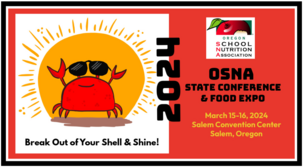
Oregon School Nutrition Association (OSNA) State Conference and Food Expo
Come join with your Oregon school lunch professional colleagues at OSNA’s 2024 State Conference and Food & Equipment Expo, March 15-16, at the Salem Convention Center and ride the wave of new ideas, insights and innovations in school foodservice to benefit your K-12 meal program! This year’s theme is “Breaking Out of Your Shell.”
Register on-line here
For more information, including program and events, see the OSNA State Conference webpage.
|

National School Breakfast Week
March 4-9, 2024
National School Breakfast Week (NSBW) celebrates the importance of a nutritious school breakfast in fueling students for success. This special observance during the first week of March celebrates the national School Breakfast Program and the many ways it gives kids a great start every day.
|
Healthy Meals Incentive (HMI) Awards and Healthy Meals Summit
FNS has established the Healthy Meals Incentives Initiative to improve the nutritional quality of school meals through food systems transformation, school food authority recognition and technical assistance, the generation and sharing of innovative ideas and tested practices, and grants.
Healthy Meals Incentives activities are expected to increase utilization, and thereby demand, for nutritious agricultural commodities, such as whole grains, vegetables, legumes, and fruits as well as food products that reflect various cultures. These efforts are also positioned to strengthen small and rural school food authorities’ access to nutritious agricultural commodities through food systems transformation and grants to small and rural school food authorities. Click here to learn more of the Healthy Meals Incentives.
|

Making the Most of School Meals
The important connection between nutrition and academic achievement is well established and starting to get the recognition it deserves! Likewise, as school nutrition professionals, you are an important key to academic support by providing students with the fuel they need to succeed with tasty, nutritious meals that meet school nutrition program standards. However, it’s been said, “It’s not nutrition until it’s eaten.”
So, what if all the effort to provide those meals is not fully reaching the intended goal because students don’t have enough time to eat?
If students don’t have enough time to eat, socialize, and finish their meal, will they be nourished and prepared to focus when they get to the classroom? Allowing students adequate seat time is key to building lifelong healthy eating habits and supporting students’ nutrition and academic potential.
Take a moment to ask yourself:
- Does my school allow students at least 20 minutes of seated time to eat?
- Is seat time written into our local school wellness policy?
- What can I do to support adequate time for students to eat?
Every school is different, and each school may need different strategies to navigate the scheduling, staffing, and facility challenges they face. There are many ideas and best practices to consider. The CDC’s Healthy Schools’ Making Time for School Lunch is an excellent resource that provides useful tips for all members of the school community.
Remember, increasing seat time for all students won’t happen overnight. Try using one strategy at a time, connect with others, and don’t forget to celebrate your success! Your efforts can support making the most of school meals.
|

Grant Applications to Improve School Meals through Local, Regional Partnerships Now Open
Applications are now open for the School Food Systems Transformation Challenge Sub-Grants, which is part of USDA’s Healthy Meals Incentives Initiative.
These grants will transform the K-12 school food marketplace by increasing collaboration between school districts, food producers, suppliers, distributors, and/or community partners. Students can expect to see improvements in the quality of food on their plates, thanks to these new efforts.
FNS encourages all eligible applicants to consider applying for one or both grant opportunities:
Supporting Community Agriculture and Local Education Systems (Project SCALES):
Led by the Center for School and Community Partnerships at Boise State University, these projects will increase the procurement of locally sourced foods by developing innovative partnerships between schools and producers; growers; and processors. In addition, schools will be supported in the preparation of the foods and promoting them to students. Project SCALES was awarded $16.1 million and will provide two cohorts with sub-grants of up to $150,000 each (70 total). Applications for the first cohort will close on Jan. 26, 2024. Applications for the second cohort will open in 2025.
Partnerships for Local Agriculture & Nutrition Transformation in Schools (PLANTS):
Led by Chef Ann Foundation, these projects will support regional efforts to expand scratch-cooked meal programs, increase equity, foster a resilient supply chain, and create scalable and sustainable change for school districts across the country. Chef Ann Foundation’s PLANTS was awarded $7.8 million and will provide sub-grants of $500,000-$600,000 to each of eight awardees. These grants will increase opportunities for regional small- and mid-scale producers, aggregators, and processors to become part of the K-12 school food market. Applications close on Jan. 22, 2024
Applications for sub-grants managed by two other organizations – Full Plates Full Potential and Illinois Public Health Institute – will open in early 2024. Collectively, the four organizations were awarded $50 million by USDA to administer these sub-grants.
Eligible organizations are encouraged to check the USDA’s Healthy Meals Incentives website to learn more about the School Food Systems Transformation Challenge Sub-Grants. For updates, sign up for the bi-monthly newsletter at the bottom right of the USDA Team Nutrition website.
|

Breakfast After the Bell (BAtB)
SY 23-24 Breakfast After the Bell Equipment Grant
The 2023 Breakfast After the Bell (BAtB) Equipment subgrants have been processed through the Electronic Grants Management System (EGMS). As a reminder, July 10, 2024, is the last day to submit claim documentation and EGMS claim as per your executed agreement. Please follow these instructions on how to claim:
- Submit your BAtB Equipment Grant Reimbursement form and invoice to schoolnutrition@ode.oregon.gov.
- Upon approval of your claim, enter your claim through Follow the EGMS External User Guide for steps on how to enter your claim.
If you have questions regarding the BatB Equipment grant, please contact Laura Allran at laura.allran@ode.oregon.gov.
Focused Breakfast After the Bell Resources - Reducing Chronic Absenteeism:
These are resources you can also share with your school administrators.
Recipes:
Fun Ideas? Please share your ideas, what’s working well, and any questions with us any time. Crista Hawkins and Laura Allran.
|
 Upcoming ODE/SNP Webinar Trainings
Oregon Department of Education Child Nutrition Program (ODE CNP) is offering the following webinar(s):
Production Records and Offer Versus Serve (OVS) - April 9, 2024 @ 2:00 PM Register Here
This session will cover:
- OVS overview and requirements
 News and Information About Other Child Nutrition Programs
For any questions about how supplemental USDA foods support the NSLP, CACFP or SFSP meal program for current school year or next school year, please contact the ODE USDA Foods Distribution Team at ode.fooddistribution@ode.oregon.gov
Please visit the Farm to Child Nutrition webpage for the latest grant information and due dates.
Fresh Fruit and Vegetable Program
Extra! Extra! Read all about it. Newsletters will be distributed during the following weeks. (During the summer, newsletters will be distributed once a month) We encourage you to access previous newsletters on the School Nutrition Memos Page:
 School Nutrition Program Contacts
Civil Rights
In accordance with federal civil rights law and U.S. Department of Agriculture (USDA) civil rights regulations and policies, this institution is prohibited from discriminating on the basis of race, color, national origin, sex (including gender identity and sexual orientation), disability, age, or reprisal or retaliation for prior civil rights activity.
Program information may be made available in languages other than English. Persons with disabilities who require alternative means of communication to obtain program information (e.g., Braille, large print, audiotape, American Sign Language), should contact the responsible state or local agency that administers the program or USDA’s TARGET Center at (202) 720-2600 (voice and TTY) or contact USDA through the Federal Relay Service at (800) 877-8339.
To file a program discrimination complaint, a Complainant should complete a USDA Program Discrimination Complaint Form which can be obtained online at: https://www.usda.gov/sites/default/files/documents/usda-program-discrimination-complaint-form.pdf, from any USDA office, by calling (866) 632-9992, or by writing a letter addressed to USDA. The letter must contain the complainant’s name, address, telephone number, and a written description of the alleged discriminatory action in sufficient detail to inform the Assistant Secretary for Civil Rights (ASCR) about the nature and date of an alleged civil rights violation. The completed AD-3027 Complaint form or letter must be submitted to USDA by:
- mail:
U.S. Department of Agriculture
Office of the Assistant Secretary for Civil Rights
1400 Independence Avenue, SW
Washington, D.C. 20250-9410; or
- fax:
(833) 256-1665 or (202) 690-7442; or
- email:
program.intake@usda.gov
This institution is an equal opportunity provider.
|