 February 1 is World Read Aloud Day. Started by LitWorld in 2010, and sponsored by Scholastic, the purpose of World Read Aloud Day is to bring people together through a shared love of reading. The timing of the release of the National Council of Teachers of English’s (NCTE) newest position paper on The Role of Nonfiction Literature fits nicely with World Read Aloud Day. NCTE’s paper suggests that contemporary nonfiction plays an important role in K-12 education, and nonfiction pleasure reading is just as important as reading fiction for pleasure. Mary Ann Cappiello, Professor of Language and Literacy at Lesley University, curated a list of nonfiction picture books that could be great read-alouds for World Read Aloud Day, or any other day of the year. She also created other nonfiction book lists, including nonfiction chapter books.
February is Black History Month; this month is set aside to pay tribute to the achievements, celebrations, and contributions of African Americans and the challenges they endured in their quest to achieve full citizenship in this society. One event that helps lift African American voices is the NCTE-sponsored African American Read-in. Established by the Black Caucus of the National Council of Teachers of English in 1990, the goal of the Read-In is to bring communities together around reading and by centering both African American authors and books. Reading Rockets created a list of authors and lessons to celebrate the culture and contributions of African American authors, illustrators, and storytellers. The National Education Association (NEA) also created several lessons that highlight the culture and contributions of African Americans in various areas–from music, to art, to literature, to science, and social science, and more. And, of course, there are book lists included, too!
For some considerations about teaching Black History Month, check out Learning For Justice’s Do’s and Don’ts of Teaching Black History, and Black History Month is Over. Now What?
Additionally, Student Achievement Partners curated the following list of resources for Black History Month:
-
28 Days of Black History – Sign up for daily emails that will include ways to celebrate Black History. You’ll also receive discussion questions to drive conversation and learning with students and colleagues.
-
Black History in Two Minutes (or so) – Described as “fast, accurate U.S. history,” these free videos introduce well-known (and less-well-known) topics in Black history. Topics range from Barack Obama’s 2008 election to school integration to the first Black patent holders in the U.S.
-
New York Times Race, Racism, and Racial Justice Resources – This instructional collection from The New York Times includes lessons, writing prompts, and other text-based activities that address current-day topics related to race.
-
CommonLit Black Heritage Collection – CommonLit’s Black Heritage text set features over 40 high-quality texts that center important Black people from the past and present.
New and Noteworthy

Gender Expansive Student Guidance Released
In January, the Oregon Department of Education (ODE) proudly published Supporting Gender Expansive Students: Guidance for Schools. This guidance is grounded in the recognition, respect, affirmation, friendship, joy, belonging, and safety every human deserves - including the students, staff, and families that make-up our school communities. Gender expansive students are protected under federal and Oregon civil rights laws. School districts have a responsibility to provide a safe and affirming educational environment for all students, including gender expansive students. This updated guidance clarifies new and evolving laws and policies in order to address the diverse needs of a broad range of gender expansive students and the school districts who serve them.
Alongside the guidance, ODE has created a set of tools and resources aligned with the LGBTQ2SIA+ Student Success Plan to assist school staff, students, and families with the implementation of these guidelines. There are resources designed to support administrators and school staff, including an action planning tool, a student support and safety plan template, a guide for changing name and gender marker within student information systems, and a document explaining the gender expansive individual education program (IEP) template updates. There are also several student and family-facing resources on filing discrimination complaints, accessing gender-affirming care, and asking for support in schools.
|
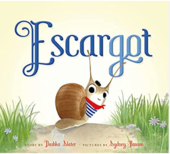
Book Review: Escargot, by Dashka Slater
Escargot, written by Dashka Slater and illustrated by Sydney Hanson, is a delightful picture book that would make a great read-aloud in an elementary classroom or with your own children, grandchildren, nieces or nephews. It’s about Escargot, a snail, who is on a journey to get to his much-anticipated salad–one “with croutons and a light viniagrette.” There are plenty of opportunities to practice your French in this story, and there’s lots of engaging vocabulary that kids will have fun trying out for themselves. The illustrations are soft, like a colored pencil drawing–except for Escargot himself. His colors are bold and almost demanding, much like his personality.
You can easily use this book as a class read-aloud and engage students in discussion to address RL standards, such as RL.1: Ask and answer questions about key details in a text; RL.2: Retell stories, including key details, and demonstrate understanding of their central message or lesson, and RL.3: Describe characters, settings, and major events in a story, using key details.
Slater is an award-winning journalist and a New York Times bestselling author with more than 15 books to her credit, including The 57 Bus: A True Story of Two Teenagers and the Crime That Changed Their Lives. The 57 Bus is a nonfiction book for teens “about race, class, gender, crime, and punishment” that “tells the true story of an agender teen who was set on fire by another teen while riding a bus in Oakland, California.”
|
Announcements and Resources
K-5 Literacy Project Update
Pandemic relief funds invested in literacy learning
Literacy is a human right and a gateway to lifelong opportunities. It is the backbone of a strong democracy. ODE is committed to dismantling systemic barriers to literacy while providing tools to help all students develop as readers, writers, speakers, and critical thinkers. Toward this end, ODE is undertaking several projects to invest in literacy development for students across Oregon.
One such project is Small, rural school library revitalization grants. ODE is offering small grants to Oregon’s rural, low-income and small K-12 school districts to modernize and revitalize their school library collections. Oregon public school districts are eligible to receive this funding if they are eligible for federal awards in either (or both) Rural Low-Income School (RLIS) or Small Rural School Achievement (SRSA) categories. Grant awards will be announced by email directly to eligible school districts in early 2023. Visit ODE’s Library and Media Education webpage for details.
Sign up for the K-5 Literacy Investment listserv for project updates: visit ODE’s Quick Subscribe Page and sign up for the "ESSER III: K-5 Literacy" newsletter.
ELA Standards: Pathways to Proficiency Documents
The Pathways to Proficiency Documents (nested under the Oregon ELA Standards Grade Level Documents (K-12) accordion) align the 2019 Oregon English Language Arts and Literacy Standards with the major learning targets in grades 3-12 and the Oregon Statewide Assessment for English Language Arts. These documents provide educators with key evidence statements, the different levels of proficiency as aligned to the achievement level descriptors (ALDs), associated learning progressions, and the Oregon Statewide Interim Assessment System resources. There are Pathways documents for Reading Literary Text, Reading Informational Text, and Writing in all three modes: argumentative, informative/explanatory, and narrative.
Research and Resources for Your Classroom
ChatGPT, WRITE Center, and The National Writing Project
ChatGPT has been in the news continuously since it was first launched in November 2022. Initial headlines warned of the death of academic writing, and there were numerous accounts of school districts banning access to the app on their networks. NCTE recently weighed in on the matter in an article in The74, with cautions and considerations about how to incorporate ChatGPT into our practice as language arts educators, and how this may cause us to rethink the traditional five-paragraph essay assignment.
Recently, WRITE Center hosted a webinar about ChatGPT and how to use it as a teaching and learning tool. You can register for on-demand access to the webinar and sign up for the WRITE Center newsletter. The National Writing Project has created an online community for educators to share their thoughts about and experiences with ChatGPT. You can check that out and register here.
If you’re interested in a more local dialogue, I’d invite you to share your thoughts and experiences with ChatGPT with me. Send your comments to tina.roberts@ode.oregon.gov.
From ILA: What the Research Says About Read-Alouds for Littles
Read-alouds provide unique opportunities to support development and fostering a love of reading–and it’s never too early to start. In Ready for Read-Alouds: 10 Practices for Book-Sharing with Infants and Toddlers (The Reading Teacher, no subscription required), authors Claire D. Vallotton, Nicole Gardner-Neblett, Lria Kim, Tamesha Harewood, and Nell K. Duke share research-based ways to enrich read-alouds with our littlest learners, as well as how to set goals for sharing these important practices with fellow educators, families, and communities.
ILA has also included some additional selections and read-aloud resources to their selection of new and noteworthy articles from The Reading Teacher (free access), Reading Research Quarterly (subscription required; some articles are free and open-source), and Journal of Adolescent & Adult Literacy (subscription required; some articles are free and open-source).
From Student Achievement Partners: Stories We Were Sold Series
In response to the Sold a Story podcast that was released last fall, Student Achievement Partners (SAP) introduced a series on the Peers and Pedagogy blog that addresses some of the stories educators were sold and the stories SAP sold when it comes to teaching literacy. The series aims toward action, sharing some of the things SAP is doing as they–and we–engage in ongoing learning about equitable literacy instruction.
Library Corner
Using Infographics to Build Media Literacy and Higher-Order Thinking Skills
Edutopia featured an article this month on teaching infographics: “Using Infographics to Build Media Literacy and Higher-Order Thinking Skills.” The author of the article acknowledges that infographics are not new media for students. Instead, they focus on the need to teach students how to first read infographics and then how to analyze the information presented in them. The author goes on to explain that the next logical step is to teach students how to generate their own infographics making their learning relevant and applicable to the environments they navigate daily.
American Library Association announces 2023 Youth Media Award winners
The American Library Association (ALA) announced the Newberry, Coretta Scott King, Printz, and Caldecott winners for 2023. Each of these awards honors contributions by authors and illustrators of picture books for young children through adolescent literacy. You can read about all the winners and honorees here.
Opportunities for Educators
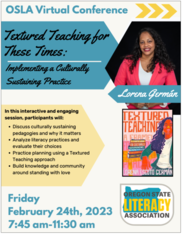
Oregon State Literacy Association Virtual Conference–Registration Open
The 2023 Oregon State Literacy Association Virtual Conference is right around the corner! There will be one session this year, and there’s still time to register!
The session is for educators of grades 6-12 and features Lorena German. German is one of the founders and facilitators of the #DisruptTexts movement. In this session, German will ask educators to consider the following questions:
- How can I make sure this content is engaging and relevant to students’ lives?
- How can I make sure this content helps them see the humanity in others?
- How can I make sure this content helps them make sense of the world around them?
“Participants will gain a clear context for why teaching about why these issues matters; they’ll also gain skills for how to do it and learn about strategies they can implement immediately.”
|
Oregon Council of Teachers of English Recognizes Teacher Excellence and Innovation with Grants and Awards
Annual grants of $150-$300 are awarded to assist teachers in developing curriculum, purchasing materials, or otherwise enhancing instruction in language arts/literacy. Submit your grant application online. Grant submission deadline is February 15, and recipient decisions are made by March 15.
Any Oregon school is invited to nominate one outstanding English language arts educator for the prestigious Oregon Excellence Awards in Teaching the English Language Arts. Nomination deadline is April 6.
The Roland Bartel Scholarship is awarded to early service teachers (within the first three years of their career) to attend OCTE’s Fall or Spring Conference. Apply prior to any conference.
National Council of Teachers of English (NCTE) recognizes students and teachers of English/language arts in areas of writing, teaching, and more. See https://ncte.org/awards/ for a detailed list of competitions and awards including dates and requirements.
Oregon Open Learning OER Office Hours - February 10, 1-2 pm
The Oregon Open Learning team invites you to attend its OER Office Hours on the afternoon of Friday, February 10th. These gatherings are designed to facilitate connections and conversation both with the team and between Oregon educators who are exploring the possibilities that Open Educational Resources (OER) and the Oregon Open Learning Hub present. Whether you are new to the OER space or a seasoned advocate, your perspective is welcome and valued. Each session, facilitated by members of the Oregon Open Learning core team, will include space for questions, individualized support, and open discussion about OER and the Hub. Register in advance and then drop in anytime between 1:00 and 2:00 pm PT. If you have questions, please email OregonOpenLearning@ode.oregon.gov.
|
Contact Us
If you have ideas for the newsletter or want to contact the ODE ELA specialists, please reach out:
Tina Roberts -- English Language Arts Education Specialist
Tony Bertrand -- English Language Arts / Social Sciences Assessment Specialist
Sody Fearn -- K-2 Balanced Assessment Specialist
Sarah Thorud -- Early Language and Literacy Intervention Specialist
Mindi Helmandollar-Armatas -- PreK-3rd Grade Coordinator
Audrey Zunkel-deCoursey -- K-5 Literacy Program Coordinator
|
|
| |
|