 The start of the new year is often a time of reflection and renewal. We look back at all we’ve accomplished across the calendar year and consider how we’ve been challenged and how we’ve triumphed. Living in a culture that can be hyper-focused on productivity and achievement, it is all too easy to go from one thing to the next without taking time to reflect. But, everything we’ve experienced shapes how we show up in the world and how we engage with those around us. Reflecting on those experiences teaches us about ourselves and helps us decide if and how we want to move differently, as a result. As we put 2022 to bed and welcome 2023, may it be filled with new opportunities, perspectives, and adventures!
New and Noteworthy
Author Jason Reynolds finishes their third year as the National Ambassador for Young People’s Literature
In this NPR interview, Jason Reynolds says, “Stories happen to be the most human thing we have to offer - right?” This idea shaped Reynolds’ ambassadorship. His main goal was to “create human moments with young people” in order to fulfill his duties as the ambassador for reading and writing for young people. His interpretation of those duties was to answer, “How could I convince young people who may not like to read that they have a story of their own and that their story is as important as everything that their teachers and parents are trying to get them to read?”
Reynolds acknowledges that kids don’t like to read because they find it boring–and that is true for many adults, as well. However, Reynolds suggests that if students are seen in the texts they’re asked to read in school, they’ll be more invested. He says of his own reading experience and how that shaped his role as ambassador, “I felt like books were almost, in some passive way, judging me for being who I was simply by erasing me from the canon, in and of itself. If I’m not shown or if I don’t exist in a story, then that means that somebody doesn’t find my life valuable enough to talk about.”
You can listen to the interview or read the transcript for more information.
Book Review: Long Way Down, by Jason Reynolds
Long Way Down, by Jason Reynolds, is a novel written in verse. It tells the story of William Holloman and how he attempts to navigate “the rules” of the street, after his brother is murdered for murdering someone else. Will knows the rules: 1. Don’t cry; 2. Don’t snitch; 3. Get revenge. As he contemplates how to avenge his brother’s murder, important people from his past show up to help him make sense of his grief, his anger, and his desire for revenge.
This commanding, beautifully-written novel is a quick and powerful read. Reynolds has the ability to draw in his readers, painting for them a visceral picture of the pain associated with the cycle of violence and revenge that attempts to right a wrong when a loved one’s life is cut short.
NCTE Releases New Position Statement on Teaching Storytelling
The National Council of Teachers of English (NCTE) has released an updated version of its Teaching Storytelling Position Statement. The newly-revised paper emphasized the importance of teaching storytelling, teachers sharing their stories as models, and allowing students to share their own stories. In addition to defining storytelling and providing a rationale for teaching it, the paper discusses six methods and approaches for applying storytelling in the classroom.
The paper cites Johnson and Freedman (2001) stating, “By sharing stories—and allowing students to share theirs—teachers create a community of learners that might just overcome some of the boundaries that keep people apart or alone in the world of school” (p. 43). The statement goes on to quote Oregon’s own Linda Christensen (2000) in Reading, Writing, and Rising Up, “When they hear personal stories, classmates become real instead of cardboard stereotypes: rich white girl, basketball-addicted Black boy, brainy Asian. . . . When students’ lives are taken off the margins and placed in the curriculum, they don’t feel the same need to put down someone else” (p. 7).
Announcements and Resources
K-5 Literacy Project Update
Pandemic relief funds invested in literacy learning
Literacy is a human right and a gateway to lifelong opportunities. It is the backbone of a strong democracy. The Oregon Department of Education (ODE) is committed to dismantling systemic barriers to literacy while providing tools to help all students develop as readers, writers, speakers, and critical thinkers.
ODE is undertaking a major revision of the state’s 2009 Literacy Framework, with a focus on K-5 education. Find out more at ODE’s website about the statewide literacy investment. Our online survey is open for two more weeks to receive your input on literacy education, so please share your thoughts with us: K-5 Literacy Framework Input Survey (in English) or La Estructura de Lectoescritura de Oregón - Comentarios de la comunidad y del educador (en Español).
Sign up for the K-5 Literacy Investment listserv for project updates: visit ODE’s Quick Subscribe Page, click on the “subscription preferences” option after entering your email address, and sign up for the "ESSER III: K-5 Literacy" newsletter.
OSAS Professional Development Opportunity: ELA Summative Test Scoring
The Oregon Department of Education (ODE) is seeking educators interested in participating in the scoring of ELA test items for Oregon Statewide Summative Tests.
- This training is primarily intended for individuals who would like to deepen their understanding of hand-scored items and the rubrics used to score them.
- Recruited applicants will be signed on as temporary employees with ODE and Measurement Incorporated and will receive compensation at the standard ODE rate of $28.96 per hour.
- The application will ask applicants to specify either ELA or mathematics scoring.
NOTE: There are minimum technical requirements to install and run the scoring platform. For instance, the scoring platform does not run properly on ChromeOS.
The initial training for this project will occur on March 17, 2023, in Salem, OR. Substitute and travel costs for the March 17 training day will be covered by ODE. Following that training day, qualified raters will then remotely score items during their own off-contract time throughout spring. ODE will prioritize selection based on educator and regional diversity, active classroom educators and instructional coaches, grade band scoring needs, and a combination of both new and experienced scoring experience.
The deadline for submitting an application is Thursday, February 9, 2023, and ODE will notify successful applicants by February 13, along with information on the next steps.
For additional information, please review the Scoring Recruitment Notice. If there are additional questions then contact Tony Bertrand, Language Arts Assessment Specialist.
ELA Standards: Pathways to Proficiency Documents
The Pathways to Proficiency Documents (nested under the Oregon ELA Standards Grade Level Documents (K-12) accordion) align the 2019 Oregon English Language Arts and Literacy Standards with the major learning targets in grades 3-12 and the Oregon Statewide Assessment for English Language Arts. These documents provide educators with key evidence statements, the different levels of proficiency as aligned to the achievement level descriptors (ALDs), associated learning progressions, and the Oregon Statewide Interim Assessment System resources. There are Pathways documents for Reading Literary Text, Reading Informational Text, and Writing in all three modes: argumentative, informative/explanatory, and narrative.
Research and Resources for Your Classroom
NCTE’s Policy Research Brief: Critical Media Literacy and Popular Culture in ELA Classrooms
The National Council of Teachers of English (NCTE) released a policy brief in 2021, Critical Media Literacy and Popular Culture in ELA Classrooms, that emphasizes ways to grow students’ media literacy in English language arts classrooms by teaching them how to be conscientious consumers of digital media and how to be creators of content, as well. The brief, produced by the James R. Squire Office of the National Council of Teachers of English, and authored by Jamila Lyiscott, University of Massachusetts Amherst; Nicola Mirra, Rutgers University; and Antero Garcia, Stanford University, says, “Students are often portrayed as mindless consumers of popular culture, but a spike in social media engagement by Millennials and Generation Z reveals that K-12 youth are often at the helm of creating media content and impacting the trends which constitute popular culture.” The authors suggest that new perspectives are needed in ELA classrooms in order to help teachers “critically engage media and popular culture to avoid continued harm and to center students as critically engaged members of a new digital social reality.”
In order to do that, they suggest moving beyond just the consumption of digital media and into production, which also means moving beyond the 5-paragraph essay as the main method for students to share their knowledge and understanding of texts. Citing Kellner and Share (2019), they suggest that “student engagement with popular culture and media in the ELA classroom is richest when it encompasses both analysis of existing texts and composition of new ones. When young people become literacy creators in addition to consumers, they gain a deeper grasp of various modes of expression and the necessary skills to contribute to ongoing creative conversations.”
The policy brief is free to access, even without an NCTE membership.
Reading Rockets Offers Free Online Foundational Reading Classes
Looking to tone your foundational literacy instructional muscles? Check out these free online course modules offered by Reading Rockets. Regardless of the grade level you teach, educators will find resources in these modules that will assist in supporting students who need additional practice with foundational reading skills. The program consists of nine modules that include not only classroom strategies and assignments, but additional resources on the foundations of teaching reading and writing, “including phonemic awareness, phonics, fluency, vocabulary, and text comprehension”. The modules also include video clips of educators demonstrating effective reading instruction in real classrooms.
Oregon Open Learning Hub: Multilingual/English Learner Resource Bank
The Oregon Open Learning Team is pleased to announce that the Multilingual/English Learner Resource Bank is now available! The resource bank provides easy access to online resources for English learner programs and services, including materials across disciplines such as social studies, health, engineering, language arts, and visual arts.
The Multilingual/English Learner Resource Bank was created to support HB 3499 (2015). This bill directed the Oregon Department of Education (ODE) to create an online resource bank for sharing evidence-based, culturally responsive best and promising practices for serving multilingual/English Learner students and engaging their families.
During the 2021-22 school year, a cohort of Oregon educators worked on the “OER Development Grant: Supporting Students who are Emergent Bilingual” project. Together, they participated in professional learning and went through a process of developing, piloting, iterating, and evaluating lesson plans to contribute to the Oregon English Language Development group. At the end of the project, the final lesson plans were evaluated using the Oregon OER Quality Framework. The lessons that met this high quality standard are now featured as the first resources in the Multilingual/English Learner Resource Bank.
A big shout out to all of the grantees for their hard work on this project! We look forward to seeing this collection grow.
|
Opportunities for Educators
Oregon State Literacy Association Virtual Conference–Registration Open
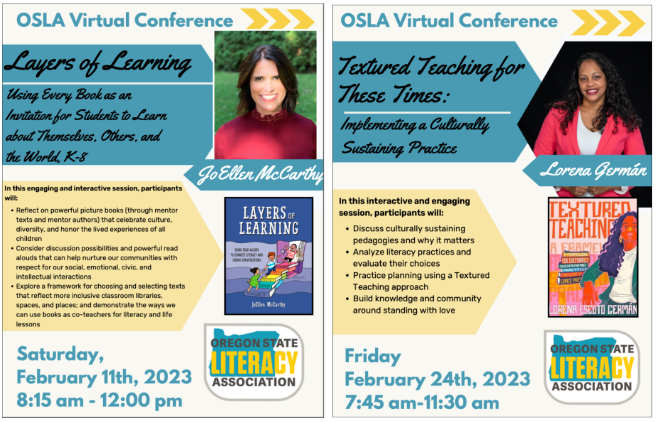
Registration is now open for the 2023 Oregon State Literacy Association Virtual Conference. There are two sessions this year.
First is a session geared toward K-8 educators with JoEllen McCarthy. In this session, participants will discover how using diverse books as read-alouds, anchor texts, and for student choice reading can foster student-centered, inclusive conversations and “inspire students to be agents of change.” Register for JoEllen McCarthy
The other session is for educators of grades 6-12 and features Lorena German. German is one of the founders and facilitators of the #DisruptTexts movement. In this session, German will ask educators to consider the following questions:
- How can I make sure this content is engaging and relevant to students’ lives?
- How can I make sure this content helps them see the humanity in others?
- How can I make sure this content helps them make sense of the world around them?
“Participants will gain a clear context for why teaching about why these issues matters; they’ll also gain skills for how to do it and learn about strategies they can implement immediately.” Register for Lorena German
ORTIi Reading Symposium Recordings Now Available
December 8, Oregon Response to Instruction and Intervention (ORTIi) hosted their annual Reading Symposium. Education reporter, Emily Hanford, shared a keynote address titled, “Discovering the Science of Reading: A Reporter’s Story.” Other sessions include “Literacy for English Learners: What’s ‘Reading Science’ Got to Do With It?” with Claude Goldenberg, and “Intensifying Literacy Instruction” with Kim St. Martin, to name a few. If you missed it, or if you want to check out additional sessions, the recordings are ready. Access to these videos is free, and you can share them widely, whether or not you originally registered for the conference.
Check out the video resource page HERE.
National Endowment for the Arts Big Read
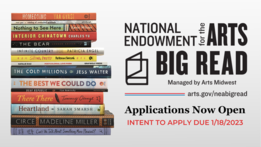
Bring the NEA Big Read to your community! Applications are now open for grants to support NEA Big Read projects between September 2023 and June 2024. An initiative of the National Endowment for the Arts (NEA) in partnership with Arts Midwest, the NEA Big Read supports community reading programs each designed around a single NEA Big Read book selection with the goal of inspiring meaningful conversations, artistic responses, and new discoveries and connections in each community. Matching grants range from $5000 to $20,000 each. The Intent to Apply Deadline is Wednesday, January 18, 2023. Visit Arts Midwest for complete grant guidelines and to apply. If you have any questions, please contact Arts Midwest at neabigread@artsmidwest.org or 612-238-8024.
|
Opportunities for Students
Contact Us
If you have ideas for the newsletter or want to contact the ODE ELA specialists, please reach out:
Tina Roberts -- English Language Arts Education Specialist
Tony Bertrand -- English Language Arts / Social Sciences Assessment Specialist
Sody Fearn -- K-2 Balanced Assessment Specialist
Sarah Thorud -- Early Language and Literacy Intervention Specialist
Mindi Helmandollar-Armatas -- PreK-3rd Grade Coordinator
Audrey Zunkel-deCoursey -- K-5 Literacy Program Coordinator
|
|
| |
|