|
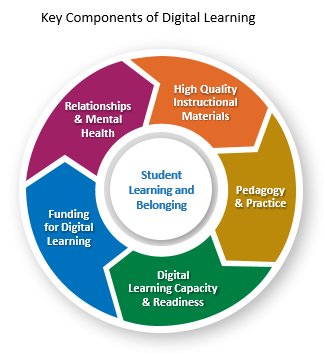
Each newsletter will work in tandem with the Key Components of Digital Learning by focusing on one of the components and offering powerful resources and promising practices as well as examples from the field, all in connection with the focus component. We encourage you to think of this newsletter as a starting point for dialogue as you engage with your teams to provide equitable and robust digital learning opportunities for all students.
If you haven't yet had a chance to read through the Key Components of Digital Learning, this is a great starting place for schools and districts to turn to when designing, planning, and implementing digital learning. The Key Components of Digital Learning is intended to serve as a foundational resource for districts to utilize in the planning, implementation, and development of strong leadership for digital learning.
The digital learning team at the Oregon Department of Education will continue to develop this resource through continued collaboration with educators and leaders from around the state. If you or your school or district have examples, elaborations, or would like to contribute ideas or stories to future additions of this resource, you can connect with ODE through this form.
In each newsletter, we will highlight one of the five components and provide resources and examples from the field. In this month's issue, we will be centering on "Relationships and Mental Health."
Focus: Relationships and Mental Health, Promising Practices and Powerful Resources
This newsletter's key component focuses on the importance of building and maintaining strong relationships with students and families while creating intentional structures and implementing strategies that support students’ mental health. Cultivating relationships and mental health in a digital space are intricately tied to ODE’s Care and Connection Campaign.
|
|
 |
Promising Practices and Powerful Resources
The ideas and resources in this section are grounded in ODE’s Integrated Model of Mental Health and emphasize strength, resilience, and enhancing social emotional abilities based on a continuum of care. Additional information can be found in ODE’s Mental Health Toolkit which is designed for district leaders, school administrators, and school-based mental health professionals (i.e. school counselors, school psychologists, school social workers, and school nurses) interested in promoting the health and well-being of school communities while creating a culture of safety, care and belonging.
- Create structures to build community. Check out resources to support thinking about how to create community in an online or blended learning environment. While the podcast episode and article "Creating Moments of Genuine Connection Online" focuses on online learning, the strategies can be embedded across all learning modalities.
- Foster a sense of belonging and safety for each student. We encourage you to check out the Care and Connection Toolkit as well as the Handle with Care Resources.
- Partner with families to create a supportive learning environment. Check out this article "Using Technology to Connect with Parents" to learn about how technology can support this practice.
- Supporting staff is essential to supporting students. Creating space for learning and providing resources can serve as one avenue to support staff. This article "Making the Most of Your EdTech Toolbox" provides strategies for ensuring that resources are available for teachers.
Relationships and Mental Health: Examples from Across Oregon
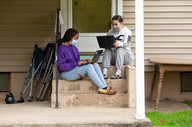
The section highlights elements of schools and programs throughout Oregon as ways to illustrate how they are building strong Relationships with students and families and supporting the Mental health of their students. As cultivating relationships and supporting students’ mental health are at the foundation of this work, we invite you to learn about examples of Care and Connection across the state as well as read Relationships and Mental Health: Examples from Across Oregon which highlights three schools, on the basis of how they center relationship building and support students’ mental health in digital spaces.
|
Photos by Allison Shelley for EDUimages
|