Fire Program Newsletter
2027 Winter Fire School Registration is Open!
The DPSST Fire Program is pleased to announce that registration is now open for the 2027 Winter Fire School. The event will be held February 20-21 on the Oregon Public Safety Academy campus in Salem and will feature seven National Fire Academy (NFA) courses and one hands-on training opportunity.
All courses are two-day sessions and will conclude at approximately 5:00 p.m. on Sunday, February 21. Complimentary lodging will be available on Friday, February 19, and Saturday, February 20, for participants traveling more than 75 miles to attend. Breakfast and lunch will be provided for all registered attendees throughout the event.
This year's classes are:
- (F0762) New Fire Chief: Contemporary Issues
- (F0455) Strategy and Tactics for Initial Company Operations
- (F0457) Decision-Making for Initial Company Operations
- (F0458) Preparation for Initial Company Operations
- (F0770) Fire Investigation: First Responders
- (F2500) Applications of Operational Safety
- (F0612) WUI Fire Operations for the Structural Chief Officer
- DPSST Hands-on Fire Training - To be announced in November
To get alerted when the Hands-on training for Winter Fire School will open, sign up for our GovDelivery Fire Training Emails!
If you are already registered and can no longer attend, please cancel your reservation by using the link in your emailed Eventbrite ticket or email Madison Mancuso at madison.mancuso@dpsst.oregon.gov. Please note that individuals who register but do not attend will be ineligible for DPSST fire trainings for one year.
Please contact Madison Mancuso at madison.mancuso@dpsst.oregon.gov or 971-433-7899 with any questions.
DPSST Approved Courses Expiring
Each year, some DPSST courses expire based on the five‑year approval cycle they follow. On December 31, 2026, courses with Course IDs beginning with 21F are scheduled to expire. Updated Course IDs have been assigned so instructors can begin submitting new F-9F forms for these courses.
Because the current Course IDs remain active until 12/31/2026, you may submit your F9F early. Staff will hold the requests and return the rosters and NOCCs to the requestor in December.
Please note that this is not a blanket expiration of all courses. Most of your currently approved courses will remain valid for several more years. Only submit new forms for courses expiring in 2026 or for any new courses you are requesting approval for. If you are unsure which courses you already have approval for, please reach out to DPSST staff and we can confirm what is current. The full Course List can be found on the DPSST website at CourseList.pdf.
The following courses are DPSST approved courses that use Nationally Recognized curriculum and that can be applied for by anyone qualified.
Nationally Recognized Courses Expiring:
| Expiring Course ID |
Course Title |
New Course ID
|
| 21F021 |
NFPA Live Fire Instructor |
27F005 |
| 21F022 |
NFPA Live Fire Instructor In Charge |
27F006 |
| 21F031 |
NFPA Marine FF for Land Based Firefighters |
27F007 |
Most courses expiring at the end of this year are proprietary courses. These are courses for which an agency or individual submitted an F‑20 form, had the curriculum reviewed and approved, and was assigned a course number that may only be used by that agency, by that individual, or by others who have written permission from the proprietor. These courses are not automatically approved for new course numbers.
To renew a proprietary course, submission of a new F‑20 form is required, as well as an F-9F form for any instructors.
Proprietary Courses Expiring:
|
Expiring Course ID
|
Course Title |
Proprietor |
| 21F015 |
NFPA Wildland Fire Apparatus |
DPSST |
| 21F016 |
COCC Fire Officer I |
Central Oregon Community College |
| 21F017 |
Maritime Fire Service Awareness |
Clackamas County Fire District #1 |
| 21F018 |
Maritime Fire Deck Hand |
Clackamas County Fire District #1 |
| 21F019 |
Maritime Fire Boat Operator |
Clackamas County Fire District #1 |
| 21F020 |
Maritime Fire Service Rescue Boat Operator |
Clackamas County Fire District #1 |
| 21F021 |
TVFR Maritime Rescue Boat Operator |
Tualatin Valley Fire & Rescue |
| 21F024 |
ARFF Fore Structural Firefighters |
Kingsley Field Fire Department |
| 21F025 |
NFPA Rope Rescue Operations |
Clackamas County Fire District #1 |
| 21F026 |
NFPA Rope Rescue Technician |
Clackamas County Fire District #1 |
| 21F027 |
NFPA Live Fire Instructor & Live Fire Instructor In Charge |
Clackamas County Fire District #1 |
| 21F028 |
Confine Space Rescue |
Gresham Fire Department |
| 21F029 |
NFPA 1072 Awareness & OHSA 120 Ops |
Indy Safety Inc. |
| 21F032 |
Rope Rescue Operations and Technician |
Gresham Fire Department |
| 21F033 |
NFPA Rope Operations |
Corvallis Fire Department |
| 21F035 |
NFPA Surface Water Rescue |
North Lincoln Fire & Rescue |
| 21F036 |
NFPA Surf Water Rescue |
North Lincoln Fire & Rescue |
| 21F037 |
Fire Officer I Academy |
Albany Fire Department |
| 21F038 |
TVFR Swiftwater Rescue Technician |
Tualatin Valley Fire & Rescue |
| 21F039 |
NFPA Youth Firesetting Intervention Specialist |
Tualatin Valley Fire & Rescue |
| 21F040 |
TVFR Maritime Awareness |
Tualatin Valley Fire & Rescue |
| 21F041 |
TVFR Maritime Deckhand |
Tualatin Valley Fire & Rescue |
| 21F042 |
TVFR Maritime Boat Operator |
Tualatin Valley Fire & Rescue |
For questions about courses expiring, F-9F Form or F‑20 Form submission please reach out to Brooke.Bell-Uribe@dpsst.oregon.gov or 503-569-8260.
Upcoming National Fire Academy Classes
Command and Control of Incident Operations
- Dates: Dec. 7, 2026 - Dec. 12, 2026
- Times: 8 AM - 5 PM all 6 days
- Location: Bend, Oregon
This class is full!
Please email Madison Mancuso at madison.mancuso@dpsst.oregon.gov to be added to the waitlist!
(F2500) Applications of Operational Safety (AOS)
This class replaced National Fire Academy's Incident Safety Officer (ISO) course.
- Dates: Mar. 3, 2027 - Mar. 4, 2027
- Times: 8 AM - 5 PM both days
- Location: Hillsboro, Oregon
Registration will open 11/9/26.
Sign up for our GovDelivery Fire Training Emails or Follow our Eventbrite page to get notified when this class opens!
(F0612) Command and Control of Wildland Urban Interface Fire Operations for the Structural Chief Officer
- Dates: Mar. 13, 2027 - Mar. 14, 2027
- Times: 8 AM - 5 PM both days
- Location: Baker City, Oregon
Registration will open 11/9/26.
Sign up for our GovDelivery Fire Training Emails or Follow our Eventbrite page to get notified when this class opens!
Maintenance Re-Certification
Reminder: it is time for the Biannual Maintenance Re-Certification process! Chiefs/Training Officers have received your Maintenance Re-Certification packets. The forms inside the packet are due back to DPSST by the end of December. If you have any questions, please don’t hesitate to reach out the Fire Certification Specialist Michelle Hilt at michelle.hilt@dpsst.oregon.gov or 503-931-8806.
October 1st Fingerprint Fee Increase Reminder
On October 1st, 2026 the Fingerprint fee increased to $48.00 per set of prints. Upon receipt of fingerprints either via paper print card or through the online Fieldprint system, DPSST will send an invoice to the agency requesting payment for the prints. Staff will keep the prints on hold until payment is received. Fingerprints can be paid for via cash, check (made out to Oregon Department of Public Safety) or credit card authorization form. DPSST also offers a fingerprint grant form for volunteers which can be found on our website using this link: DPSST Fingerprint Grant. If you have any questions about fingerprinting please reach out to Michelle Hilt at 503‑931‑8806 or Michelle.hilt@dpsst.oregon.gov.
Turkey Fryers: A Thanksgiving Tradition That Can Turn Tragic

By Joshua Bowerman, DPSST Fire Program
As Thanksgiving approaches, many Oregonians begin planning family gatherings centered around one of the holiday's biggest attractions—the turkey. While deep-fried turkey has become increasingly popular for its flavor and shorter cooking time, it also remains one of the most dangerous methods of preparing a holiday meal.
Every Thanksgiving season, fire departments respond to preventable fires caused by outdoor turkey fryers and other holiday cooking activities. According to the National Fire Protection Association (NFPA), turkey fryer fires result in an average of five deaths, 60 injuries, and more than $15 million in property damage each year. Thanksgiving also remains the busiest day of the year for home cooking fires, making it an ideal time for firefighters to review the hazards of burning cooking oil and proper extinguishment techniques.
Why Turkey Fryers Are So Dangerous
A typical turkey fryer contains three to five gallons of cooking oil heated to approximately 350°F. At these temperatures, the oil is well above water's boiling point and approaching temperatures at which ignition becomes possible if overheated.
Several factors commonly contribute to fryer fires:
- Placing a frozen or partially frozen turkey into hot oil.
- Overfilling the fryer or overheating the oil.
- Operating on combustible surfaces or too close to structures.
- Leaving the fryer unattended.
When oil spills over the sides of the pot and contacts the propane burner below, ignition is often immediate. Flames can quickly engulf the fryer, spread to nearby combustibles, and expose the propane cylinder to direct flame impingement.
Understanding Grease Fire Behavior
Once cooking oil catches fire, it burns hotter and longer than many people expect. Unlike ordinary combustibles, the oil itself serves as the fuel, making these fires difficult to control and prone to rapid spread.
One of the greatest hazards occurs when someone attempts to extinguish burning oil with water.
Water is heavier than cooking oil, so it sinks to the bottom of the pot. When it contacts oil that is over 350°F, it instantly turns to steam. As the water changes to steam, it expands to approximately 1,700 times its original volume, violently throwing burning oil into the air. The atomized oil burns rapidly, creating the fireball many firefighters have seen in training videos and dramatically increasing the risk of serious burns and fire spread.
This is why even a small amount of water can turn a manageable grease fire into one that is far more dangerous.
Extinguishing Grease Fires
The goal when fighting a grease fire is simple: stop the fire without spreading the burning oil. Unfortunately, the wrong extinguishing method can make the situation much worse.
The priority, when conditions permit, is eliminating the heat source. Shutting off the propane supply or burner can prevent additional heating of the oil, although the cooking oil may remain above its ignition temperature for several minutes.
If the fire is confined to the cooking vessel and conditions are safe, covering the pot with a properly fitting metal lid or other noncombustible cover can deprive the fire of oxygen. This should only be attempted if the lid can be placed over the pot without reaching through flames or placing the firefighter or occupant at unnecessary risk.
Portable fire extinguishers can be effective during the incipient stage of a cooking oil fire, but the choice of extinguisher matters. A Class K fire extinguisher is specifically designed for cooking oil and grease fires. Its wet chemical agent cools the oil below its ignition temperature and creates a foam blanket through saponification, significantly reducing the likelihood of reignition.
While a multipurpose ABC dry chemical extinguisher may quickly knock down visible flames, it does not adequately cool the cooking oil. If the oil remains above its ignition temperature, disturbing the container or reintroducing oxygen can cause rapid reignition. For that reason, a Class K extinguisher is the preferred choice whenever burning cooking oil is involved.
In reality, most residential turkey fryers are used outdoors, where homeowners rarely have access to a Class K extinguisher. If the fire has grown beyond the cooking vessel, threatens nearby structures or the propane cylinder, or cannot be safely controlled immediately, the safest course of action is to evacuate the area, call 9-1-1, and allow the fire department to mitigate the incident.
Firefighters arriving on scene should remember that although visible flames may be knocked down quickly, cooking oil often retains a tremendous amount of stored thermal energy. Disturbing the container, introducing water during overhaul, or moving the vessel before sufficient cooling has occurred may result in reignition or violent flare-ups.
Operational Considerations for Firefighters
Turkey fryer incidents present several unique tactical considerations.
Burning oil often extends beneath decks, into exterior wall assemblies, or into attached garages before it is discovered. The initial exterior fire may already involve siding, soffits, propane cylinders, or vegetation upon arrival.
Personnel should anticipate:
- Exposure hazards from propane cylinders.
- Slippery surfaces coated with cooking oil.
- High potential for burn injuries during suppression.
- Reignition potential due to retained heat within the cooking oil.
- Rapid extension into lightweight exterior construction.
Prevention Remains the Best Defense
The safest turkey fryer fire is the one that never starts. Homeowners should be reminded to completely thaw their turkey before frying, carefully determine the proper oil level before heating, fry outdoors on a level, noncombustible surface away from structures, continuously monitor oil temperature, and never leave the fryer unattended.
As firefighters, we recognize that many of these incidents are entirely preventable. A few moments of preparation can eliminate the conditions that lead to catastrophic fires and life-changing burn injuries.
Turkey fryer fires don't happen every day, but when they do, they can escalate in seconds. Understanding how burning cooking oil behaves, choosing the right extinguishing method, and recognizing the hazards before arriving on scene can make these incidents safer for everyone involved. As we head into the holiday season, take a few minutes to review these hazards with your crews. The conversation you have today may prevent you from responding to the call tomorrow.
|
 |
Upcoming NWCG Training Requirements
The National Wildfire Coordinating Group (NWCG) has posted a memo from their Qualifications Management Committee with pending changes to Single Resource Boss (SRB) Position Training requirements.
The memo outlines the following changes:
Currently all SRB positions include S-230, Crew Boss as a required training course. In January 2027, NWCG plans to change the training courses required to better align with each specific Single Resource Boss Position. This will look like removing S-230, Crew Boss from the required courses for each Single Resource Position and replacing S-230 with position specific courses for the following:
- S-231, Engine Boss for Engine Boss (ENGB)
- S-219, Firing Operations for Firing Boss (FIRB)
- S-236, Heavy Equipment Boss (HEQB)
Additionally, S-229, Single Resource Boss (Online) will be added as a required course for all Single Resource Boss Positions.
S-290 will continue to be a required course for Single Resource Positions.
There have also been meeting notes shared by NWCG QMC Meeting Notes July 8, 2026, that indicate that there may be additional courses added to Heavy Equipment Boss such as L-280, Followership to Leadership. These changes have not been finalized, and more information will be shared as DPSST receives it.
What this means for DPSST Fire Certifications:
DPSST Wildland Fire Certification are designed to align with NWCG standards as outlined in PMS 310-1. When this change officially goes into effect from NWCG, DPSST will update the applications for certification on our website so that they reflect the new requirements.
Staff have added the following DPSST-approved course ID numbers for the following Wildland courses. Instructors will still be required to meet the instructor requirements outlined in PMS 901-1 for each course they are applying for. Approved course ID's can be found here on the DPSST website: CourseList.pdf
- 26F071: S-231, Engine Boss (Single Resource)
- 26F072: S-219, Firing Operations
- 26F073: S-236, Heavy Equipment Boss (Single Resource)
- 26F074: L-280, Followership to Leadership
We understand that many agencies and firefighters are currently undergoing training right now to prepare for next fire season and due to the nature of NWCG changes DPSST is not able to offer a grace period in the same way that we do for structural fire certifications to allow for transition to new training requirements. Once this change officially goes into effect DPSST will only accept the required courses designated in PMS 310-1.
If you have questions about these changes please contact Brooke Bell-Uribe at 503-569-8260 or Brooke.bell-uribe@dpsst.oregon.gov.
Ammonia Emergency Response Training & Live-Release Drill
Brought to Oregon by Tanner Industries, Inc. and TRANSCAER, this free one-day training at DPSST will include classroom sessions and field exercises. Find out more below and at the registration link and register for one of the two available days now!
Overview
Available Sessions:
- Mon, 11/09/2026 09:00 AM to 03:00 PM PDT
- Tue, 11/10/2026 09:00 AM to 03:00 PM PDT
Location:
Department of Public Safety Standards and Training (DPSST), 4190 Aumsville Highway, Salem, OR 97317
Training includes:
- Classroom instruction and live release ammonia drill
- Complimentary lunch
- Certificates upon successful completion will be emailed following the event
Cost: Free
Attendee Level
- Technician Level or Ammonia Specialist (Ammonia Drill – Entry)
- Operations Level (Ammonia Drill – Decon & Air Monitoring)
- Awareness Level (May observe the drill from a safe distance & attend the lecture portion in the morning)
Event Focus
Featured Topics:
- Anhydrous Ammonia Overview
- Properties
- Routes of Exposure
- Health Effects
- First Aid
- Containers/Bulk and Non-Bulk Packaging
- Ammonia Processes
- Types of Ammonia Releases
- Ammonia Response Tactics
- Control/Containment
- ER Guide Cards
- Tarp & Cover
Description
Classroom Sessions:
Ammonia Properties & Emergency Response: An overview of anhydrous ammonia, including its chemical and physical properties, placards, labels, containers, tank construction, and the hazards and potential outcomes associated with an anhydrous ammonia incident.
Field Exercises:
Ammonia Drill: Live release ammonia drill for participants to practice and perform basic control and confinement operations, including tarp and cover. Decontamination and air monitoring will also be incorporated into the drill.
Register Here:
Ammonia Emergency Response Training & Live-Release Drill | TRANSCAER
Registration will close at the end of the day on 11/5/2026.
Flyer Here:
For questions contact DPSST Fire Training Coordinator Aaron Bielemeier at Aaron.Bielemeier@dpsst.oregon.gov or 503-302-5523
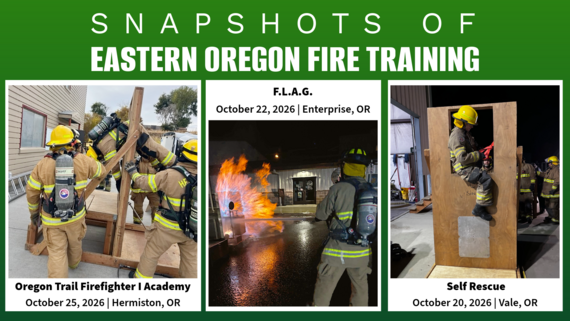
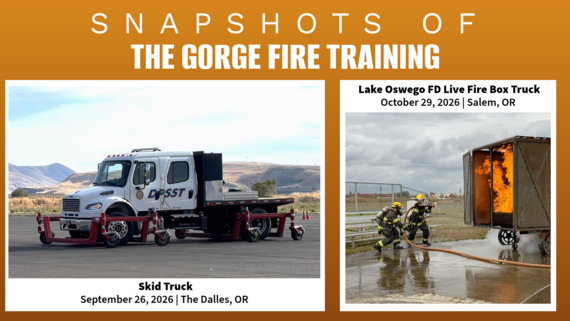
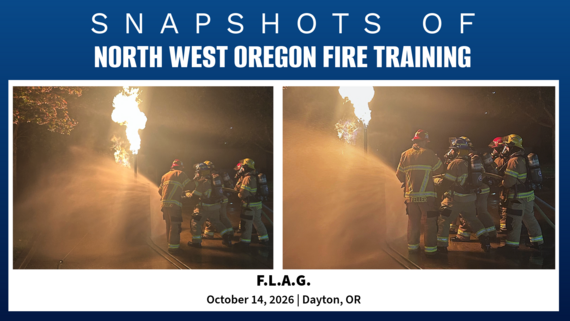
From the Fire Training Trail: Fall Edition
Here's a look at our DPSST Regional Fire Training happening across Oregon. For more information on possibly bringing any of these trainings to your fire department or visiting campus, contact your Regional Fire Training Coordinator.
Application Reminder
DPSST staff are seeing an increase in applications submitted without sufficient information about how the training was completed. The application includes a grid for applicants to provide details about how and when the training occurred. When the Training Completed section is left blank or filled with vague information, staff must follow up to obtain the necessary details.
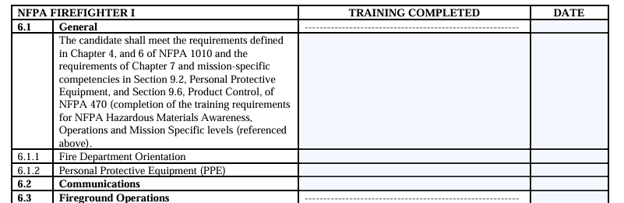 Below is a list of appropriate responses to use in the Training Completed section to help staff process applications more efficiently and avoid delays in issuing certifications:
“In House Training” – Use this when the training was provided internally in accordance with your Agency Accreditation agreement.
“See IRIS or Snapshot” – Use this when the training has been recorded via a DPSST roster and appears in IRIS or Snapshot. Before submitting the application, confirm that the training is accurately listed in one of these systems.
“See Attached” – Use this when attaching a DPSST Notice of Course Completion (NOCC) or another approved training document that verifies completion.
“Seeking Reciprocity” – Use this when attaching a certification issued by another certifying body that qualifies the individual for reciprocal certification.
If you have questions about completing applications or what qualifies as acceptable proof of training, please contact Brooke Bell Uribe at Brooke.bell-uribe@dpsst.oregon.gov or 503 569 8260.
|