Fire Program Newsletter
2026 Fall Fire School
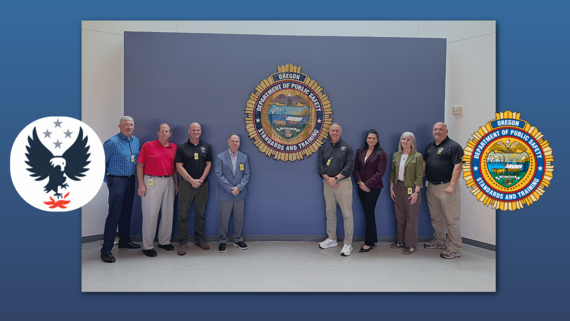
More than 100 firefighters from departments across the state participated in Fall Fire School on September 26-27 at the Oregon Public Safety Academy in Salem.
The two-day event, hosted free of charge by the Department of Public Safety Standards and Training (DPSST) Fire Program, featured eight National Fire Academy courses covering topics such as community risk reduction, incident command, leadership, wildland urban interface operations, health and safety, and youth firesetting intervention. These specialized courses provided expert-led training in several topics that students can bring back to their fire agencies to improve response and safety in their communities.
The event kicked off with a quick briefing in the auditorium, then it was straight to the classrooms for instructor and student introductions. Classes were a mix of lecture, discussion, workgroups, and student presentations that put into practice what they’ve learned.
With Fall Fire School behind us, Winter Fire School is now right around the corner on February 20-21. Registration is set to open on October 15. Whether you were or weren’t able to join us for Fall Fire School, be sure to sign up for a Winter Fire School class when they open. There will be something for everyone!
Tips During and After Living in Wildfire Smoke
By Gorge Coordinator Nikki Heitschmidt
After the Wildfire Smoke
Many communities in Oregon lived in the smoke from wildfires in 2026. This smoke can create a mental heaviness of uncertainty as well as physical discomfort. Some ask if there is anything they can do during and after the smoke to improve day-to-day living?
There are a few things you can do when the smoke clears to improve air quality in your home and vehicle? First, change your homes furnace air filter. Furnace air filters are the lungs to the system. Dirty filters cause the system to work under a heavier load than designed. Check-in with your neighbors, they might need assistance changing their air filter(s). Washing bed linens or other washable goods and wiping down hard surfaces may be helpful as well.
Change your vehicle air filters, both motor and cabin. These filters can be easy to forget about as you move on with life after the smoke clears. A dirty filter can negatively affect your vehicles’ fuel economy, and a dirty cabin filter may affect cabin air quality.
Also, don’t forget to check and change the filter(s) in the HVAC system at the fire station. A reminder that these systems may have multiple units heating and cooling the station depending on size and layout.
During a Wildfire Smoke Event
Is there a way to improve the air quality in my home while I am affected by wildfire smoke?
Yes, there are. Options range from Do-It-Yourself versions to commercial made units. The EPA (Environmental Protection Agency) has an article titled: Do-It-Yourself Air Cleaners: Making Cleaner Air More Accessible, Published September 6, 2023. There is a follow-up article titled; Research on DIY Air Cleaners to Reduce Wildfire Smoke Indoors, updated July 16, 2026.
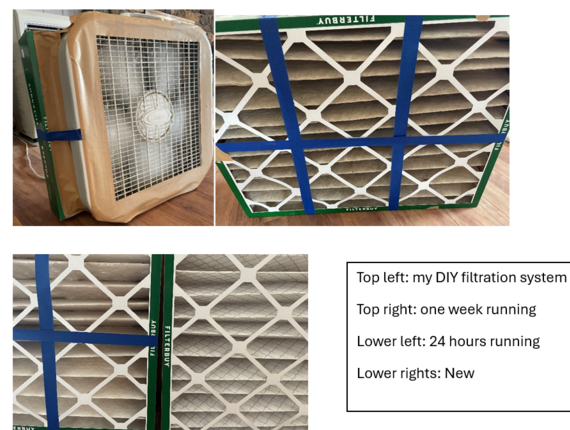
I decided to make a DIY air cleaner. I made the “Good” version from DIY Air Cleaner Designs: Beyond the Basics. I used a 4” filter and a standard 20” box fan, turned the fan on low and waited. For reference, the air quality in my area was in the 150’s for over two weeks. I found myself coughing and my eyes were irritated being in the house. I do not have an indoor air monitor to know how the air quality improved, but I noticed an improvement in how I felt after just a few hours. After twenty-four hours of running the fan, the white filter was noticeably dirty. After a week of using the system, the filter was brown. See pictures below!
 What is Wildfire Smoke Made of and Why is it Bad for Your Health?
Wildfire smoke contains a mixture of toxic chemicals. The smoke is made up of small and large particles with PAH’s, black carbon, VOC’s and trace metals. The mixture is based on type of fuel(s) burned, current burn conditions and the distance the smoke has traveled. These chemicals may be a respiratory irritant for some, cause systemic inflammation in others or worsen preexisting cardiovascular conditions. Wildfire smoke is not only an irritant but a real health problem for many.
Wildfire smoke is not something we can always avoid, but we have options to improve our indoor air quality during and after a wildfire.
Be safe out there.
Firefighter Type 2 -S-130 Course Completion Reminder
As the Oregon Wildland Fire Season winds down, Fire Certification Staff would like to remind agencies of a recurring issue that has been causing delays in issuing fire certifications.
Firefighter Type 2 (FFT2) is the entry-level wildland fire certification offered by DPSST. It requires completion of three NWCG courses:
- S-130 Firefighter Training
- S-190 Introduction to Wildland Fire Behavior
- L-180 Human Factors in the Wildland Fire Service
With NWCG’s modernization efforts, some courses are now offered partially or entirely online. For example, L‑180 and S‑190 are offered fully online and provide an online completion certificate. S‑130, however, may be completed either in a blended format (part online and part in person) or fully in person. Students who complete the blended version receive a certificate for the online portion only and must still complete the in‑person component with a qualified instructor.
Staff have been seeing submissions for S‑130 that include only the online certificate, with no documentation of the required in‑person portion. This is especially problematic for agencies that do not have FFT2 included in their accreditation agreement.
There are two ways to correct this issue:
-
Instructor Documentation via F9F Form
- The instructor who delivers the in‑person portion of S‑130 can submit an F9F form for the class. DPSST does not recognize partial components of S‑130. Agencies and instructors offering S‑130 in a blended format are responsible for verifying completion of the online coursework before issuing the S‑130 Notice of Course Completion (NOCC) and submitting the roster to DPSST. Once the roster is received, the student will receive full credit for S‑130 on their DPSST profile, regardless of whether it was blended or fully in person.
-
NWCG Certificates (If Applicable)
-
This option applies only to instructors who are approved by another entity to issue NWCG course completion certificates. DPSST does not have authority to approve NWCG instructors; we follow NWCG standards and issue DPSST rosters and NOCCs. However, instructors authorized to issue NWCG certificates may do so, and these certificates typically indicate whether the class was instructor‑led or blended.
If your agency has an active accreditation agreement, that agreement confirms you are training to the standards identified for each level. This includes ensuring that students complete the instructor‑led portion of S‑130 in addition to the online component. If you were previously unaware of this requirement, please consider this your notice and work to ensure any missing instructor‑led training is completed.
If you have questions about this, please contact Brooke Bell‑Uribe at brooke.bell-uribe@dpsst.oregon.gov or 503‑569‑8260.
Save the Date for Winter Fire School! Registration open Date Moved to October 15!
We are looking forward to hosting the 2027 Winter Fire School February 20th - February 21st, 2027. We will be announcing the opening of registration Thursday, October 15th, 2026. If you would like to get notified when this training goes live, please sign up to receive our Fire Training emails on Gov Delivery or follow our Eventbrite page.
Current NFA Classes
Command and Control of Incident Operations
Dates: Dec. 7, 2026 - Dec. 12, 2026
Times: 8 AM - 5 PM all 6 days
Location: Bend, Oregon
2 Spots open for registration! Sign up by using this link: C&C IO
Maintenance Re-Certification
Reminder: it is time for the Biannual Maintenance Re-Certification process! Chiefs/Training Officers have received your Maintenance Re-Certification packets. The forms inside the packet are due back to DPSST by the end of December. If you have any questions, please don’t hesitate to reach out the Fire Certification Specialist Michelle Hilt at michelle.hilt@dpsst.oregon.gov or 503-931-8806.
October 1st Fingerprint Fee Increase Reminder
Staff sent out a notice about this fee increase last month, but we wanted to send a reminder. Due to fee increases from the Federal Bureau of Investigation and the Oregon State Police, the DPSST fee for the one-time fingerprint requirement for initial firefighter certification has increased from $45.00 to $48.00. Any fingerprint cards or Fieldprints received before October 1st will be billed at the $45.00 rate, and prints received on or after October 1st will be billed at the new $48.00 rate.
If you have questions about this fee increase or the DPSST fingerprint requirement, please contact Michelle Hilt at michelle.hilt@dpsst.oregon.gov or 503-931-8806.
Ammonia Emergency Response Training & Live-Release Drill
Brought to Oregon by Tanner Industries, Inc. and TRANSCAER, this free one-day training at DPSST will include classroom sessions and field exercises. Find out more below and at the registration link and register for one of the two available days now!
Available Sessions:
- Mon, 11/09/2026 09:00 AM to 03:00 PM PDT
- Tue, 11/10/2026 09:00 AM to 03:00 PM PDT
Location:
Department of Public Safety Standards and Training (DPSST), 4190 Aumsville Highway, Salem, OR 97317
Overview
Training includes:
- Classroom instruction and live release ammonia drill
- Complimentary lunch
- Certificates upon successful completion will be emailed following the event
Cost: Free
Attendee Level
- Technician Level or Ammonia Specialist (Ammonia Drill – Entry)
- Operations Level (Ammonia Drill – Decon & Air Monitoring)
- Awareness Level (May observe the drill from a safe distance & attend the lecture portion in the morning)
Event Focus
Featured Topics:
- Anhydrous Ammonia Overview
- Properties
- Routes of Exposure
- Health Effects
- First Aid
- Containers/Bulk and Non-Bulk Packaging
- Ammonia Processes
- Types of Ammonia Releases
- Ammonia Response Tactics
- Control/Containment
- ER Guide Cards
- Tarp & Cover
Description
Classroom Sessions:
Ammonia Properties & Emergency Response: An overview of anhydrous ammonia, including its chemical and physical properties, placards, labels, containers, tank construction, and the hazards and potential outcomes associated with an anhydrous ammonia incident.
Field Exercises:
Ammonia Drill: Live release ammonia drill for participants to practice and perform basic control and confinement operations, including tarp and cover. Decontamination and air monitoring will also be incorporated into the drill.
Register Here:
Ammonia Emergency Response Training & Live-Release Drill | TRANSCAER
Flyer Here:
For questions contact DPSST Fire Training Coordinator Aaron Bielemeier at Aaron.BIELEMEIER@dpsst.oregon.gov or 503-302-5523
|