Fire Program Newsletter
Oregon Honors Fallen Firefighters During Annual Remembrance Ceremony
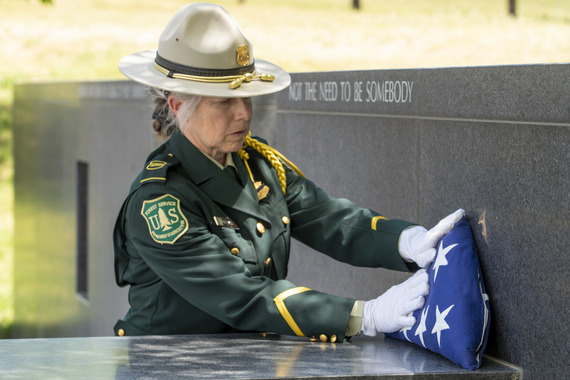
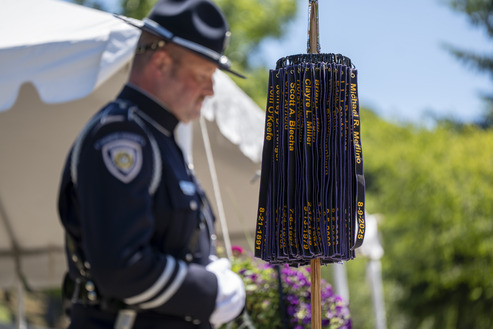
A ceremony held Tuesday, June 16 commemorated Oregon fire service members who have died in the line of duty. The Oregon Fallen Fire Fighters Memorial Ceremony honored the brave individuals who gave their lives to protect people, properties and natural resources around the state.
Tuesday’s ceremony remembered three fallen fire service members whose names were recently added to the memorial: Paul J. (Jim) Bieker Jr., a retired captain with Portland Fire & Rescue; Brian Robert Wolgamott, a Unites States Fish and Wildlife Service fire planner; and Michael Merlino, a battalion chief with Sutherlin Fire Department.
 |
|
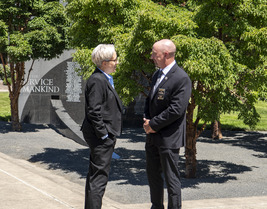
The annual event is held at the Oregon Public Safety Academy, site of the Oregon Fallen Fire Fighters Memorial. The memorial commemorates 185 fire service members who have made the ultimate sacrifice since 1881, including career, volunteer, wildland and structural fire fighters. In attendance were families of the fallen, fire service colleagues, members of the public safety community from across the state, and elected officials including Governor Tina Kotek. |
Keynote speaker Patrick Fale, deputy chief of strategic services with Tualatin Valley Fire & Rescue, spoke about the deep sense of duty shared by the three fallen firefighters and the commitment required of those who choose a life of service. He reflected on their daily examples of leadership, their unwavering dedication to others, and the ultimate sacrifices they made in support of their communities. |
|
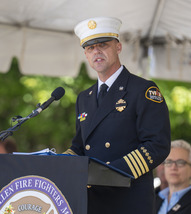 |
“Jim, Brian, and Michael each upheld the value of life and the strength of community,” Deputy Chief Fale said. “They dedicated their lives to these, to such a degree that their service ultimately led down the path of the ultimate sacrifice — the same path and ultimate sacrifice given of the other 182 names memorialized on this wall.”
Portland Fire & Rescue retired Captain Paul J. “Jim” Bieker Jr. passed away from thyroid cancer on April 14, 2023. Captain Bieker joined Portland Fire & Rescue in 1981 and retired in 2023 after 38 years of service. He left behind his wife, four children, and four grandchildren at the time of his passing.
United States Fish and Wildlife Service Fire Planner Brian Robert Wolgamott passed away on Nov. 28, 2024, after a two-year battle with cancer. Fire Planner Wolgamott began his wildland firefighter career in 2012, and after many years working with the U.S. Forest Service as a wildland firefighter, he accepted a position with the U.S. Fish and Wildlife Service in the Klamath Basin. He received a cancer diagnosis shortly after accepting the position and continued to work while undergoing treatments. He is survived by his wife and three children.
Sutherlin Fire Department Battalion Chief Michael Merlino passed away from thyroid cancer on Aug. 9, 2025. Battalion Chief Merlino spent 30 years serving his community at departments across Douglas County, where he was highly regarded for his work ethic and skillset. His impact on the community was evident in the widespread support from residents, colleagues, and local leaders who rallied around him throughout his battle with cancer.
Speaking in tribute to the fallen, Governor Kotek emphasized the importance of honoring their memories while supporting the families, colleagues, and communities who continue to feel their loss.
“Behind each name is a story of service, community, loss and remembrance,” she said. “In remembering them today, we recommit ourselves to action in support of their calling.”
Governor Kotek also noted that Oregon is heading into a potentially difficult fire season and expressed gratitude for the firefighters who will deploy to the front lines to protect communities across the state.
The ceremony is a significant event that the Department of Public Safety Standards and Training (DPSST) hosts annually in partnership with the Oregon Fire Service Honor Guard. For more information on the Oregon Fallen Fire Fighters Memorial, including the names of the fallen, history of the memorial, and the Oregon Fire Service Honor Guard’s involvement, please visit DPSST’s Oregon Fallen Fire Fighters Memorial website at https://www.oregon.gov/dpsst/Memorials/Firefighters/Pages/default.aspx.
Fall Fire School: Registration Now Open!
The DPSST Fire Program is excited to announce that the National Fire Academy (NFA) Winter Fire School classes postponed during the partial federal government shutdown have been rescheduled. Now called Fall Fire School, these NFA courses will be held September 26–27 on the Oregon Public Safety Academy campus in Salem.
Explore the available class options on the DPSST Fire Program Eventbrite page and register now to secure your spot. If a class is full, a waitlist is available by contacting Fire Program Specialist Madison Mancuso at madison.mancuso@dpsst.oregon.gov.
All courses run for the full two days and will conclude around 5 p.m. on Sunday, September 27. Complimentary lodging is available on Friday, September 25, and Saturday, September 26, for participants traveling more than 75 miles. Breakfast and lunch are provided for all attendees.
If you can no longer attend after registering, please remember to cancel your reservation. Many classes have waitlists, and releasing your spot may allow someone else to participate. Please note that individuals who register but do not attend will be ineligible for DPSST fire trainings for one year.
For questions, contact Madison Mancuso at madison.mancuso@dpsst.oregon.gov or 971-433-7899.
And be sure to save the dates for Winter Fire School, happening February 20–21, 2027. Additional details for the 2027 Winter Fire School will be shared later this summer.
Maintenance Re-Certification

Reminder: it is time for the Biannual Maintenance Re-Certification process! By now, your agency should have received their Maintenance Re-Certification packet. The forms inside the packet are due back to DPSST by the end of December. If you have any questions, please don’t hesitate to reach out the Fire Certification Specialist Michelle Hilt at michelle.hilt@dpsst.oregon.gov or 503-931-8806.
|
From the Fire Training Trail: June
Your monthly look at DPSST Regional Fire Training happening across Oregon. For more information on possibly bringing any of these trainings to your fire department or visiting campus, contact your Regional Fire Training Coordinator.
Brookings Instructor I June 2026
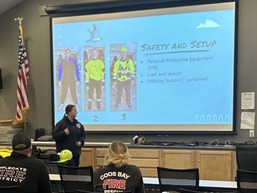
Southwest Regional Coordinator Rick Cooper taught a hybrid Instructor I class at Brookings Fire & Rescue the last weekend in June. Rick stated that the student presentations were among the best he’s seen and included one on the importance of firefighters learning and understanding American Sign Language to better communicate with the deaf and hard of hearing community when responding on calls.
|
|
 |
 |
|
OVFA Conference June 2026
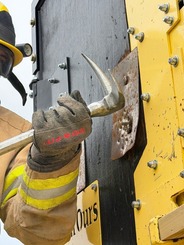
DPSST Fire Training staff hosted a two-day hands-on skills class at the Oregon Public Safety Academy for the Oregon Volunteer Firefighters Association Conference. Students stayed busy during both days utilizing several on-campus training resources that included water mapping, flammable liquids and gas, search and rescue, and forcible entry.
|
Auto Extrication Training: Are We Training Enough?
By Central Oregon Training Coordinator Hayden Jones
When it comes to auto extrication training, it is often one of the most overlooked disciplines in the fire service. Many departments have responded to motor vehicle crashes for years, often without experiencing major complications during extrication incidents. Because of this, it's easy to become comfortable with the skills we have and assume that our current level of training is enough.
However, if we look at the types of calls most departments respond to, the numbers tell a different story. Medical calls typically make up the highest percentage of responses, but vehicle accidents and extrications often rank second or third. In many departments, motor vehicle crashes occur far more frequently than structure fires. If that's the case, why aren't we dedicating more time to training for incidents that occur so regularly in our communities?
Auto extrication is a perishable skill. Vehicle construction continues to evolve, incorporating advanced steels, new battery technologies, alternative fuel systems, and increasingly complex safety features. What worked on a vehicle ten years ago may not be the safest or most effective method today. Regular training allows responders to stay current with these changes while building confidence and efficiency on scene.
Over the last several years, the Fire Program has been providing and evolving auto extrication training throughout the state. Our goal is to help departments streamline training programs, establish widely accepted terminology, and create a more consistent approach to vehicle rescue operations. By standardizing concepts and techniques, agencies can better prepare new hires, volunteers, and experienced firefighters alike.
The Fire Program is currently offering one and two-day Auto Extrication courses throughout Oregon that can be brought directly to your department. The one-day hands-on class covers Firefighter II competencies, while the two-day class covers Common Passenger Vehicle Operations-level competencies in their entirety while also introducing students to Common Passenger Vehicle Technician-level concepts and real world scenarios. Participants gain practical experience with modern extrication techniques, scene management, patient-centered rescue strategies, and problem-solving skills that can be applied to a wide variety of vehicle incidents.
The objective is simple: provide responders with the knowledge and confidence to hit the ground running when faced with an extrication incident. Through realistic scenarios and hands-on training, students learn to think critically, adapt to changing conditions, and work efficiently as a team to achieve the best possible outcome for the patient.
As emergency responders, we owe it to our communities and to the patients we serve to continually improve our skills. If vehicle accidents make up a significant portion of our call volume, then auto extrication training deserves to be a significant part of our training calendar as well. Investing time in training today ensures that when the next serious crash occurs, our crews are prepared to perform safely, effectively, and professionally.
|