Fire Program Newsletter
Join Us June 16th for the Annual Fallen Fire Fighters Memorial
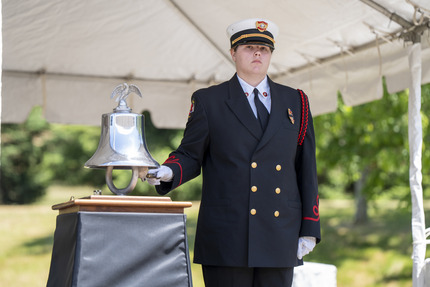
Please join the Department of Public Safety Standards and Training (DPSST) and the Oregon Fire Service Honor Guard (OFSHG) for this year’s Oregon Fallen Fire Fighters Memorial Ceremony on Tuesday, June 16. The ceremony will begin at 1p.m. at the Oregon Public Safety Academy, located at 4190 Aumsville Highway SE in Salem.
The Oregon Fallen Fire Fighters Memorial stands as a daily reminder of the sacrifices made by brave individuals from diverse backgrounds, who died in the line-of-duty protecting
our communities and natural resources around the state. Each year, we gather at the memorial for a ceremony to honor the nearly 200 firefighters who have died in the line-of-duty since the 1880s.
This year, firefighters Brian Robert Wolgamott, Michael R. Merlino, and Paul J (Jim) Bieker Jr. will be added to the memorial and recognized at the ceremony.
United States (U.S.) Fish and Wildlife Service Fire Planner Brian R. Wolgamott passed away after a two-year battle with cancer on November 28, 2024. Fire Planner Wolgamott began his wildland firefighting career in 2012, and in 2022 he accepted a position with the U.S. Fish and Wildlife Service in the Klamath Basin. Unfortunately, shortly after he learned he had cancer.
Sutherlin Fire Department Battalion Chief Michael Merlino passed away from Thyroid cancer on August 9, 2025. Chief Merlino spent 30 years serving his community at departments across Douglas County where he was regarded for his work ethic and skillset. His contributions and legacy were solidified when community showed an outpouring of support during his battle with cancer as well as after his passing.
Portland Fire & Rescue Retired Captain Paul James “Jim” Bieker also passed away from Thyroid cancer on April 14, 2023. Captain Bieker joined Portland Fire & Rescue in 1981 and retired in 2023 after putting in 38 years in the fire service. He left behind his wife, four children, and four grandchildren at the time of his passing.
We hope you can join us June 16 as we commemorate the heroic men and women who have made the ultimate sacrifice to protect their communities.
Fall Fire School: Registration Now Open!
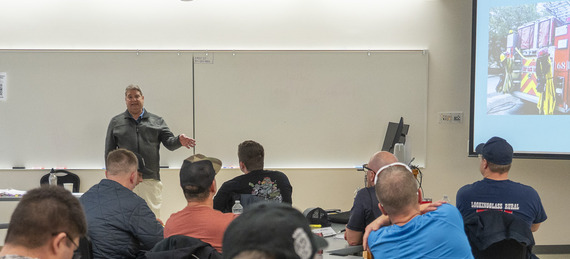
The DPSST Fire Program is excited to announce that the National Fire Academy (NFA) Winter Fire School classes postponed during the partial federal government shutdown have been rescheduled. Now called Fall Fire School, these NFA courses will be held September 26–27 on the Oregon Public Safety Academy campus in Salem.
Explore the available class options on the DPSST Fire Program Eventbrite page and register now to secure your spot. If a class is full, a waitlist is available by contacting Fire Program Specialist Madison Mancuso at madison.mancuso@dpsst.oregon.gov.
All courses run for the full two days and will conclude around 5 p.m. on September 27. Complimentary lodging is available on Friday, September 25, and Saturday, September 26, for participants traveling more than 75 miles. Breakfast and lunch are provided for all attendees.
If you can no longer attend after registering, please remember to cancel your reservation. Many classes have waitlists, and releasing your spot may allow someone else to participate. Please note that individuals who register but do not attend will be ineligible for DPSST fire trainings for one year.
For questions, contact Madison Mancuso at madison.mancuso@dpsst.oregon.gov or 971-433-7899.
And be sure to save the dates for Winter Fire School, happening February 20–21. Additional details for the 2027 Winter Fire School will be shared later this summer.
Maintenance Re-Certification

It is time for the Biannual Maintenance Re -Certification process! Packets are on their way to your agency for your Chief or Training Officer to fill out and return to DPSST to maintain or lapse individual fire fighter certifications. If you are new to this process or would like a refresher, here are a few tips and things to keep in mind to make this process go as smoothly as possible!
|
- Maintenance Packets are mailed out every even year on or around June 1st.
- Your agency packet will come in a RED folder and will include the following:
- Quick Steps reference list
- Frequently Asked Questions
- A blank PAF (Personnel Agency Form)
- Fire Maintenance Requirements Summary (gives hours and options for maintaining the different certification tracks)
- Oregon Administrative Rule (related to Maintenance Re-Certification)
- Fire Program contact list
- Your fire agency roster as of June 1, 2026
- Maintenance Re-Certification Forms (one for each CERTIFIED fire fighter)
- Maintenance Packets are due back December 31st, 2026.
- When filling out the forms check all boxes you want to maintain. Blank boxes will be lapsed, effective January 1st, 2027.
- You must maintain a prerequisite level to maintain a more advance level of certification. For example: you cannot maintain NFPA Fire Apparatus Equipped with Fire Pump without maintaining NFPA Fire Apparatus Driver Operator so you would need to check both boxes.
- The packets are processed in the order they are received. There are over 300 fire service agencies in Oregon and over 11,000 active Fire Service Professionals in Oregon. One to three people process all of these forms. We will process packets as soon as possible but please be patient.
- Forms filled out incorrectly will be followed up with, but this delays the processing of your forms so please take the time to fill out the forms carefully.
- If you are at an agency with over 100 certified fire fighters, please send packets back in groups of 100 forms.
- When your agency forms are processed you will receive a confirmation letter.
- You can see if your forms have been processed on IRIS or Snapshot. Your firefighters can access IRIS to track their certifications as well.
- Only certificates issued ON or BEFORE 05/21/2026 will be included on the Recertification Forms.
Questions? Please contact Michelle Hilt at Michelle.HILT@dpsst.oregon.gov503-931-8806 or Michelle.HILT@dpsst.oregon.gov
Application for Certification Reminders
Recently, DPSST staff have been seeing an increase in errors and oversights on submitted applications. When this happens, staff reaches out to agencies for clarification or correction, which unfortunately delays the processing and issuance of applicant certifications. To help avoid these setbacks, we’ve outlined a few of the most common issues we’ve been noticing:
- Please ensure that your agency’s current accreditation agreement includes the certification level you’re applying for before using Resource One as training toward that level. If the certification level is not listed on your agreement, Resource One cannot be used to meet the training requirements.
-
When listing training on the application, be sure to indicate how that training was completed. Some helpful examples include: InHouse, See IRIS or Snapshot (please verify this before noting it), NOCC Attached, NWCG, See Transcript (include course), or Course # (as it appears in IRIS).
-
Doublecheck that all required boxes are marked for each certification level being requested.
-
Please make sure you are using the most current version of the application forms available on the DPSST website. Several applications have been updated over the past year (including Driver, Airport Firefighter, and Firefighter). As NFPA Standards are updated, the applications must also be updated and used for certification requests.
If you have any questions on how to fill out any DPSST forms correctly please reach out to Fire Certification Supervisor Brooke.bell-uribe@dpsst.oregon.gov or 503-569-8260.
Upcoming Events at DPSST
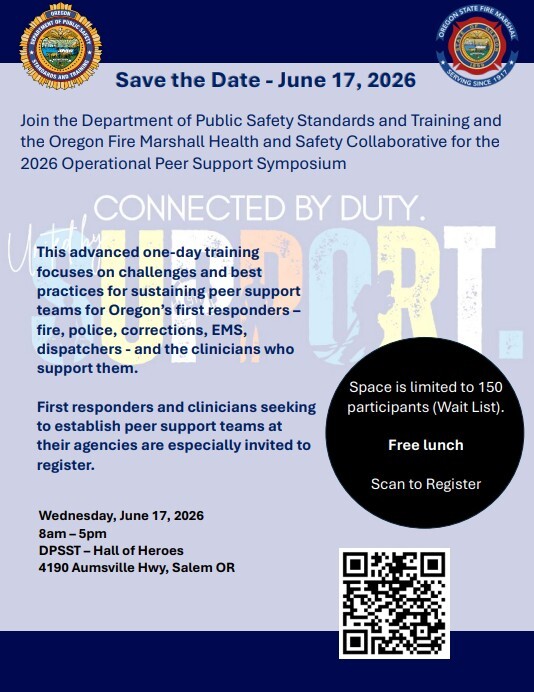
June Peer Support Symposium
Department of Public Safety Standards and Training and Oregon State Fire Marshalls are coming together to host a Peer Support Symposium. Please see the details listed below:
- Date: June 17, 2026
- Time: 8 am - 5 pm
- Where: DPSST - Hall of Heros 4190 Aumsville Hwy. Salem, Oregon 97317
- Who: Fire, police, corrections, EMS, dispatchers
- Cost: Free
- Registration Link: Operational Peer Support Symposium
|
Emotional Survival for First Responders
Salem Police Chaplaincy and Valor Technical Cleaning are bringing an Emotional Survival for First Responders class to DPSST 4190 Aumsville Hwy SE, Salem, OR 97317 on June 15th, 2026. This class will start at 8 am and will go til 5 pm. This class is free and is ideal for those in fire, law enforcement, EMS corrections, parole and probation and dispatchers. If you are interested, please use this registration link: https://forms.office.com/g/wUG4WAvMzW
New District Liaison Officers
DPSST staff would like to introduce two new District Liaison Officers (DLOs) serving Coos, Lake, and Klamath Counties.
For Coos County, Aaron Reisenbigler will serve as the District Liaison Officer. Aaron is the Training Officer for Central Coos Fire and Rescue and is actively involved with several other districts in the region. DPSST staff have worked with Aaron for years and appreciate his attention to detail, organization, and thoughtful questions. We are grateful for his willingness to volunteer in this role and look forward to strengthening partnerships throughout his district with his support.
Klamath and Lake Counties will also be welcoming a new DLO. Jeremy Wadkins, a Deputy State Fire Marshal with the Oregon State Fire Marshal’s Office and an instructor with Klamath Community College, brings a strong passion for fire training along with a broad knowledge base and a willingness to learn.
As DLOs for their respective districts, Aaron and Jeremy will conduct Agency Accreditation Reviews, sign off on Task Performance Evaluation Requests, and serve as local points of contact for questions related to DPSST Fire Certification and general training. We appreciate their commitment to volunteering their time to serve in these important roles and look forward to continued collaboration throughout these regions.
For contact information for Aaron, Jeremy, or any other District Liaison Officer, please visit the DLO Contact List at: Department of Public Safety Standards and Training : District Liaison Officer Program : Fire Programs : State of Oregon.
For other questions related to DPSST’s DLO Program Please reach out to Brooke-Bell-Uribe at Brooke.bell-uribe@dpsst.oregon.gov or 503-569-8260.
Now Accepting Applications for Region 4A DLO: Linn and Benton Counties
The Department of Public Safety Standards and Training (DPSST) Fire Program is accepting applications for the voluntary Linn & Benton County District Liaison Officer (DLO) position.
DLOs are volunteers who facilitate communication between local organizations and the DPSST Fire Program. They may attend local training meetings, consult with fire chiefs, training officers, and community college officials, assist with task performance evaluation testing, and conduct Agency Accreditation Reviews (R-1). These reviews determine the levels of certification and training an agency can provide in-house.
DLOs stay current with fire certification practices to provide up-to-date information from DPSST. There are 21 DLOs serving voluntarily throughout the state, and their contributions are invaluable to DPSST’s mission and the Fire Program's success.
The DLO position is typically filled by a member of the Oregon fire service within the region they serve. Ideal candidates have a passion for training and either understand DPSST processes or are willing to learn.
If you are interested in applying, submit a DLO Application by July 15, 2026. For more information, visit: DLO Program Information. To access the application form, visit: DLO Application Form.
Questions and completed applications can be directed to Fire Certification Supervisor Brooke Bell-Uribe at brooke.bell-uribe@dpsst.oregon.gov or 503-569-8260.
From the Fire Training Trail: May
Your monthly look at DPSST Regional Fire Training happening across Oregon. For more information on possibly bringing any of these trainings to your fire department or visiting campus, contact your Regional Fire Training Coordinator.
 |
|
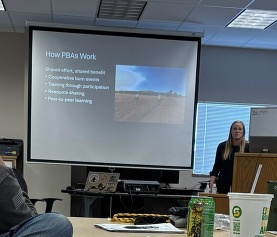
Instructor I ODF La Grande April 2026
In partnership with the Oregon Department of Forestry (ODF), Northeast Regional Coordinator Mike Bozeman taught a hybrid Instructor I class in La Grand at the end of April. Members from the Blue Mountain Interagency Dispatch Center, which included Wallowa, Pendleton, Monument and John Day units, successfully completed his class and are now prepared to instruct ODF staff in preparation for fire season.
|
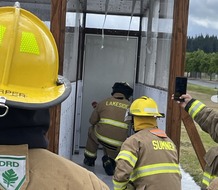
Campus Coos County April 2026
Fire Training Coordinators Rick Cooper, Ryan Frizzell, and Nikki Heitschmidt had sixteen firefighters from several departments in Coos County visited DPSST's campus on May 16th and 17th to learn water mapping on our water mapping prop, as well as perform hands-on reps in the fire tower and search and rescue houses.
|
|
 |
 |
|
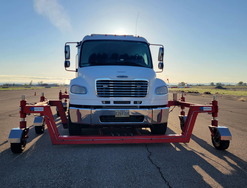
Skid Ontario April 2026
Central Oregon Coordinator Hayden Jones assisted in planning a Heavy Rescue class where students got to practice their hands-on skills in a variety of scenarios. This full day training occurred on May 20th and assisted firefighters with task book sign offs and not only included local students, but also brought several students from the valley.
|
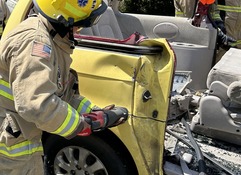
Common Passenger Vehicle Extrication May 2026
Southwestern Oregon Coordinator Rick Cooper and Fire Trainer Ken Waller taught a Common Passenger Vehicle Extrication course at Western Lane Fire and EMS in Florence on May 28th and 29th to 17 eager students from the area.
|
|
 |
Guest Article: Training Without a Training Center
How a Small Rural Oregon Coast Fire District Builds Realistic Training Through Community Partnerships, DPSST Support, and Constant Learning
At Nestucca Rural Fire Protection District (NRFPD) on the Oregon Coast, firefighters understand that realistic and consistent training is one of the most important investments a department can make.
Like many small rural fire districts throughout Oregon, NRFPD does not have a dedicated regional or district training center. What the district does have is a department culture that believes quality training, education, and knowledge sharing are critical to firefighter safety and the service provided to the community.
As a result, the district has built a training program centered around realism, consistency, adaptability, and community involvement.
“We may not have a training facility,” said Jeremy Neel, Division Chief of Training for the district. “But we are extremely fortunate to have a community that supports us, members willing to train hard, and outside large agencies and departments that have been willing to share their knowledge and resources with us.”
NRFPD regularly trains inside local businesses, hotels, private residences, on farms, in and around public facilities, rock quarries, in the rivers and bay, on the sand dunes, and on beaches throughout the district to create realistic scenarios and expose firefighters to the types of buildings and environments they will actually encounter during emergencies.
The district also regularly utilizes a local tow yard for vehicle extrication training to create more realistic rescue scenarios involving damaged vehicles, patient access challenges, stabilization problems, and evolving rescue situations.
“Realistic training matters,” Neel said. “Our district covers an extremely large and diverse response area, from bays, rivers, and ocean environments to forests, highways, sand dunes, private timber land, farms, businesses, and residential communities. The types of emergencies we respond to can vary dramatically from one call to the next. Like many small rural districts, we also operate on a tight budget and do not have dedicated personnel solely focused on grants. That limits our training resources and the facilities we can purchase or build. Because of that, we rely heavily on the actual environments and locations we respond to every day to help train our firefighters for the realities of the emergencies they will encounter when someone calls 911.”
The district has also utilized training props and programs provided by the Oregon Department of Public Safety Standards and Training (DPSST) over the past several years.
Earlier this year, NRFPD used the DPSST Vertical Ventilation Prop for roof operations and ventilation training. The district is also scheduled to host an F.L.A.G. (Flammable Liquids and Gas) class in the coming months and looks forward to using the DPSST Mobile Fire Training Unit Live Fire Training Prop later this summer.
Leadership says those resources have been invaluable for smaller rural agencies attempting to provide modern, standards-based training opportunities with limited budgets and infrastructure.
“We are incredibly grateful for the support DPSST provides to smaller departments,” Neel said. “Those props and training opportunities allow departments like ours to provide realistic, safe, hands-on training that otherwise would be extremely difficult for a small district to build on its own.”
NRFPD covers a primary response area of more than 125 square miles along the Oregon Coast and regularly provides mutual aid coverage that expands operational responsibility to more than 325 square miles of coastline, rivers, bays, forests, highways, Oregon Parks and Recreation lands, Forest Service lands, private timber lands, and sand dune recreation areas.
Although the district serves a permanent population of just over 5,500 residents, sunny weekends, holidays, and major tourism events can increase the local population to more than 30,000 people.
Like many rural fire districts, NRFPD says it is expected to provide the level of service associated with larger departments while operating with significantly fewer personnel, older equipment, and limited financial resources.
The district responds to approximately 1,000 emergency calls annually and maintains a wide range of certifications and specialty rescue capabilities despite its size.
Current district’s specialty certifications and operational disciplines include:
- NFPA Rope Rescue – Operations Level
- NFPA Rope Rescue – Technician Level
- NFPA Common Passenger Vehicle Rescue – Operations
- NFPA Common Passenger Vehicle Rescue – Technician
- NFPA Heavy Vehicle Rescue
- NFPA Surface Water Rescue
- NFPA Swiftwater Rescue
The district is also actively working toward incorporating NFPA Surf Rescue capabilities over the coming years to address growing rescue demands along the Oregon Coast.
In addition to technical rescue programs, district personnel maintain certifications and competency training in the core fire service disciplines, including:
- NFPA Firefighter I
- NFPA Firefighter II
- NFPA Hazardous Materials Awareness
- NFPA Hazardous Materials Operations
- NFPA Apparatus Driver/Operator
- NFPA Apparatus – Pumper
- NFPA Apparatus – Aerial Device
- NFPA Apparatus – Mobile Water Supply
- NFPA Apparatus – Wildland Fire Suppression
- NFPA Fire & Emergency Services Instructor I
- NFPA Fire & Emergency Services Instructor II
- NFPA Fire & Emergency Services Instructor III
- NFPA Live Fire Instructor
- NFPA Live Fire Instructor In Charge
- NFPA Fire Officer I
- NFPA Fire Officer II
- NFPA Fire Officer III Task Book
- NFPA Fire Officer IV Task Book
- NFPA Fire Inspector I
- NFPA Fire Investigator
District leadership says maintaining these certifications and competencies would not be possible without strong departmental support for training, dedicated career crews willing to teach and mentor volunteers, and outside instructors willing to share curriculum and knowledge.
“We are fortunate to have career firefighters, volunteer firefighters, instructors, and neighboring departments who understand the importance of knowledge sharing,” Neel said. “A lot of the curriculum and ideas we use have come from larger departments that have spent years developing and refining their programs, and they have been willing to share that knowledge with smaller agencies like ours.”
NRFPD regularly brings in state instructors, private instructors, and nationally recognized trainers to improve technical rescue and operational capabilities throughout the district.
One of the district’s volunteer members is also a nationally certified Rope Rescue Technician Instructor, FAA-certified drone pilot, and licensed small-engine pilot who conducts regular weekly rope rescue and drone operations drills with district personnel.
The district also regularly trains alongside neighboring mutual aid agencies to improve interoperability and regional response coordination.
Leadership says one of the district’s training culture's greatest strengths is the involvement of the community itself.
Local residents and businesses routinely allow firefighters to utilize homes, farms, businesses, and properties for training evolutions while volunteering their time to role-play as patients and victims during scenarios.
“Our community is directly involved in helping us train,” Neel said. “That support allows us to create realistic scenarios while strengthening relationships between the department and the people we serve.”
The district also continues sending personnel to outside training opportunities across the state and country, including FDIC International in Indianapolis, Indiana, where more than 38,000 fire service professionals from over 55 countries gathered this year to exchange operational knowledge, rescue techniques, leadership strategies, and firefighter safety advancements.
Leadership says maintaining a progressive training culture is critical for small departments attempting to adapt to the rapidly changing demands of the modern fire service.
“We cannot continue operating under the mindset of ‘this is how we’ve always done it,’” Neel said. “The fire service is constantly evolving, and small departments have to evolve with it. The communities we serve deserve firefighters who are continually learning, training, and improving.”
NRFPD says the work is ongoing and that the district continues striving to improve training quality, firefighter wellness, leadership development, and operational readiness every year.
The district is also actively recruiting Volunteer Firefighter EMTs and Resident Firefighters interested in training and serving within a progressive all-hazards rural coastal fire district.
Additional information, photographs, and training media can be found at:
Website: www.nrfpdor.gov
Facebook: https://www.facebook.com/NestuccaRuralFireProtectionDistrict/
|