Fire Program Newsletter
Wildland Task Force Update
On April 22nd, the DPSST Fire Certification section convened a Wildland Task Force to discuss the most current version of the National Wildfire Coordinating Group (NWCG) standard for fire certifications and instruction.
The group was very well represented with Oregon fire service agency members from across the state representing both career and volunteer firefighters, in addition to partner our agencies of Oregon State Fire Marshal and Oregon Department of Forestry.
The discussions were thoughtful and thorough, highlighting the purpose of these groups as the initial step toward updating Oregon Administrative Rule (OAR) to reflect the most current certification and instruction standards.
The recommendations that came from the group will next be presented to the Fire Policy Committee (FPC) in August, however, could be postponed until November if wildfire season prevents wildland stakeholders from attending the meeting. After this, there are a few items that need to be re-reviewed by the Task Force, then back to FPC, then public comment, and finally the Board on Public Safety Standards and Training (Board).
We’d like to remind everyone that the discussions held during the Wildland Task Force meeting were only initial discussions and no final decisions were made. Nothing is final until Task Force recommendations go through the full process with final approval being the Board which is several months out.
Please also remember that the way current OAR is written, you should be following current PMS 310-1 standards which includes the most recent extensive updates to NWCG Task Books. If you have any questions about this, the Task Force, or any other concerns, please contact Brooke Bell-Uribe at brooke.bell-uribe@dpsst.oregon.gov or 503-569-8260.
From the Fire Training Trail: April
Your monthly look at DPSST Regional Fire Training happening across Oregon. For more information on bringing any of these trainings to your fire department or visiting campus, contact your Regional Fire Training Coordinator.
 |
|
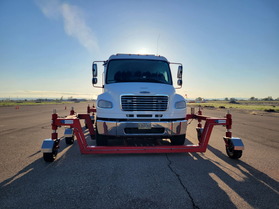
Skid Truck Training in Ontario
DPSST hosted Skid Truck training in Ontario. Conducted by Fire Trainers Ken Waller and Joshua Bowerman, along with Eastern Regional Fire Coordinator Mike Bozeman, students got classroom and hands-on lessons on how to drive large vehicles in adverse weather conditions. The next location for the skid truck will be the Klamath area. Please contact Hayden Jones for more information.
|
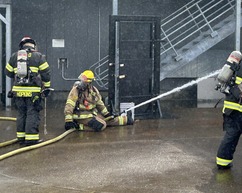
Live Fire Training in Lake Oswego
Lake Oswego Fire Department visited DPSST’s campus to utilize our Class B burn tower for multiple scenarios that included fire attack, hoseline maneuvers, SCBA confidence and endurance, and attic and basement fire attacks. If you’d like to know more about what the DPSST campus has to offer, please contact your Regional Fire Training Coordinator.
|
|
 |
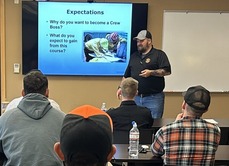
S-230 class in Coos Bay
Southwest Regional Fire Coordinator Rick Cooper organized an S-230 Crew Boss class taught by Coos Forest Protective Agency’s Jeff Chase. Students came from across Oregon to take this NWCG class that fulfills part of the training requirements for Single Resource wildland positions.
|
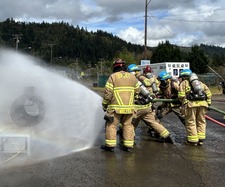
FLAG Training in Douglas County
Southwest Regional Fire Coordinator Rick Cooper and Fire Trainer Ken Waller conducted a classroom and hands-on Flammable Liquids and Gas training to firefighters at North Douglas County Fire & EMS on a beautiful Saturday in April.
|
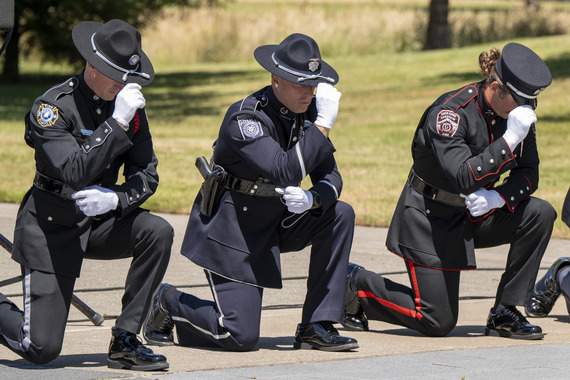
Join us on June 16th for the Annual Fallen Fire Fighters Memorial
Please join the Department of Public Safety Standards and Training (DPSST) and the Oregon Fire Service Honor Guard (OFSHG) for this year’s Oregon Fallen Fire Fighters Memorial Ceremony on Tuesday, June 16. The ceremony will begin at 1p.m. at the Oregon Public Safety Academy, located at 4190 Aumsville Highway SE in Salem.
The Oregon Fallen Fire Fighters Memorial stands as a daily reminder of the sacrifices made by brave individuals from diverse backgrounds, who died in the line-of-duty protecting our communities and natural resources around the state. Each year, we gather at the memorial for a ceremony to honor the nearly 200 firefighters who have died in the line-of-duty since the 1880s.
This year, firefighters Brian Robert Wolgamott, Michael R. Merlino, and Paul J (Jim) Bieker Jr. will be added to the memorial and recognized at the ceremony.
United States (U.S.) Fish and Wildlife Service Fire Planner Brian R. Wolgamott passed away after a two-year battle with cancer on November 28, 2024. Fire Planner Wolgamott began his wildland firefighting career in 2012, and in 2022 he accepted a position with the U.S. Fish and Wildlife Service in the Klamath Basin. Unfortunately, shortly after he found out he had cancer.
Sutherlin Fire Department Battalion Chief Michael Merlino passed away from Thyroid cancer on August 9, 2025. Chief Merlino spent 30 years serving his community at departments across Douglas County where he was regarded for his work ethic and skillset. His contributions and legacy were solidified when community showed an outpouring of support during his battle with cancer as well as after his passing.
Portland Fire & Rescue Retired Captain Paul James “Jim” Bieker also passed away from Thyroid cancer on April 14, 2023. Captain Bieker joined Portland Fire & Rescue in 1981 and retired in 2023 after putting in 38 years in the fire service. He left behind his wife, four children, and four grandchildren at the time of his passing.
We hope you can join us June 16 as we commemorate the heroic men and women who have made the ultimate sacrifice to protect their communities.
Upcoming Events at DPSST
June Peer Support Symposium
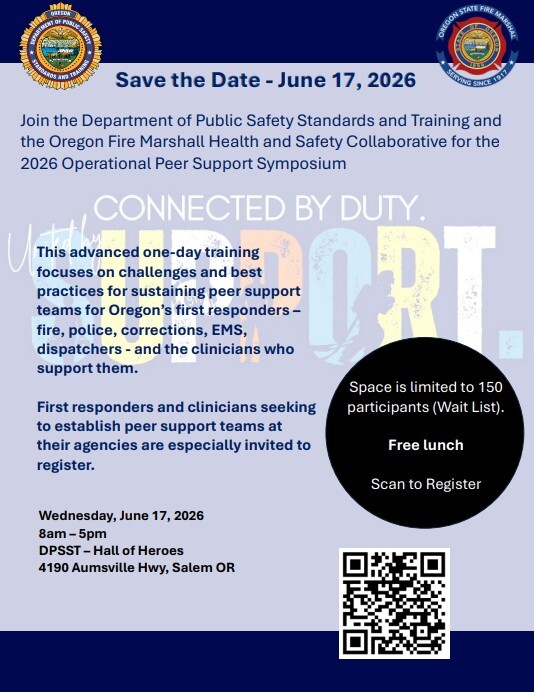
Department of Public Safety Standards and Training and Oregon State Fire Marshalls are coming together to host a Peer Support Symposium. Please see the details listed below:
- Date: June 17, 2026
- Time: 8 am - 5 pm
- Where: DPSST - Hall of Heros 4190 Aumsville Hwy. Salem, Oregon 97317
- Who: Fire, police, corrections, EMS, dispatchers
- Cost: Free
- Registration Link: Operational Peer Support Symposium
Emotional Survival for First Responders
|
Salem Police Chaplaincy and Valor Technical Cleaning are bringing an Emotional Survival for First Responders class to DPSST 4190 Aumsville Hwy SE, Salem, OR 97317 on June 15th, 2026. This class will start at 8 am and will go til 5 pm. This class is free and is ideal for those in fire, law enforcement, EMS corrections, parole and probation and dispatchers. If you are interested, please use this registration link: https://forms.office.com/g/wUG4WAvMzW
NFPA 1010 Airport Firefighter Goes into Effect on
May 1st, 2026
After review by the Task Force, Fire Policy Committee, Public Comment, and the Board on Public Safety Standards and Training, the 2024 Edition of NFPA 1010: Standard for Professional Qualifications for Firefighters (Chapters 4 and 8) will be implemented into Oregon Administrative Rule (OAR) on May 1, 2026. This update replaces the current reference to the 2019 Edition of NFPA 1003 for Airport Firefighter certification.
Updated applications and Task Books for NFPA Airport Firefighter will be released immediately following implementation. Individuals who already have an open Task Book under the previous edition may continue working under that version until the end of the grace period on May 2, 2027.
Key Points About the Standard Change
- NFPA consolidated multiple professional qualification standards into NFPA 1010, including Airport Firefighter.
- Airport Firefighter requirements now fall under Chapter 8, with Chapter 4 (General Requirements) and Chapter 7 (Firefighter II) continuing to serve as prerequisites.
- The certification title is updated to “Airport Firefighter” to align with other NFPA naming conventions.
- Most changes from NFPA 1003 to NFPA 1010 are semantical and do not significantly alter training or certification expectations.
- A small number of Job Performance Requirements (JPRs) were removed, but no new ones were added.
Application and Task Book Updates
- Application materials have been updated to reflect new chapters and JPR numbering.
- Prerequisite certifications remain unchanged.
- Spelling of “Firefighter” has been standardized.
- Reciprocity will continue to recognize IFSAC and Pro Board certifications.
- Task Book clarifications have been added regarding who may sign individual tasks and the cover page.
- Task boxes will be larger with a diagonal line for improved documentation. • The evaluator sign‑off page remains.
- Completion of the Task Book will continue to be the only approved method for skills-based evaluation.
Guide to Certification Updates
-
The Airport Firefighter Guide to Certification will be updated to reflect:
-
The 2024 Edition of NFPA 1010
-
Application and Task Book revisions
-
Appropriate courses, timelines, and reciprocity details
-
References to relevant NFPA Annex information
For questions regarding NFPA Airport Firefighter certification please contact Fire Certification Supervisor Brooke Bell-Uribe at brooke.bell-uribe@dpsst.oregon.gov or 503-569-8260.
Live Burns
By Eastern Oregon Fire Training Coordinator Mike Bozeman
Live burns are a great tool for demonstrating fire behavior to new recruits and to hone skills for experienced firefighters. As with other types of training, live fire training contains inherent risks whether your live fire training is in a Class A or B fixed facility, Mobile Fire Training Unit (MFTU) or an acquired structure. Class A fuels have different burn characteristics than Class B Gas fuels but regardless, each scenario has risks that need to be addressed before each training session.
NFPA 1402 Standard on Facilities for Fire Training and Associated Props, NFPA 1403 Standard on Live Fire-Training Evolutions, and Oregon OSHA Division 2L should be your go to references when conducting live fire training.
As with any live burn, a well-documented incident action plan (IAP) needs to be completed and a walk through of the structure with all participants before the start of evolutions.
In fixed facilities or an MFTU that use Class B gases, propane, natural gas for the fuel using fixed burners, sensors need to be calibrated and documented before the start of the burn evolutions. Class B gases burn much cleaner than Class A fuels, which allows for multiple evolutions with a shorter reset time for the next evolution, but the room will absorb heat and can cause heat injuries if the burn room is not ventilated to cool the room between sets. Hydraulic ventilation is a great way to entrain cooler air into the burn room in between evolutions.
Fixed facilities that use Class A burning materials do not have gas sensors that need to be calibrated, but they do allow for multiple evolutions without the loss of integrity of the structure. They do absorb heat as well and need to be ventilated between sets to cool the burn room. When setting the burn crib, instructors need to be aware how the crib is set, number of pallets and configuration of the pallets and the amount of excelsior that is used for the set. Organic certified hay can be used in place of excelsior. The heat release rate is affected by the material arrangement within the burn room.
Fire Service Research Institute (FSRI) conducted experiments that measured heat flux range and temperatures during interior structure fires using a FSRI Thermal Operating Class Scale through what they call an Emergency III. These experiments showed the safe working time for firefighters working within the structure and the survivability of occupants that may be still in the building. For more content of these experiments please visit Fire Service Research Institute here: https://fsri.org.
Using the FSRI Thermal Operating Class Scale, the operating temperature in Ordinary 1 has a temperature range of 161-degree F to 392-degree F and a Heat Flux Rate of 2-7 Kw/M2. Firefighters can safely work within this range for 10 to 20 minutes.
Temperature Operating Class Emergency I has a temperature range from 392-degrees Fahrenheit to 500-degrees Fahrenheit and a Heat Flux Rate of 12-15Kw/M2. Firefighters have only a working time of tens of seconds before injury occurs.
Temperature Operating Class Emergency II and III exceed test limits of PPE and can cause immediate material damage and injury.
Additional helpful information to keep in mind is in this video from FSRI entitled “Understanding the Basics: Heat Release Rate vs Temperature”: https://youtu.be/h8o-z_mV-V4?si=TeEWaY9mcFZdGm9D
Live fire training in a controlled environment can be extremely fun. Firefighters and fire officers can hone skills needed on the fire ground such as communications, size up line placement, water mapping, hydraulic ventilation, and team building and cohesion as a shift.
But instructors need to be aware that heat absorbed into our turnouts is cumulative. Over time the heat will eventually saturate our PPE and heat and burn injuries can happen.
Instructors also need to validate the intent of the exercise. Have an incident action plan (IAP). Brief everyone on the plan and ensure everyone understands their role from a Live Fire Instructor In Charge to a recruit. Additionally, ensure PPE inspections are performed.
Use a thermal imaging camera (TIC) when operating inside the burn room, especially if a flash over trainer is used.
Use a burn matrix for crew rotation to ensure personnel are getting time to rehab and cool off. That includes allowing PPE to air out and cool off.
Live burn training is a great and rewarding tool that can and should be used to train our personnel with. Just remember to be mindful of the intent of the training and how to be safe when utilizing this training.
Now Accepting Applications for the Region 6 DLO: Douglas County
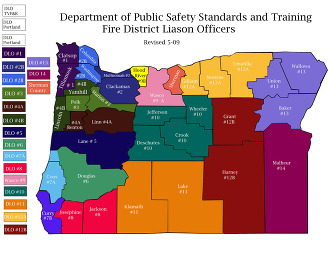
The Department of Public Safety Standards and Training (DPSST) Fire Program is now accepting applications for the voluntary Douglas County Fire District Liaison Officer (DLO) position.
DLOs are volunteers who facilitate communication between local organizations and the DPSST Fire Program. They may attend local training meetings; consult with fire chiefs, training officers, and community college officials; assist with task performance evaluation testing; and conduct Agency Accreditation Reviews (R‑1). These reviews help determine the levels of certification and training an agency is authorized to provide in-house. DLOs stay current with fire certification practices to share up-to-date information from DPSST. There are currently 21 DLOs serving voluntarily throughout the state, and their contributions are invaluable to DPSST’s mission and the success of the Fire Program. The DLO position is typically filled by a member of the Oregon fire service within the region they serve. Ideal candidates have a passion for training and either understand DPSST processes or are willing to learn.
If you are interested in applying, please submit a DLO Application by June 1, 2026.
For more information, visit: DLO Program Information. To access the application form, visit: DLO Application Form. (Microsoft Word - DLOAPP2014)
Questions and completed applications can be directed to Fire Certification Supervisor Brooke Bell-Uribe at brooke.bell-uribe@dpsst.oregon.gov or 503-569-8260.
|
|