Another major ODOT project wraps up ahead of schedule
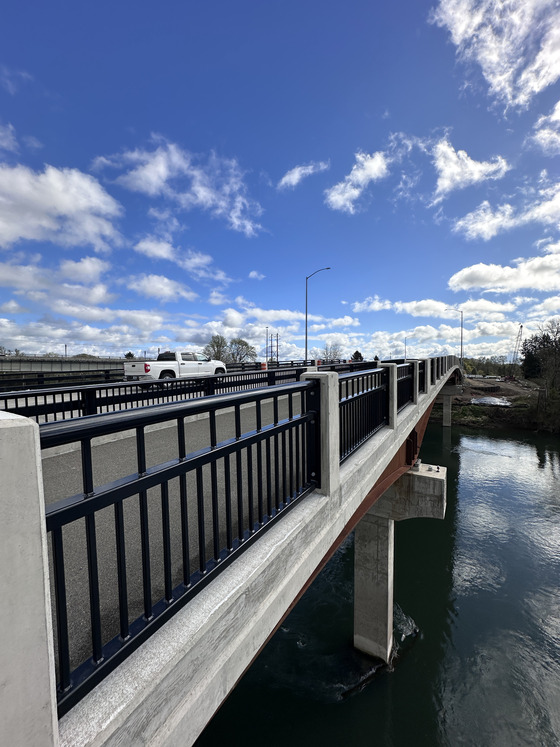 The new Van Buren Bridge is complete and welcomes travelers who drive, walk, bike and roll.
Oct. 29, 2026
For more information, contact Mindy McCartt, 503-507-6045.
CORVALLIS — Work on the new Van Buren Bridge is wrapping up ahead of its year-end deadline. ODOT thanks the Corvallis community, nearby businesses and travelers for their patience and support throughout construction.
The new bridge carries eastbound OR 34 across the Willamette River. The old bridge, built in 1913, was narrow, had low clearance and carried weight restrictions that created a bottleneck for traffic and freight. It was also vulnerable to earthquakes.
Built to modern seismic standards, the new bridge is designed to provide a more reliable crossing after a major earthquake. It has two eastbound travel lanes, a dedicated bike lane and a protected path across the river for people walking, rolling and biking.
The project also improves safety and traffic flow in downtown Corvallis. A new traffic signal at Van Buren Avenue and Northwest First Street replaces the former flashing pedestrian crossing.
The bike and pedestrian path beneath the bridge was recently completed. Crews are finishing landscaping and restoring construction areas.
“This bridge isn’t just a piece of infrastructure. It is a beautiful new landmark for Corvallis,” said Christine Hildebrant, ODOT Area 4 manager. “This is more than a new structure. It’s a long-term investment in mobility, safety and vibrancy in the heart of the valley.”
Planning and teamwork save time and money
Hamilton Construction came to the project with a detailed plan and worked hard to carry it out. During the first season, one crew installed the temporary detour bridge that carried traffic during construction while another built a temporary work bridge for crews and equipment. Completing both before winter helped keep the rest of the project on schedule.
That progress continued during the first three seasons when environmental permits allowed work in the river. Crews often worked more than 10 hours a day, six days a week. Their effort allowed the team to avoid a fourth season of work in the river and put the project on track to wrap up well ahead of its deadline.
Hamilton also emphasized quality throughout construction. Crews regularly checked their work, along with the required project inspections, to ensure it met standards.
The team also identified several ways to reduce costs during construction. Examples include:
-
About $220,000 by using bridge joints from a different manufacturer.
-
About $129,000 by using thinner, less expensive steel panels on the face of a wall that does not support the structure.
-
Just over $80,000 by having the contractor provide the molds used to create decorative features in the concrete.
-
About $48,000 from a contractor-proposed drainage change.
-
About $74,000 from an approved change in how components from the original bridge were salvaged.
During design, the project team planned for the possibility that crews would need to build a temporary work bridge on the west bank of the river. Hamilton found another way to do the work, reducing impacts near downtown Corvallis and allowing a maple tree near the Riverfront Commemorative Park restroom to remain.
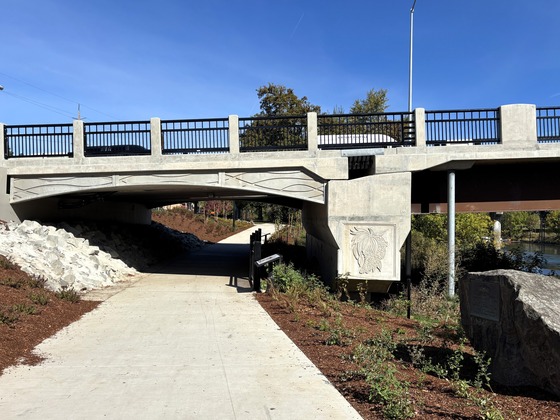 New paths run beneath the east and west sides of the Van Buren Bridge.
Community celebrates the new bridge
Nearly 100 people gathered at Riverfront Commemorative Park on May 6 to celebrate the new bridge. Community members, Tribal representatives, local officials, project partners and ODOT employees attended the ribbon cutting. After the ceremony, many walked across the protected path and explored the bridge’s interpretive displays.
“The Van Buren Bridge is an important connection for Corvallis and everyone who travels through our community,” said Corvallis Mayor Charles Maughan. “Thank you to our residents and businesses for their patience, and to the many partners who worked together to deliver a bridge that will serve our community for generations.”
ODOT appreciates the many partners who helped bring the project to life, including the City of Corvallis, Benton and Linn counties, the Confederated Tribes of the Grand Ronde, the Federal Highway Administration, the Oregon Transportation Commission, the Oregon State Historic Preservation Office, Cogito & Fisher, DOWL, Hamilton Construction, Sea Reach, other Tribal partners, ODOT’s historic preservation staff and the many contractors and subcontractors who contributed their expertise and craftsmanship.
|