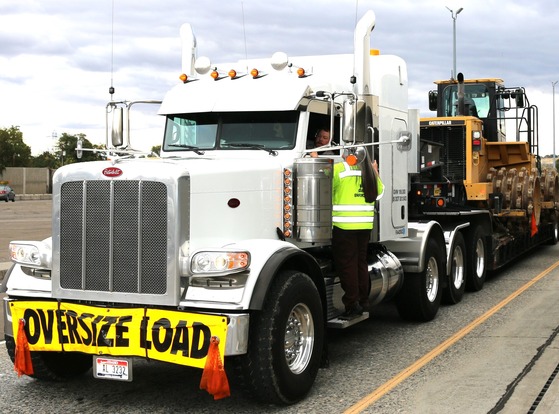
 A semi with an Oversize Load sign on the front bumper carries a wide tractor.
permit service for motor carriers is saving taxpayers nearly $1 million annually
Call volume has decreased by nearly 50%. Customer wait times have been reduced by more than 80%. And the state no longer needs to fill seven vacant positions because of adoption of the new service.
Aug. 19, 2026
For more information, contact Chris Crabb, 971-304-9705
SALEM – A new web-based, self-service permitting system for motor carriers moving over-dimension loads through Oregon has created $940,000 in savings in its first year of operation. The award-winning Oregon Routing Information Online project, better known as ORION, is an example of how the Oregon Department of Transportation is getting more efficient.
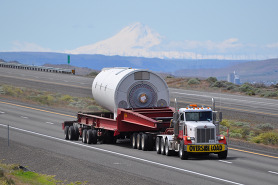
A typical 18-wheeler is about 9 feet wide, 13 feet tall and 70 feet long. Over-dimension loads can be 12 to 16 feet wide and reach heights of 18 feet or more. Superloads can exceed 150 feet in length, with weights upwards of 250,000 pounds or more. Any vehicle that exceeds legal vehicle dimensions and weight must get an over-dimension permit.
“The movement of freight is essential to commerce in Oregon, and the amount of over-dimension traffic on our roadways increases every year,” said ODOT Commerce and Compliance Administrator Carla Phelps. “Ensuring these over-dimension loads can travel through the state without incident is critical to the safety of the traveling public, commercial drivers, and Oregon roads and bridges.”
Before ORION went live in May 2025, the over-dimension permit process was labor intensive and time consuming. Permit analysts used paper maps and attachments for guidance on which routes were best depending on the weight, width, length and height of the load. They also used an electronic routing manual to verify vertical clearances, weight restrictions and temporary restrictions along each state highway.
Today, all that information has been programmed in the ORION system and is regularly updated. Commercial carriers with an active registration/tax account in Oregon can enter their vehicle information -- including weight, length, width and height -- and their start and end points. ORION analyzes all the information and provides the shortest, safest route. There are still certain load or route criteria that, when triggered, require additional review and approval from analysts and road authorities. However, that process has been greatly automated, sending emails to the road authorities, letting them know they have a permit to review in ORION.
“ORION has allowed our staff to shift their focus to the largest and more complex loads that require extensive coordination and careful safety review,” said Phelps. “This modernization project eliminated the need to fill seven currently vacant positions, which helped fill the budget gap left by a struggling State Highway Fund.”
Some benefits from the first year of ORION include:
- 45% of single-trip permits are now self-issued by customers on the spot.
- Call volume has decreased by nearly 50%.
- Customer wait times have been reduced by more than 80%.
- A significant decrease in paper-centric processes; permits are now stored and retrieved electronically.
- Automatic updates to TripCheck, giving carriers immediate access to current conditions and improving roadway safety.
Because of a structural revenue issue caused by flattening gas taxes, inflation, and legal restrictions on available funding, ODOT has reduced spending by about $500 million since 2019 to stay within available funding. Some of these savings have come from efficiencies and process improvements like ORION. Other examples include increasing CCD and DMV self-services options, consolidating office spaces and shifting service center hours to reduce staffing during hours with lower call volumes.
Oregon also charges a mileage-based fee on commercial vehicles operating on Oregon public highways called the weight-mile tax. This system ensures heavy vehicles contribute fairly to the maintenance and repair of the roads they use, as heavier trucks naturally cause more wear and tear on infrastructure.
###
View and download oversize load photos on our Flickr page.
|

Traffic Alert
Whether you are commuting in Portland or planning a trip through the area, please be aware of a major closure of all southbound lanes of I-5 in Portland between I-84 and I-405 starting Sept. 11 and lasting up to five weeks. During the closure, overdue road repairs will be done as part of the I-5 Rose Quarter Improvement Project. Learn more about the closure at the project website and sign up for traffic alerts.
|
|