ODOT begins next phase of investigation into OR 229 landslide
Subsurface exploration will help guide safe highway repairs
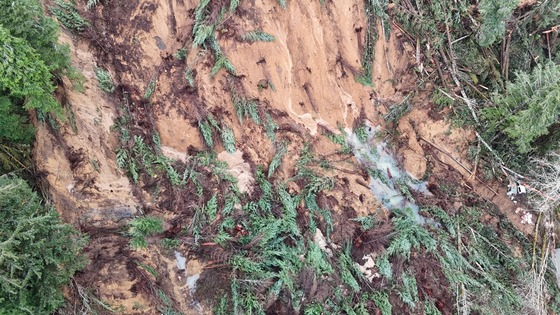 OR 229 landslide showing the massive debris field and areas of pooling water that remain at the site.
Aug. 11, 2026
For more information, contact Mindy McCartt, 503-507-6045.
LINCOLN COUNTY – ODOT is beginning the next phase of work responding to the massive landslide that closed OR 229 between mileposts 14.2 and 15.1 in December 2025.
In the coming weeks, travelers and nearby residents may see heavy equipment working in and around the slide area as crews prepare for subsurface investigations. This is a critical step toward designing the highway repair.
This work is an important milestone. The information gathered over the coming months will guide the design of both temporary and permanent repair options.
Much of the work is happening underground and behind the scenes, but it will provide engineers with the information needed to design a safe, long-term repair.
What work is happening now?
ODOT has begun a geophysical survey near the bottom of the landslide. This non-invasive method maps underground soil and rock layers without excavation. The information gathered will help guide drilling teams and refine where additional subsurface exploration is needed. Field work began in July and is expected to be completed this month.
Beginning this month, crews will use heavy equipment to create temporary access paths for drilling equipment to safely reach investigation sites. Crews will move fallen trees and grade rough paths while minimizing disturbance to the landslide.
Geotechnical drilling is expected to begin in mid-August and continue through the end of October. During drilling, engineers will collect soil and rock samples and install monitoring equipment in each drill hole.
After drilling is complete, ODOT will continue monitoring the sites to better understand how the landslide moves over time and how groundwater affects slope stability, especially during the winter months.
Most of the drilling work will occur outside the existing highway right of way with permission from adjacent property owners.
Why is this work necessary?
Before engineers can design a safe repair, they need a better understanding of what is happening below the surface.
The subsurface investigations will help engineers:
- Map underground soil and rock layers.
- Determine how deep the landslide extends.
- Measure groundwater levels.
- Monitor ongoing ground movement.
- Design long-term highway repairs and slope stabilization measures.
Temporary access road and highway repairs
ODOT remains committed to restoring access as safely and quickly as possible.
Initial investigations identified areas of continued wet soil and unstable slopes within the landslide that require additional subsurface exploration before engineers can safely design a temporary access road or permanent highway repair.
The information collected over the coming months will help ODOT develop repair concepts, estimate costs and establish future construction timelines.
There is currently no estimated schedule for reopening OR 229, but ODOT will have further information to share this fall.
Funding
ODOT is tracking costs associated with the emergency response and ongoing investigation. Because the state declared an emergency following the landslide, eligible work is expected to qualify for reimbursement through the Federal Highway Administration's Emergency Relief Program.
A cost estimate for the permanent highway repair has not yet been determined. Additional engineering and subsurface investigations are needed before repair alternatives can be designed and construction costs estimated.
|