Oregon 42 drivers asked to use both lanes, take turns with ‘zipper merge’
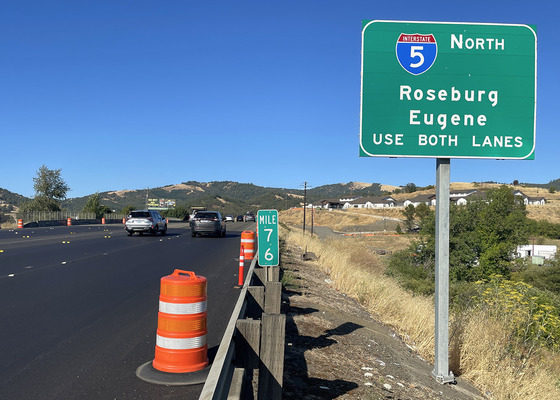 Signs along Oregon 42 encourage eastbound drivers to use both lanes until they reach the bridge over Interstate 5, then take turns merging. The new pattern is called a “zipper merge” because drivers in both lanes merge like the teeth of a zipper.
New signs and pavement markings encourage drivers to take turns merging before reaching northbound I-5 ramps
August 3, 2026
GREEN DISTRICT – Drivers traveling on Oregon 42 from Winston to Roseburg are going to see something new next week. It’s called a “zipper merge.”
Sometime around August 9, new signs and pavement markings will be added that encourage eastbound Oregon 42 drivers to use both lanes all the way to the bridge over Interstate 5, then take turns merging when the road narrows to one lane.
This little change could solve several common problems.
On most weekday mornings, Winston drivers heading to Roseburg tend to get into the left lane of Oregon 42 and stay there, knowing the right lane will eventually end. Vehicles in the left lane sometimes back up to Grant Smith Road and Carnes Road, affecting traffic at both intersections.
When drivers back up in the left lane, traffic congestion slows everybody down, and fewer cars can get through a green light. The lane imbalance also means people tend to drive faster in the open right lane, and the speed difference can lead to serious crashes.
Road rage is another common problem. Some left-lane drivers resent late mergers and refuse to let them in. Aggressive driving can also lead to crashes.
But the zipper merge encourages cooperation and a sense of fairness as drivers use both lanes and take turns merging like the teeth of a zipper. Traffic is less likely to back up to Grant Smith Road or Kelly’s Corner and affect those intersections, and ODOT expects to see fewer crashes related to uneven speeds in each lane.
Drivers are reminded to use their turn signals when merging and allow room for other vehicles.
The zipper merge has been successfully used in many other areas and states. According to a study by the Minnesota Department of Transportation, zipper merges can reduce the length of traffic backups by 40 percent, meaning drivers can get to their destinations more quickly when they cooperate and take turns.
The new zipper merge is part of the Oregon 42 Lookingglass Creek to Interstate 5 project, which paved almost five miles of highway, installed a new traffic signal at Rolling Hills Road and added several other safety features.
Construction on the $11.97 million project is scheduled for completion in September.
A list of Frequently Asked Questions about the zipper merge is available on the project webpage. For more information, contact ODOT Public Information Officer Dan Latham at 541-817-5200 or Dan.Latham@odot.oregon.gov.
## ODOT ##
Before and after: New signs and pavement markings are expected to be introduced to the east end of Oregon 42 the week of August 9.
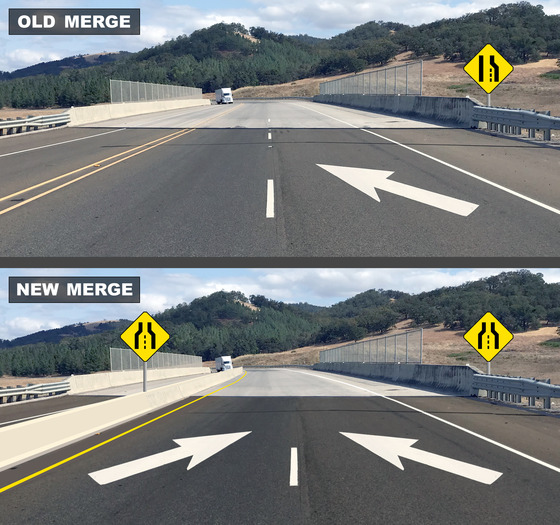 Under the old traffic pattern (top), eastbound Oregon 42 drivers in the right lane were directed to merge into the left lane as they neared the bridge over Interstate 5. The new pattern encourages drivers to use both lanes of Oregon 42 all the way to the bridge, then take turns merging from two lanes down to one. This is known as a “zipper merge” since vehicles merge like the teeth of a zipper.
|