Historic Columbia River Highway reopens at Larch Mountain Road after landslide repairs
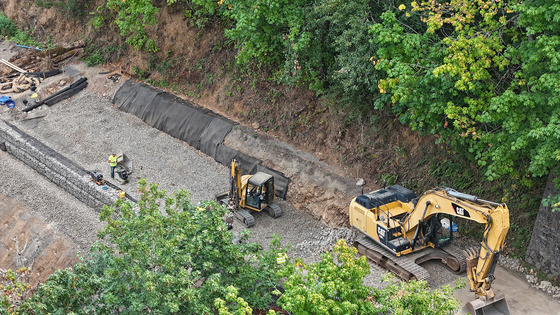 The Larch Mountain section of the Historic Columbia River Highway was closed this summer for landslide repair. This photo is from Aug. 25, 2025.
News media contact: David House, 503-551-8641
Sept. 26, 2025
TROUTDALE – The Historic Columbia River Highway will reopen by 5 p.m. Friday, Sept. 26, after repairs are completed to the section between Larch Mountain Road and Vista House.
We closed this section of the historic highway, also known as U.S. 30, on July 7 to vehicles, bicyclists and pedestrians to repair damage from the ancient landslide there.
We are grateful for the patience of residents, travelers and tourists during construction.
This section has required regular monitoring and maintenance ever since the highway was first built more than a century ago. In March 2025, geotechnical engineers noted that settling had accelerated and caused additional structural issues for guardrail and downslope.
These safety concerns prompted closure of this section of the highway on March 12. After temporary repairs and dry weather, we reopened this section of the highway March 25 while we designed a longer-term repair this summer.
Summer 2025 repair
The longer-term repair was challenging for many reasons.
The location of the work zone required getting crews, equipment and heavy metal materials down a steep slope for installation. The three pipe outfalls needed for improved soil drainage required a pully system to lower them about 100 feet downslope to the site.
To improve stability, this project added geo-grid mesh in layers from the wall to the back of the cut into the slope to add stability to the wall. We also added soil anchor nails and wire mesh below the wall for additional stabilization.
Perhaps the biggest challenge was fitting the work into the narrow window of construction season.
“This was a quick-build project from design, bid, construction and finish before the rainy season,” ODOT engineer Jason McNeil said. “Fortunately, we have not had any major issues with design, and with the help from the designers and the contractor, we worked through issues quickly to keep the project moving forward and on track.”
After reopening the highway, final touches on the project may require occasional lane closures and flagging traffic for a few more weeks to complete the work.
Background
The Larch Mountain landslide is a deep, massive landslide complex that occupies more than 100 acres of the Crown Point State Scenic Corridor. The historic highway skirts around the perimeter of this massive landslide, and about 800 feet of the highway crosses an active section of the landslide just east of the intersection with Larch Mountain Road, about half a mile west of Crown Point.
When the Historic Highway was built between 1913 and 1922, the ancient Larch Mountain Slide was a challenge. The original design for the highway at this location was a viaduct, or a bridge over land, though the structure could not accommodate the continuous movement of the landslide. This viaduct was removed in the 1960s when ODOT built the current alignment.
In 1983, and then again in 2007, ODOT constructed a retaining wall to support the historic highway. Continued ground movement, sometimes up to 12 inches in a year has required annual repaving and reassessment.
Fall 2025 closure reminder
The East Viaduct on the historic highway at Multnomah Falls will close Wednesday, Oct. 1, to all traffic to continue a repair project through spring 2026. During the viaduct closure, vehicles traveling westbound from Hood River will be turned around at the Oneonta Trailhead before reaching the Multnomah Falls Lodge.
Please visit Tripcheck.com for the latest information on road conditions.
ODOT funding
While ODOT’s funding crisis is having a profound impact on maintenance and operations, most projects will continue. These projects are typically funded through separate programs, often with state or federal funds that are legally restricted to project development, and cannot be used for maintenance or day-to-day operations.
|