$11.3 million awarded to projects across Oregon that reduce greenhouse gas emissions
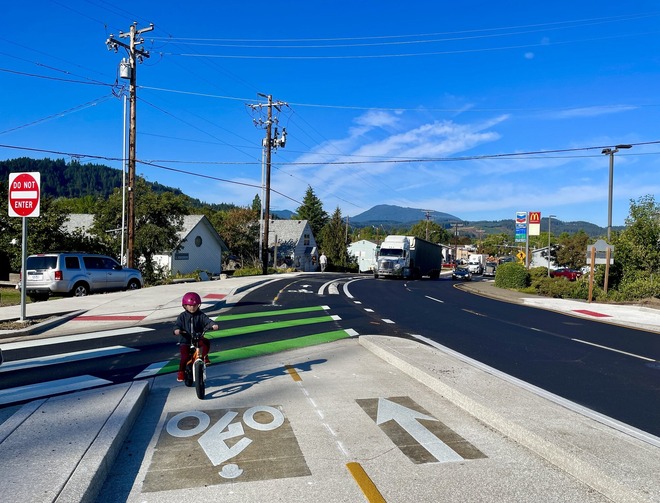 A bike lane along U.S. 20 in Philomath. Note: This project was not funded by the Carbon Reduction program.
For more information, contact Matt Noble 503-779-9868
Electric vehicles, EV charging stations, transit improvements, and bicycle and pedestrian infrastructure are among the 14 projects across Oregon to receive funding from the second round of the federal Carbon Reduction Program.
The program’s second round of competitive grant funding, which ran in spring this year, had $11.5 million available for “small urban and rural” projects in Oregon that reduce greenhouse gas emissions from transportation.
The 14 projects were split among 13 local agencies and one Tribe. Over 70% of the funds will go to projects in disadvantaged communities, following the federal government’s Justice40 initiative.
Eligible projects for the grant were in urban and rural areas of the state with populations under 200,000. Cities, counties, Tribal governments, and local and state transportation agencies were eligible to apply.
The Carbon Reduction Program will distribute $82 million of federal funding over five years for transportation projects in Oregon. The ODOT Climate Office administers the program. Office staff worked with a consultation group of local transportation organizations and advocates to develop strategies, priorities and evaluation criteria for the program.
The next round of funding from the Carbon Reduction Program is expected to be in spring 2026.
The Carbon Reduction Program is one of the ways Oregon is working to reduce greenhouse gas emissions from transportation over the next several decades. By 2050, emissions from transportation will be about 60% lower than they were in 1990, according to data on our new transportation emissions website.
Time flies. Make sure you can, too: Get your REAL ID before May 7, 2025.
|