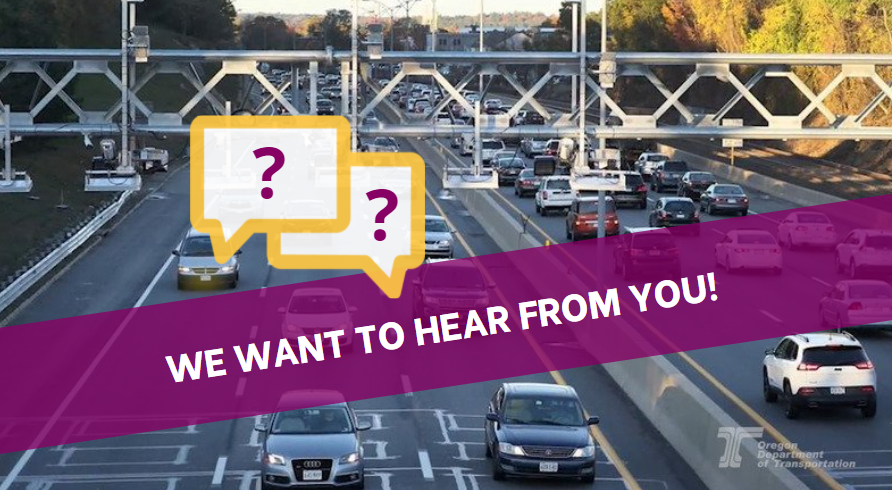
Oregon Toll Program Update: We want to hear from you!

Having trouble viewing this email? View it as a Web page.

In this issue:

  • Tell us: What matters most to you when it comes to tolling?
  • Advancing equity with tolling: ADA turns 31!
  • Stay connected.

Tell us: What matters most to you when it comes to tolling?

Traffic delay on the highway can lead to traffic problems in local communities. Over the next month, we are inviting feedback through a series of quick surveys, with different questions each week. We want to learn from you about travel, transportation problems and priorities, and what you would like to see from the toll program. 

Click here to take our second survey to share what matters most when it comes to tolling on I-5 and I-205. Keep an eye on your inbox – we’ll be sending weekly updates for the next four weeks.

Miss the first survey? It’s not too late! Tell us here about using I-205 and I-5.

Oregon Toll Program simple survey number 2 icon.

What is this project?

ODOT has two toll projects underway in the Portland metro area – the I-205 Toll Project and the Regional Mobility Pricing Project – to address traffic on I-205 and I-5 in a way that is equitable and addresses climate change and safety. While separate projects, they inform each other. Toll prices will be higher at peak traffic times, a concept known as “congestion pricing.” With both projects:

  • Drivers only pay for what they use.
  • Tolls can help traffic move more smoothly.
  • Tolls provide a more reliable trip.
  • Toll prices will not be a surprise.

Why do we need tolls?

Traffic is getting worse. It is:

  • Making life harder.
  • Bad for our economy.
  • Creating more emissions and contributing to climate change.

There is not enough money from gas taxes or other revenue sources to fix Oregon’s highways and fund projects to reduce traffic. It’s not easy for people with low incomes, disabilities, and other barriers to get to where they need to go. Tolls can help address these problems and provide a reliable funding source for transportation projects. The Oregon Department of Transportation needs your input to make tolls work for our community.

Advancing equity with tolling: ADA turns 31!

Have you ever noticed curb cutouts or talking traffic signals for people crossing the street? These help make transportation accessible for everyone. This is thanks to the Americans with Disabilities Act (ADA), signed into law 31 years ago this month. The Toll Program wants tolls to improve transportation for people - not make it worse. Our Equity and Mobility Advisory Committee is working on strategies that center transit and multimodal options, neighborhood health and safety, and affordability and undeserved communities. This includes people experiencing a disability.

To help​​​​ celebrate the 31st anniversary of the Americans with Disabilities Act, there is an upcoming series of free lunch and learn opportunities.

Here are the basics:

What: The Oregon Disabilities Commission and the Northwest ADA Center are hosting a webinar series in recognition of the Americans with Disabilities Act (ADA) 31st anniversary. The series kicks off with Disability Rights Activist Judy Heumann, recently featured in the Oscar-nominated documentary “Crip Camp".

When: Tuesdays, July 20 and 27 from noon to 1 p.m.

You can sign up for the free lunch and learn opportunities here.

For more information about the ADA, see Accessibility at ODOT and details about Engineering for Accessibility on the ODOT website. 

Stay connected.

Please follow along with us to receive updates on the Regional Mobility Pricing Project and the I-205 Toll Project and tell us what's on your mind.

For more information and to sign up for email updates, please check out the project website or email the project team.


Si desea obtener información sobre este proyecto traducida al español, sírvase llamar al 503-731-4128.

Nếu quý vị muốn thông tin về dự án này được dịch sang tiếng Việt, xin gọi 503-731-4128.

Если вы хотите чтобы информация об этом проекте была переведена на русский язык, пожалуйста, звоните по телефону 503-731-4128.

如果您想瞭解這個項目,我們有提供繁體中文翻譯,請致電:503-731-4128。

如果您想了解这个项目,我们有提供简体中文翻译,请致电:503-731-4128。

For Americans with Disabilities Act or Civil Rights Title VI accommodations, translation/interpretation services, or more information call 503-731-4128,
TTY (800) 735-2900 or Oregon Relay Service 7-1-1.


The information in this document, and the public and agency input received, may be adopted or incorporated by reference into a future environmental review process to meet the requirements of the National Environmental Policy Act.