Oregon Toll Program: March 2021 Newsletter

Having trouble viewing this email? View it as a Web page.

In this issue:

  • Tolls can manage congestion and generate revenue for better travel
  • Analysis shows most I-205 drivers start or end their trip locally
  • Get involved: Join our upcoming committee meetings

Tolls can manage congestion and generate revenue for better travel.

Clarifying our goals and coordination between tolling and congestion management.

Tolling is a widely used industry term to describe road pricing programs. It is worth clarifying upfront that ODOT is using ‘tolling’ as an umbrella term for the program, which is expected to include various types of tolling such as congestion pricing (also known as variable rate pricing), and other applications needed to generate revenue and manage congestion.

The two toll projects underway have a dual purpose: manage congestion and generate revenue. We are working to identify a balanced toll rate that enhances traffic flow while generating revenue for transportation improvements. A toll that is too low won’t manage congestion well. A toll that is too high leads to too many highway drivers using local streets. With a balanced toll more people benefit from improved travel on the highway and throughout the region.

We get it—no one likes paying tolls or fees. But like the cost of any service—it’s all about what you get for the amount you pay. In Oregon, the benefit of paying a toll will be a faster trip with less traffic. Congestion pricing will give people the choice for a faster highway trip when they really need it—like when they’re late for work or need to pick up their child from school or daycare. Read on for more details.
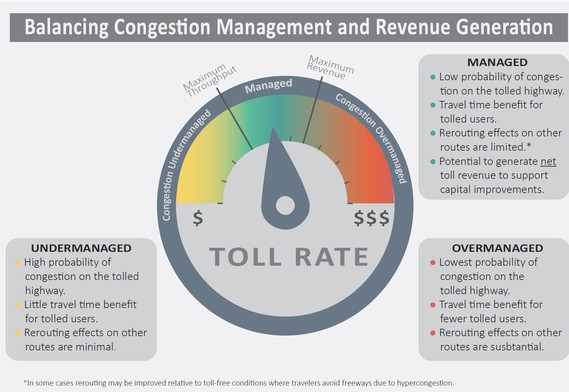
A graphic showing the Toll Program’s dual objectives

The Toll Program’s dual objectives when setting a toll rate that finds a good balance between improving highway congestion and generating revenue for transportation improvements. The graphic shows that a system without a good balance can have negative effects to local streets and fewer people will benefit from improved travel.

“Toll” and “tolling” are general terms.

Definition: A toll is a user fee to drive on a road or across a bridge. Tolling is currently in place in many cities across the country, including Tacoma and Hood River. What we are doing: We use the words “toll” and “tolling” instead of “pricing” or “user fee” because most people understand these words, they translate better into other languages spoken in the region, and we want to be transparent.

Congestion pricing is a type of tolling.

Definition: This type of tolling charges a higher price during peak traffic periods. It’s also called value pricing or variable rate tolling. The higher fee encourages some drivers to use other travel options such as carpools or transit, or change their travel time to less congested times of the day, or change where they are going. Congestion pricing is used in places such as on the San Francisco-Oakland Bay Bridge and in Seattle for the SR 520 Bridge and the SR 99 Tunnel. This is different than fixed-rate tolling, in which users pay a flat, static rate to use a road or bridge regardless of congestion or time of day. What we are doing: We are using variable rate tolls or congestion pricing. The rate of the toll will vary based on congestion at peak and non-peak hours. Even a small decrease in the number of people trying to get on the highway will make for faster commutes.

Dynamic pricing is a type of congestion pricing.

Definition: In a dynamic pricing system, tolls fluctuate in real time based on congestion. San Diego is one city with dynamic pricing on express lanes. What we are doing: In the Portland area, we are considering a predictable way of tolling where toll rates vary according to a set schedule so you would know the cost in advance. We are analyzing variable rate tolls, not dynamic pricing. We want highway users to know how much a toll costs before they start their trip.


Learn more about congestion pricing and tolling from the Federal Highway Administration or the Oregon Toll Program website.

Analysis shows local users make up a heavy share of I-205 trips.

Results from the I-205 Corridor User Analysis.

An I-205 Corridor User Analysis was done to better understand the travel patterns of current users of I-205 near the Abernethy Bridge. We will use this information to inform the development and analysis of options for the I-205 Toll Project.

3 in 4 trips are made locally.

While trips using the I-205 Abernethy Bridge come from throughout the Portland metropolitan region and beyond, three in four users access I-205 locally —meaning that they enter or exit I-205 at one of the five interchanges in this seven mile segment of the highway. Users come from nearby areas such as West Linn, Oregon City, Gladstone, and Clackamas. Fewer travelers come from areas farther away, including 3% from Clark County, Washington.

Congestion is creating diversion today.

Our analysis of travel patterns shows drivers exit or avoid I-205 during higher demand periods when traffic congestion is present. For example, in the afternoon rush, 20% to 30% more travelers heading north on I-205 to the Oregon City Arch Bridge exit to use Borland Road or Willamette Falls Drive compared to midday. With the added lane in both directions from the I-205 Improvements Project and congestion management from tolls, travel on I-205 will improve. The toll project is analyzing if drivers that currently avoid I-205 during peak hours would return to the highway if it was less congested and they knew how long their trip would take.


This analysis used StreetLight Data Inc.'s mobility platform as a primary tool along with the Regional Travel Demand Model (RTDM) and the Oregon Statewide Integrated Model. Read the full I-205 Corridor User Analysis for more in-depth information, maps and other graphics.

Get involved.

Join our upcoming committee meetings.

There are two upcoming virtual meetings about the toll project, and you are invited to attend.

Equity and Mobility Advisory Committee Meeting

The Equity and Mobility Advisory Committee will meet Wednesday, March 31, 2021, 3:30 p.m. – 6 p.m.

At this meeting, the committee will:

  • Continue discussing how to measure whether our engagement is successful and inclusive.
  • Continue discussing how we can measure whether the toll projects meet equity and mobility goals described in the Equity Framework.
  • Review the committee work plan.

We would like to hear your comments! Public comment is at the beginning of the meeting around 3:45 p.m.

You can also submit written or verbal comments any time. Please submit comments by email (oregontolling@odot.state.or.us) with “Committee Public Comment" in the subject line, or call 503-837-3536 and state “Committee Public Comment" in your message.  If we receive your comment by 11 a.m. March 29, we will send it to the Equity and Mobility Advisory Committee in advance. All comments we receive before or at the meeting are included in the meeting summary. We will reserve 10 minutes to hear verbal comments at the meeting. If you would like to make a comment, you will have up to two minutes to speak. For more information, please see the committee webpage.

Region 1 Area Commission on Transportation Meeting

On Monday, April 5, 2021, the Toll Program team will present to the Region 1 Area Commission on Transportation online through Zoom at 5:30 p.m. The commission is an advisory group that brings together different stakeholders to collaborate on transportation issues affecting the Portland metro area. At this meeting, the group will discuss responses to comments received during the I-205 Toll Project comment period, as well as the upcoming project schedule for regional tolling. For more information, please see the commission webpage.

We hope you’ll join us at either meeting to learn more about the toll program and the important work we are doing.

For more information and to sign up for email updates, please check out the project website or email the project team.


Si desea obtener información sobre este proyecto traducida al español, sírvase llamar al 503-731-4128.

Nếu quý vị muốn thông tin về dự án này được dịch sang tiếng Việt, xin gọi 503-731-4128.

Если вы хотите чтобы информация об этом проекте была переведена на русский язык, пожалуйста, звоните по телефону 503-731-4128.

如果您想瞭解這個項目,我們有提供繁體中文翻譯,請致電:503-731-4128。

如果您想了解这个项目,我们有提供简体中文翻译,请致电:503-731-4128。

For Americans with Disabilities Act or Civil Rights Title VI accommodations, translation/interpretation services, or more information call 503-731-4128,
TTY (800) 735-2900 or Oregon Relay Service 7-1-1.


The information in this document, and the public and agency input received, may be adopted or incorporated by reference into a future environmental review process to meet the requirements of the National Environmental Policy Act.