When Communities Need Government to Respond
October has been a reminder of how quickly federal immigration policy and enforcement can change the daily lives of Oregonians.
Since October 5, community partners have reported approximately 65 or more detentions across Oregon, alongside increased enforcement activity near workplaces and public spaces. Behind these reports are families suddenly facing difficult questions: Where is my loved one? How do I find legal assistance? How will we pay rent? Is it safe to go to work tomorrow?
These are not abstract policy questions. They are the realities community organizations are helping families navigate, often while responding to rapidly changing information themselves.
And they are precisely why Oregon needs strong connections between communities and state leadership.
Governor Tina Kotek responded publicly and quickly to the increased enforcement activity. Through her October 9 community message and October 12 announcement, the Governor reaffirmed Oregon's commitment to immigrant and refugee communities, reinforced the state's Sanctuary Law, and directed stronger coordination and information sharing across state government.
Her actions build on Executive Order 26-04, which established the Interagency Council for Immigrant and Refugee Coordination (ICIRC) earlier this year. Led by OIRA, the Council provides an established structure for agencies to identify emerging issues, share information, and coordinate responses within their respective responsibilities.
Throughout October, OIRA has been working closely with community partners, legal service providers, and state agencies to understand what is happening across Oregon.
Our conversations have surfaced concerns about detention activity, family stability, access to services, and public trust. We've also heard about families navigating renewed federal reviews of their immigration or humanitarian status, adding another layer of uncertainty for people who have already established lives in Oregon.
Just this week, a community partner shared concerns about refugee community members with humanitarian protections who were afraid to go to work following reported enforcement activity at an Oregon workplace.
Immigration enforcement does not only affect the people who are detained. Its effects can reach workers who are legally authorized to live and work in the United States, their families, their employers, and entire communities.
These conversations have also underscored the importance of distinguishing verified information from emerging reports, particularly when circumstances are changing quickly.
We've brought these concerns into our coordination with state leadership and agency partners, while continuing to share federal policy developments and practical resources through our weekly updates.
This is what it means to elevate community voice. Not simply to listen, but to make sure what communities are experiencing informs the decisions being made in government.
And while immigration enforcement has dominated much of October's attention, other significant federal changes have continued to unfold.
Refugee admissions and resettlement policies remain in flux. Changes affecting humanitarian protections, employment authorization, and access to healthcare and public benefits are creating additional uncertainty for families and the organizations serving them.
These developments matter because a family navigating immigration enforcement may also be navigating a change in healthcare coverage, an employment question, or a disruption in support services. The effects do not arrive neatly separated by federal agency or policy area.
As we move into November, OIRA will continue supporting Governor Kotek's direction, strengthening coordination through ICIRC, and working with community partners to identify emerging concerns and barriers.
I also want to recognize the OIRA team and the many community and agency partner who have worked alongside us throughout October. None of this work happens in isolation. Every conversation, shared connection, coordinated effort reflects the relationships that make our work possible. I often say that flourishing is mutual. October has been a reminder of what that means in practice. Our ability to respond, support one another, and move forward depends on the strength of the relationships we build together. I’m deeply grateful to everyone who continues to make this work possible.
OIRA was established with a clear purpose: to ensure immigrant and refugee communities are not an afterthought in Oregon's policy decisions.
That purpose matters most when the decisions are difficult, the information is changing, and communities need government to pay attention.
Director, Office of Immigrant and Refugee Advancement
|
 |
State Coordination and Preparedness
Building on Governor Tina Kotek's direction to strengthen Oregon's response to increased federal immigration enforcement activity, OIRA continued working with state agencies and community partners throughout October to identify emerging concerns, improve communication, and support access to essential services.
As community partners reported enforcement activity across Oregon, OIRA worked with the Governor's Office and participating agencies to share information, identify potential impacts on state programs, and determine where additional coordination or guidance was needed.
At its October meeting, the Interagency Council for Immigrant and Refugee Coordination (ICIRC) strengthened its approach to addressing concerns that extend across multiple schools, offices, or programs. This allows OIRA to work more directly with agencies to identify gaps, clarify responsibilities, and support timely follow-up.
One area of focus has been working with the Oregon Department of Education on questions related to student enrollment documentation and guidance for school districts, including how schools receive information and where additional support may be needed.
OIRA also continued collaborating with the Department of Administrative Services and Oregon Department of Justice to prepare immigration enforcement response training for state employees. The training will help employees understand Oregon's Sanctuary Promise laws, respond appropriately to interactions involving federal immigration enforcement, and follow established agency procedures. Preparations are underway for an initial rollout to participating agencies, followed by broader statewide implementation.
These efforts are part of putting Governor Kotek's direction into practice, strengthening state preparedness, improving communication, and helping agencies respond to the needs of immigrant and refugee communities.
Community Engagement and Statewide Response
October has demonstrated the breadth of OIRA's work as federal immigration developments continue to affect communities across Oregon. Alongside supporting Governor Tina Kotek's direction and coordinating with state agencies on emerging enforcement concerns, OIRA has maintained an extensive schedule of community engagement, interagency collaboration, and policy coordination.
Our October engagement calendar includes more than 40 scheduled meetings and collaborative activities, connecting OIRA with community organizations, refugee resettlement partners, legal service providers, local governments, state agencies, and national networks. These engagements span immigration enforcement response, refugee policy, healthcare, public benefits, workforce development, and economic opportunity.
Even as OIRA responded to rapidly changing federal developments and requests for state coordination, we continued hearing directly from communities about the challenges they are navigating.
Partners described families seeking legal representation following detentions, immediate needs for housing and financial assistance, growing mental health concerns, and questions about public safety and trust in law enforcement. We've also heard about refugee families undergoing renewed federal reviews of their status and community members with humanitarian protections who are fearful of reporting to work.
Conversations with refugee-serving organizations, including partners supporting Ukrainian communities, have also highlighted concerns about healthcare coverage changes, employment authorization, work requirements, and access to accurate information about public benefits.
These conversations are not separate from OIRA's statewide coordination responsibilities. They are what makes that coordination informed and responsive. Community experiences help identify emerging issues, shape discussions with state agencies, and bring concerns directly to state leadership.
At a time when federal policies are changing rapidly, OIRA continues working across government and community networks to connect information, identify challenges, and support Oregon's response.
Our work is not simply to respond to what is happening today, but to ensure immigrant and refugee communities remain part of the decisions shaping Oregon's future.
OIRA’s work extends beyond policy coordination and community meetings. Our team also participates in statewide and national conversations, builds perspective, and invests in professional development to strengthen our work on behalf of immigrant and refugee communities.
Strengthening Partnerships in Lane County
This month, OIRA Director Jessica Ventura visited Eugene to meet with Catholic Charities of Lane County, Pacific Refugee Support Group, and United for Immigrant Justice.
The visit also included an opportunity to connect with Oregon Refugee Children Assistance (ORCAS) program, which supports children and families, during a fall celebration organized by its case manager.
These engagements reflect OIRA’s commitment to building relationships across Oregon and connecting directly with the organizations and communities whose experiences help inform statewide policy.
Immigration Policy and Oregon’s Workforce
On October 20, OIRA Director Jessica Ventura participated in the WORKing Together conference at the Salem Convention Center as a panelist for “Changing Tides: How Immigration Policy Is Impacting Oregon's Employment Landscape.”
The discussion explored the important role immigrant and refugee workers play in Oregon's economy and how changes in federal immigration policy affect workforce participation, employment stability, and businesses across the state.
OIRA brought a statewide policy and community perspective to the conversation, highlighting how immigration enforcement, uncertainty around employment authorization, and changes to public benefits can create barriers for workers and families, even when individuals are legally authorized to work.
The discussion also emphasized that immigration policy is not separate from workforce policy. Changes affecting immigrant and refugee communities have broader implications for Oregon's employers, industries, and economic stability.
Connecting with National Partners
November 2–4, OIRA staff will attend the Casey Family Programs Immigration & Child Welfare Convening in Chicago. The gathering will provide opportunities to exchange perspectives with national partners and explore issues affecting immigrant and refugee children and families.
Together, these activities reflect the breadth of OIRA's work, from responding to immediate federal developments to strengthening the relationships, expertise, and partnerships that support Oregon's immigrant and refugee communities over the long term.
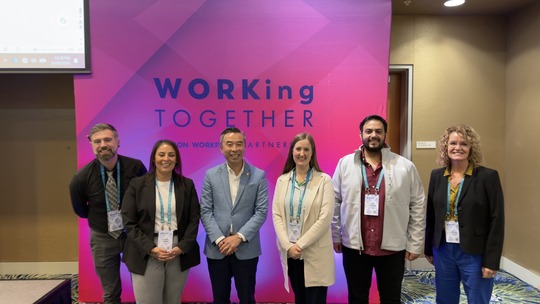 At the WORKing Together Conference, pictured left to right: Damon Runberg, Jessica Ventura, Representative Daniel Nguyễn, Theresa Park, Emile Assaly and Kim Parker-Lleranas

Oregon Secretary of State Elections Toolkit
Help us share important information that every eligible voter in Oregon should know for this year’s elections!
The Oregon Secretary of State Office invites voters, county election offices, community partners, and any organization involved in civic education and voter outreach to use the 2026 Elections Toolkit as a trusted resource for election information.
All materials available in the 2026 Elections Toolkit are official, nonpartisan, and free to use.
|
Materials about federal changes to SNAP: information for legally present immigrants
Simple, sharable resources to help you help others
|

Voter Education Event- Tonight- Latino Network
We’ll have delicious food and childcare available, along with TriMet passes for in-person attendees.
Date: October 22
Time: 5:30–7:30 PM
Location: La Plaza Esperanza
Registration
|
Upcoming Public Charge webinar: Oct. 26 (English) and Oct. 28 (Spanish)
Please join a coalition of community leaders and advocates, state agency officials, local lawyers from the Oregon Law Center, and national lawyers from the National Immigration Law Center for a discussion on the new federal rule on Public Charge.
In this webinar you will learn what the Public Charge rule is, who it applies to, what has changed and what has stayed the same with the new rule, and explore ideas for how to help immigrants and their families consider whether and how public charge impacts them. The webinar will be run once in English (with interpretation into other languages) and a second time in Spanish. These webinars will be recorded, so those not able to attend can view the webinars at a later date.
English webinar: Monday, October 26, 2:00-3:30pm (with interpretation into other languages, including Spanish) REGISTRATION LINK HERE
Spanish webinar: Wednesday, October 28, 2:30-4:00pm. REGISTRATION LINK HERE
With any challenges in registration, please reach out to info@oregonhealthequity.org.
For people who speak or use a language other than English, people with disabilities or people who need additional support, we can provide free help. This meeting will be virtual only. Please contact info@oregonhealthequity.org by October 23rd to request an accommodation. We will make every effort to provide services to requests after October 23rd. The earlier you make a request the more likely we can meet the need.
#######################
Les invitamos a unirse a una coalición formada por líderes comunitarios y defensores de los derechos, funcionarios de las agencias estatales, abogados locales del Oregon Law Center y abogados nacionales del National Immigration Law Center para debatir sobre la nueva regla federal relativa a la «carga pública».
En este seminario virtual aprenderán en qué consiste la regla de la «carga pública», a quiénes se aplica, qué ha cambiado y qué se ha mantenido igual con la nueva regla, y descubrirán ideas sobre cómo ayudar a los inmigrantes y a sus familias a valorar si la regla de la «carga pública» les afecta y de qué manera. El seminario web se impartirá una vez en inglés (con interpretación a otros idiomas) y una segunda vez en español. Estos seminarios virtuales se grabarán, por los que no puedan asistir podrán verlos más adelante.
Seminario virtual en inglés: lunes, 26 de octubre, de 14:00 a 15:30 (con interpretación a otros idiomas, incluido el español). ENLACE DE REGISTRACIÓN AQUÍ
Seminario virtual en español: miércoles, 28 de octubre, de 14:30 a 16:00. ENLACE DE REGISTRACIÓN AQUÍ
Si tiene alguna dificultad con el registro, póngase en contacto con info@oregonhealthequity.org.
Para las personas que hablan o utilizan un idioma distinto del español o el inglés, las personas con discapacidad o aquellas que necesiten apoyo adicional, ofrecemos ayuda gratuita. Esta reunión se celebrará únicamente de forma virtual. Póngase en contacto con info@oregonhealthequity.org antes del 23 de octubre para solicitar una adaptación. Haremos todo lo posible por atender las solicitudes recibidas después del 23 de octubre. Cuanto antes realices la solicitud, más probabilidades tendremos de poder atenderla.
|
|




