April has been an especially active month for Office of Immigrant and Refugee Advancement (OIRA), with more than 40 community meetings, student forums, and partner convenings taking place across Oregon. Many of these conversations have been in person, which has allowed us to hear directly from students, families, service providers, and community leaders.
In student-led town halls, I heard directly from young people about how immigration enforcement is impacting their sense of safety, their focus in school, and their daily lives. At community colleges where I was invited to speak, students shared similar concerns about family stability and uncertainty about what the future holds.
Across these conversations, one thing is clear: students and young people are navigating a complex and stressful environment, while still showing up for school, for their families, and for their communities.
We were also invited to listen to community members from a range of backgrounds, including faith-based communities, Asian and Pacific Islander communities, and members of the African diaspora. Each conversation reflected different experiences, but there were shared concerns about safety, access to services, and the broader impact of immigration enforcement on individuals and families.
While experiences vary, community partners consistently shared that enforcement activity is being felt across multiple communities, including among individuals and families with a range of immigration statuses.
These are not abstract impacts. They are showing up in classrooms, in workplaces, and in homes across Oregon.
As we move into May, we recognize that many communities will be gathering in recognition of May Day. For many, this is a time rooted in long-standing traditions connected to workers, families, and community voice. It is also a moment when we often see increased visibility and activity across communities.
May also marks an important period in Oregon’s election calendar, with key deadlines approaching for the May primary. During times of increased community activity and engagement, access to clear, accurate information is especially important. We encourage partners to continue sharing trusted, up-to-date resources to support eligible Oregonians in navigating the voting process.
OIRA’s role remains focused on helping ensure that immigrant and refugee communities are not an afterthought in how systems respond. We continue to work across state agencies, alongside community partners, and in coordination with local jurisdictions to support consistent access to services and ensure that information is shared clearly and responsibly.
As part of this work, OIRA also staffs and coordinates the Interagency Council for Immigrant and Refugee Coordination under Executive Order 26-04, supporting alignment across agencies and helping ensure a consistent statewide approach as conditions continue to evolve.
|
 |
Two SNAP changes begin June 1, 2026
The Oregon Department of Human Services (ODHS) is making two updates to the Supplemental Nutrition Assistance Program (SNAP). Both changes take effect June 1, 2026.
Community partners play an important role in helping SNAP participants understand how these updates may affect them.
Verification of shelter and utility costs
Starting June 1, people who apply for SNAP or renew their benefits must provide proof of their shelter and utility expenses if that information is not already on file.
This includes costs such as:
-
Electricity, gas, water or other utilities
Households must also provide updated proof if they move to a new address.
In previous years, many SNAP participants only needed to report these expenses without providing documents.
Benefits will not automatically close if proof is not provided. However, without verification, ODHS will calculate benefits without shelter and utility deductions. This may result in a lower monthly SNAP amount.
Renewal interviews resume for certain older adults and people with disabilities
A temporary federal waiver allowed some SNAP households to skip their renewal interview. That waiver ends May 31, 2026.
Beginning June 1, 2026, renewal interviews will resume for households where:
-
All adults are age 60 or older, or meet the SNAP definition of disabled, and
-
No one in the household has earned income
Households may include children, but all adults must meet these criteria.
Many people impacted by this change have not recently completed a SNAP interview.
Renewal interviews are a standard part of SNAP and help ensure benefits are issued correctly. Approximately 187,000 people in Oregon may be impacted.
Community partners can support customers and clients by:
-
Reminding people to gather proof of rent, mortgage and utility costs before they apply or renew
-
Encouraging households to update their information if they move
-
Letting older adults and people with disabilities know that renewal interviews will resume
-
Remind customers to watch for mail, email or notices from ODHS about interviews or verification requests
-
Referring customers to ODHS or local offices if they need help completing their renewal
Sharing this information early can help prevent delays or reductions in benefits.
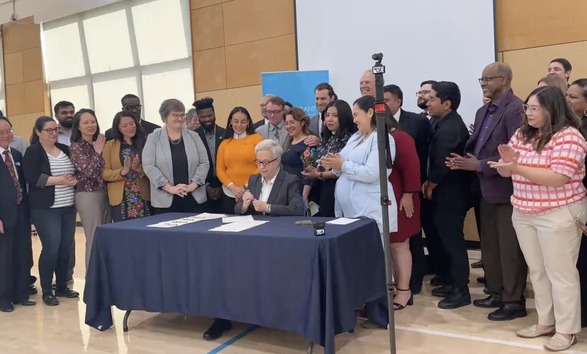
During a ceremonial bill signing event in East Portland April 9, Governor Tina Kotek signed eight bills to enact new safeguards for immigrant communities, protect civil liberties, and uphold Oregon values of transparency, accountability, and justice.
The legislation comes as the federal administration continues escalated deportation enforcement, disregard for the rule of law, and other federal overreach. Governor Tina Kotek has taken action in support of immigrant and refugee communities since before President Trump took office.
“Our immigrant and refugee communities are Oregon communities, and I will always protect the safety and prosperity of every Oregonian,” Governor Kotek said. “No one should be afraid to go to work, take their child to school, or ask for help because of who they are or where they come from. These bills will help us push back on unlawful federal overreach.”
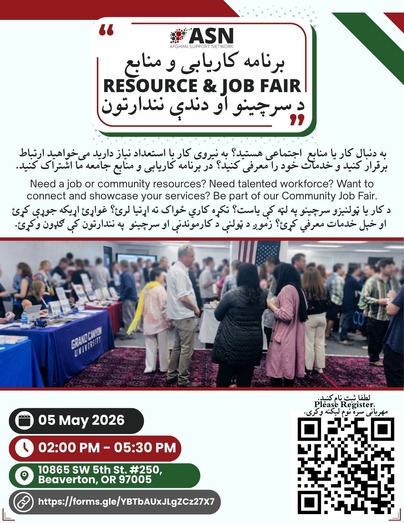
Afghan Support Network Job Fair:
May 5, 2-5:30 p.m.
10865 SW 5th St. #250 Beaverton, OR 97005
|
|
At a time when division can feel louder than understanding, stories bring us back to what matters—our shared humanity. On Saturday, May 16, 2026, in observance of Asian American & Native Hawaiian/Pacific Islander Heritage Month, I Am An American Live: Stories of Exclusion and Belonging returns to The Patricia Reser Center for the Arts, presented in collaboration with The Immigrant Story. Through powerful, first-person narratives from individuals with roots in Vietnam, China, the Philippines, and Burma, this live production shines a light on the struggles, resilience and enduring hope of the immigrant experience.
As our nation approaches its 250th anniversary of independence, this production offers a time to reflect on who we are and who we choose to stand with. These stories invite us not only to listen, but to bear witness—to stand in solidarity with immigrant communities and affirm that everyone deserves dignity, safety, and a sense of belonging.
The evening will also feature a world premiere performance by 2026 Fields Artist Fellow Talilo Marfil, whose original work brings a powerful, local voice to the stage.
Join us. Listen deeply. Stand together.
This event is free and open to all.
Four Stories. One Stage. Countless Journeys.
|
|
We are pleased to share that a collaborative and community-centered service initiative is now available through OSWWACDC in partnership with On The Move Ministries with Jesus Outreach and ALMS Medical Center.
Together, we are providing supportive services to help African immigrant and refugee families, as well as other underserved community members in the Portland area.
Services available include:
🍎 Weekly food box distribution for families in need
🏥 Culturally competent primary and preventive healthcare services
🤝 Social service referrals (housing assistance, mental health services, employment readiness, and ODHS resource connections)
🌍 Civic engagement programs that strengthen leadership, participation, and community connection
📊 Each year, this collaboration supports thousands of families through food distribution, healthcare visits, social service referrals, and community events.
📍 Services are provided at:
OSWWACDC Office
10249 NE Clackamas St.
Portland, Oregon 97220
971-291-2451 Elder Johnny Bradford
503-206-4137 OSWWACDC Office
We encourage all community leaders, churches, organizations, and families to refer individuals who may benefit from these services. Together, through partnership and collaboration, we can uplift and strengthen our community.
For referrals or more information, please help connect community members with our office.
|
|
The Community Services Network (CSN), in partnership with our local health system partners, has put together a series of free virtual learning sessions, and we would love for you and your team to join us.
Whether you are looking to deepen your own knowledge or better equip yourself to support the communities you serve, these sessions offer a great opportunity to learn, ask questions, and connect. We encourage you to register and share these opportunities with your colleagues and networks.
Understanding the Oregon Health Plan (OHP): An Introductory Class – Spanish Session
Date: May 26, 2026
Time: 9 – 10:30am
In collaboration with CareOregon’s Connect to Care team, this session offers a welcoming and accessible overview of the Oregon Health Plan, presented entirely in Spanish. Participants will learn who qualifies, the benefits available, and how the program works so they can better support the Spanish-speaking communities they serve.
CCO 101: Understanding Coordinated Care Organizations
Date: May 21, 2026
Time: 9:30 – 11:00am
This session provides a helpful introduction to Coordinated Care Organizations (CCOs), including how they operate within the Oregon Health Plan and how community partners can better connect the people they serve to care and resources.
Register here: CCO 101 Registration Link
Medicare 101
Date: April 8, 2026
Time: 9 – 10:30am
Representatives from Health Share of Oregon and Trillium Community Health Plan will be the presenters for this interactive session. Participants will gain a foundational understanding of Coordinated Care Organizations (CCOs), learn how they operate within the Oregon Health Plan, and have the opportunity to engage directly with the CCO representatives to ask questions and connect resources to the communities they serve.
Registration link: Medicare 101 Registration Link
|
|