In this moment, many people are asking what safety means and how we sustain hope amid fear and uncertainty. Safety is not abstract. It shows up in daily routines, in trust, and in the expectation that people will return home to one another. When those assurances begin to break, the effects reach far beyond any single family or community.
Fear has long been used to divide communities and mark some people as disposable or removable. Immigrant and refugee communities have endured not because harm leaves them untouched, but because mutual care has been a survival strategy. People share information, resources, and responsibility when formal systems fall short.
I have been returning to the idea that all flourishing is mutual, language I recently encountered while reading Braiding Sweetgrass. It names something many communities already live. Wellbeing is shared. Safety is relational. When one group is made less secure, the effects ripple outward and weaken the whole.
At the same time, resilience should not be mistaken for limitless capacity. Mutual care sustains people, but it cannot replace systems that are accountable, responsive, and grounded in dignity. Community strength does not absolve institutions of responsibility.
As we navigate this moment, the question before us is not only how communities continue to support one another, but how institutions meet that care with partnership, clarity, and action.
This new year begins in a moment that feels heavy for many. Oregon continues to see the effects of higher enforcement activity. Families have changed routines. Schools and community organizations are carrying more responsibility. Partners across the state are holding fear, urgency, and exhaustion as they help people stay informed and safe. These are not abstract conditions. They shape daily life.
Across the country, we are seeing how federal enforcement shifts play out locally. In Minnesota, an estimated 3,000 federal officers have been deployed, and schools have moved to distance learning through mid-February. These conditions are affecting both immigrant and refugee families and have created significant disruption for students, workers, and service providers.
Minnesota shares important similarities with Oregon. Both are sanctuary states with comparable immigrant and refugee populations. What is unfolding there offers an early view of how federal enforcement shifts can affect daily life, public systems, and community stability. Tracking these developments helps us anticipate possible needs here and support partners with clear, nonpartisan information.
As a policy office, our role is to steady the noise where we can. We provide nonpartisan information about what immigrant and refugee communities are experiencing in real time, and we support state agencies as they navigate fast federal shifts. Over the past month, our work has included conversations with legislative members, agency partners, and community leaders to share what we are hearing and help align next steps. We approach this work with clarity and care because the stakes for families remain high.
Thank you for the steadiness you bring to your work and to communities during an intense start to the year. We move through this moment together with clarity, purpose, and care.
In partnership,
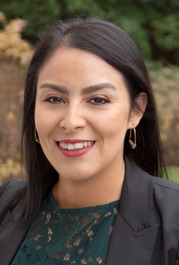
Jessica Ventura
|
 |
Grant opportunity
The Vilcek Foundation raises awareness of immigrant contributions in the United States and fosters appreciation of the arts and sciences.
The foundation invites applications from mission-driven nonprofit organizations that have a specific focus on supporting immigrants in the arts, sciences, education, or through the provision of social services. We invest in organizations that take a creative approach to putting their mission into action and prioritize the development of unique projects and operations that effectively achieve meaningful goals. The ideal grant recipient creates outputs, provides services, or serves populations in an innovative way that sets them apart from other organizations.
The foundation is currently accepting applications for our 2026 Vilcek Foundation Grants. The updated deadline to apply is April 30, 2026.
|
Oregon legislative session
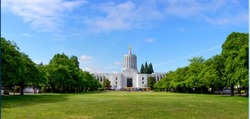
Oregon’s 2026 legislative short session begins on February 2 and will last 35 days. Two bills directly impact OIRA’s work: Statewide Data and Public Safety Protocols (SB 1594) and the Senate Education Bill (SB 1538). OIRA is also tracking legislation related to immigration enforcement (HB 4001, HB 4143), civil rights and protections (SB 1570, HB 4123, HB 4079, HB 4150, HB 4114, HB 4138), and potential budget items, including $5 million for universal program stabilization, $5 million for rapid response and family stabilization, and $3 million to mitigate the loss of SNAP benefits for refugee children.
Community partners and the public can follow these bills and watch testimony through the Oregon Legislative Information System (OLIS)
|
|
Since I began in July, one of my first priorities was to meet partners where they do their work and listen to what has been supporting their efforts and where gaps remain. Our team has traveled more than 2,000 miles and met with over 40 community partners across Oregon. These conversations directly shaped our understanding of community needs and guided the direction of our strategic work.
Over the past several months, OIRA completed a focused strategic planning process. This work moved quickly because communities needed clearer guidance and stronger coordination during a period of rapid federal change. Across partner conversations, interviews, a statewide survey, and internal staff engagement, we heard consistent themes about the need for greater clarity about OIRA’s role, stronger statewide alignment, better communication, attention to rural access, and a deeper integration of community voice.
This process resulted in a finalized mission, core values, and strategic directions, grounded in what partners shared. Completing this work now provides agencies, community groups, and providers with a clear reference point as Oregon prepares for continued federal shifts and a possible Executive Order.
A summary graphic of our mission, core values, and strategic goals is included below. The full report will also be available for those who would like to review the details.
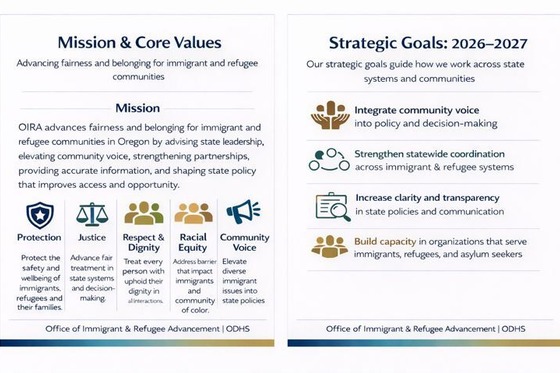
• Sharing the finalized mission, core values, and strategic directions with partners • Aligning implementation with agencies, the Governor’s Office, and legislative partners • Using this framework to support statewide coordination during periods of instability
We also hosted our second open house this month, with more than 80 partners joining us. We shared updates on our strategic planning process and the themes we are tracking for the 2026 short session. These are not endorsements or policy positions. They reflect the patterns we are seeing and are intended to help partners stay oriented in a fast-moving environment.
|
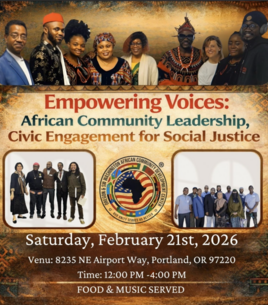
Community and Public Leadership Gathering
Please SAVE THE DATE for an important event. The Oregon Southwest Washington African Community Development Center, with our partners and community leaders are hosting a
Empowering Voices: African Community Leadership, Civic Engagement for Social Justice
Saturday, February 21, 2026
Time: Noon- 4 p.m.
Venue: Sheraton Hotel - 8235 NE Airport Way, Portland
Join us for a special time to come together, with great speakers, good food, and community support. Can you join us? Reply here: Community and Public Leadership Gathering
We will send more information as the date approaches. If you have concerns about attending in person, we understand. Please email us at OSWWACDC@gmail.com. We will share information with you.
|

Free Immigration Legal
Consultations
- Immigration eligibility screenings
- Provide legal opinions and strategy
- Referral to SOAR’s Legal program for eligible cases
Appointment only! Sign up for a 30-minute consultation with an attorney or an accredited representative using the QR code below. Assistance is available in multiple languages.
Location:
Muslim Educational Trust
10330 SW Scholls Ferry Rd. Tigard, OR 97223
Phone: 503-379-0964
Email: KASAKAWA@EMOREGON.ORG
|
Use this QR code for a 30-minute consultation

Meals on Wheels Community Input Survey
The Meals on Wheels People team is seeking input from our diverse community groups and partner agencies to help shape our Eastside Resource Center (our new location on SE 82 street) menu so it reflects the diverse tastes, traditions, and dietary needs of seniors living in the surrounding neighborhoods.
Your valuable feedback will help us:
- Best utilize our dining center to serve seniors in our community surrounding SE 82 street.
- Offer familiar, comforting, nutritious meals.
- Enable all communities to feel valued and welcomed at our dining center.
February Lunar New Year Celebration at Meals on Wheels People
|
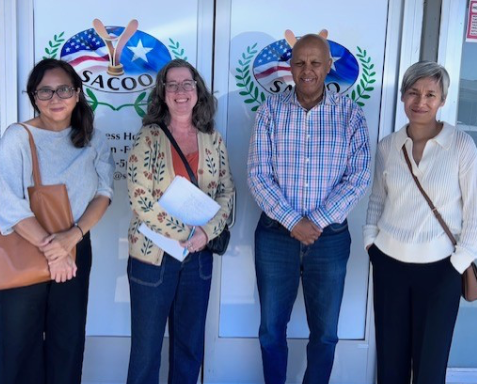
Somali Restaurant as part of Meals on Wheels Diner's Club
After months of anticipation and collaborating in partnership with Somali American Council of Oregon (SACOO)'s president, Musse Olol and the restaurant owner, Sucad Elmi, African Imperial Restaurant became our restaurant partner in our Diner's Club Program.
The Diner's Club Program is a unique initiative aimed at bringing more joy to the dining experience of older adults 60 years old and older where they can visit our partner restaurant and enjoy the meal at no cost.
Learn how to become a Diner's Club member
African Imperial Restaurant is located at
2435 NE Glisan St., Portland, OR 97230
Hours: Monday through Sunday 10 a.m. to 8 p.m.
Menu Highlights: A variety of halal lunch and dinner options
|
|