Hello, Self-Sufficiency Programs champions,
As you prepare for your Q3 Performance Accountability Feedback (PAF) meeting with your manager, take a moment to reflect on how your personal action plan aligns with our shared Vision into Action for Self-Sufficiency Programs (SSP). Your plan highlights the unique contributions you bring to supporting the people we serve. Remember, your PAF meeting is an opportunity for growth and collaboration.
Together with your manager, you'll review the action items you identified earlier this year as developmental goals. This process keeps us moving forward while allowing room for flexibility and adaptation. .
Small steps can lead to big changes. Whether it's a new approach you're trying or a challenge you've overcome, I encourage you to share your experiences with your colleagues. Your insights can inspire and help us all grow. Feel free to send your stories to SSP.VisionIntoAction@odhs.oregon.gov
Thank you for your ongoing dedication and for turning Vision into Action.
With respect and gratitude,
Director, Self-Sufficiency Programs
|
Baby Promise: an exemption to the Employment Related Day Care (ERDC) Waitlist
Effective October 16, 2024, placement in a Baby Promise slot will be an exemption to the ERDC waitlist. Baby Promise is a publicly funded program offering free infant and toddler care. The care is full-time, year-round, high-quality child care and education for families eligible for ERDC, serving children from six weeks to three years old. Baby Promise is available in the City of Reedsport, Coos, Crook, Curry, Deschutes, Jefferson, and Multnomah County. Enrollment is open throughout the year.
To learn more about why Baby Promise is an exemption to the ERDC Waitlist, see the Baby Promise Exemption Talking Points for Staff. The ERDC Waitlist QRG has also been updated to support ODHS staff. These and many other resources are available in the ERDC Waitlist Toolkit located on the ERDC OWL page.
Please join Coffee Chat with Child Care on Tuesday, Oct. 22 at 8:35 a.m. to ask questions and learn more about the Baby Promise referral exemption to the waitlist including information about the referral form and changes in the ONE system.
Please direct families to the ERDC landing page if they need more information. The Department of Learning and CARE (DELC) has updated the following waitlist resources to share with families:
ERDC Waitlist One Pager
English | Spanish | Russian | Chinese | Vietnamese
ERDC Family Resource Guide
English | Spanish | Russian | Chinese | Vietnamese
 This feature showcases how staff are taking a new approach to their work based on the Vision Into Action. Visit the OWL for more information on the Vision Into Action.
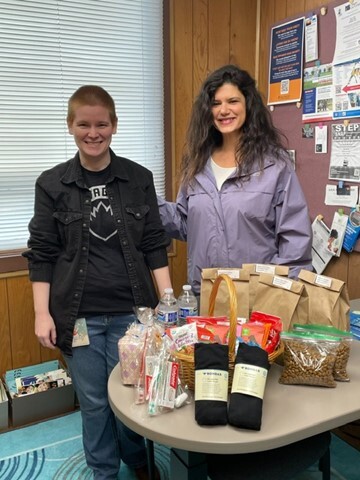
Kristen Benton and Krystyna Miller-Ahles: Benefit & Eligibility Workers D1
What we do for SSP?
As Benefit & Eligibility Workers, we support individuals and families by determining their eligibility for benefits, connecting them with other state programs, referring them to resources available within our coastal community, and doing everything we can to help lift them up.
One way we contribute to the Vision into Action:
On a daily basis we engage with people in Oregon who are struggling to meet their basic needs. Recognizing that coming into our office for assistance can be a very frightening and overwhelming experience, we do our best to make them feel comfortable. Before jumping into the intake, we like to start by asking how their day is going and offering a healthy snack and bottled water from a basket we keep in the interview cubicle. We then listen with empathy, focus on their needs, make suggestions, and give them options. When we are done with the eligibility determination, we offer toothbrushes, toothpaste, dental floss, and feminine products. This upcoming winter, we will also be able to provide blankets.
Recently, Taylor Miner who’s a Human Services Specialist 1 in our office connected us with her brother, a local high school senior whose senior project is providing ready-made meals and dog food to the public. In collaboration with Taylor and her brother, we can now also offer these items to those in need.
How this work makes a difference for the people we serve:
Oftentimes the Oregonians coming into our office feel lost and alone. By creating a welcoming environment and showing some tender loving care, we foster trust and a safe space where people feel loved and cared for. Hearing comments such as, “enjoyed today so much”, “feeling the love”, and seeing their smiling faces is heartwarming.
Vision into Action goal(s) we supported:
We have actively supported the Vision into Action goal of responding to the needs of individuals and families in our community. By meeting some of their basic needs, providing them with resources, connecting them with programs, and letting them know they are not alone, we are doing our part to help lift them out of poverty in a loving and compassionate way.
|
You can share examples of how you are changing the approach to your work. If you have already made a change in alignment with Vision Into Action, we invite you to share your story.
We are excited to collaborate this year in celebrating and honoring survivors, raising awareness about domestic violence (DV) prevention and intervention efforts, and highlighting safety supports available for survivors and families.
Prevalence rates tell us that we all know or come in contact with survivors of DV. Survivors are our family, friends, coworkers, clients, peers, and community members.
-
1 in 4 women and 1 in 10 men have experienced contact sexual violence, physical violence, and/or stalking by an intimate partner during their lifetime.
-
54% of transgender individuals experienced some form of intimate partner violence (IPV).
- Black women experience IPV at a rate 35% higher than white women and 2.5 times higher than women of other races.
-
1 in 3 Latinas experience IPV in their lifetime.
-
More than 4 in 5 American Indian and Alaska Native (AI/AN) women (84.3 percent) have experienced IPV in their lifetime.
-
1 in 5 of Asian or Pacific Islander women reported experiencing rape, physical violence, and/or stalking by an intimate partner in their lifetime. Visit OPDV for more information.
One of way everyone can support survivors is to ensure we show up for survivors with belief and understanding.
-
Believe and Acknowledge: Sharing stories of abuse is an incredibly difficult thing to do. Realize that when someone is choosing to disclose this information to you, it is an act of trust. Treat their stories with respect and believe them.
-
Reminds Survivors it is Not Their Fault: When recounting these experiences, it is normal for some survivors to blame themselves because of our society’s victim-blaming norms. Continue to listen but be sure to reassure them that it is not their fault.
-
Avoid Accusatory Language: Instead of asking questions about the details that surrounded the abuse, offer compassion and understanding without providing your interpretation of the event.
-
Understand the Abusive Person is Fully Responsible: Just as the abusive person is the only one who can choose to be abusive, they are also the only person who could have stopped it. If you find yourself considering other avenues that the survivor could have taken to prevent the abuse, remind yourself that the only thing that would have changed the outcome is the perpetrator’s decision to commit it. Visit onelove for more information.
For more knowledge building materials, check out the Domestic Violence Awareness Month Owl Page which includes a calendar of events and activities. Each week is dedicated to elevating a different topic or national campaign to help gain knowledge and raise awareness.
Purple up all month long using the DVAM virtual meeting background.
|