House Bill 2420 Update
House Bill 2420 (2023): HB 2420 created a work group composed of county vital records offices, funeral directors, other partners and community members to propose options for equitable access to birth and death certificates throughout the state and equitable fee revenue to maintain and improve the state and county vital records system. The proposal will be delivered to an interim committee of the Legislative Assembly no later than January 1, 2025.
The work group continues to meet throughout the year. So far work has focused on building a shared knowledge base of the current vital records system and holding panel discussions to better understand various perspectives.
|
For questions about HB2420, please contact CHS.PartnerServices@oha.oregon.gov.
Why Do Vital Records Offices Need to be Aware of the Potential for Fraud?
Birth certificates are widely recognized as legal proof of a person’s age, place of birth and identify. This makes them an attractive target of identity fraud. A criminal choosing the name of a deceased person (from news, obituaries or even grave markers) and ordering a birth certificate in that name is a well-known first step in the fraud process. The fraudulently obtained birth certificate can be used to acquire a state-issued ID and generate financial accounts under a false identity.
One of the primary fraud prevention activities that is done at the state and across the nation is to flag birth records when that person dies. This is done automatically in OVERS if the person is born and died in Oregon and when we get death records from other states for people born in Oregon. When this happens, the deceased person’s birth record is flagged and marked with the word DECEASED when it is issued as a certified copy.
So, what happens if a person orders their own birth certificate and their birth record is flagged indicating the person is dead?
This is what we do at the state in these situations:
- The order is flagged so the record is not released until the potential fraud process is completed.
- The State Registrar is notified of potentially fraudulent activity.
- The customer is contacted to get more information to see if there is an error in the order or if there may be an error in the matching of the death record to the birth.
To confirm a customer's identity, we may have them verify the following while on the phone:
Their full name, mailing address, and phone number,
The type of record being ordered and the person named on the record (the registrant), and
The reason for ordering the record.
We may also ask them to provide the following:
A copy of their current and valid picture ID on a notarized statement of identity and
A clear picture of the customer holding their picture ID next to their face so we can confirm they appear to be the same person.
In most cases, the issue is resolved at this step. If necessary, the following steps may also be taken:
- Local law enforcement is contacted to file a report.
- The FBI is notified.
- The Social Security Administration is notified.
A recent situation at the state ended up being much more complicated. A customer ordered their own birth certificate. Their birth certificate had recently been flagged as deceased and the death had occurred about a month before. This triggered our fraud prevention process.
Local law enforcement generally do not have many options except to create a report, but this time was different. While we waited for the federal response, the customer called our office again to inquire about the status of their order. The information they provided allowed a local police officer to find and personally interview the customer. The investigation resulted in confirming that the person who ordered their birth certificate was alive. The person registered as deceased in their name had the customer’s ID card on their body at the time of death.
The correct death record was filed. The decease flag on the customer’s birth record was removed and we were able to provide them with a certified copy.
Although this was a time-consuming process, it was ultimately a fortunate outcome for the customer.
Properly evaluating potential fraud often takes a great deal of investigation and personal interviews. We are here to protect the identities of our customers and due diligence is important.
If you would like to learn more about the process of identity theft prevention, the Federal Trade Commission’s web site on the subject is a good resource.
For questions about the Center for Health Statistics’ identity verification or fraud prevention process, please contact david.w.tyner2@oha.oregon.gov.
Farewell, Kristen Farrell
Congratulations to Kristen Farrell on beginning a new position with the Division of Child Support with the Oregon Department of Justice.
Kristen shared the following farewell message:
During my time here, I have had the privilege of working with dedicated individuals who are committed to serving Oregonians, both here and abroad, by providing exceptional service and assistance to achieve their desired outcomes easily and effectively. I want to express my sincere appreciation for all your support and willingness to collaborate with me. The Amendment Team at Vital Records is an amazing department with amazing people and CHS has been a fantastic group to work with over these many years. I will definitely miss you all but look forward to working with you again in a slightly different way.
If you were working directly with Kristen and need assistance, please email the Amendment unit at CHS.Amendments@oha.oregon.gov or call 971-673-1147. Another staff member will help you as soon as they are able.
We thank Kristen for her many years of dedication to CHS, our partners, and to all Oregonians. Her contagious smile and laugh along will her second-to-none customer service will be greatly missed. We wish her all the best in this next chapter of her career.
Birth Facility Performance Report
The Center for Health Statistics emails the Birth Facility Performance Report to BIS managers at the end of every month. The report is for the prior month and is an important overview of how your facility is doing when it comes to entering and registering birth records.
The report has selected measures set by Oregon law and those established by the National Center for Health Statistics (NCHS). Included in each report will be the Oregon requirements and the requirements of NCHS.
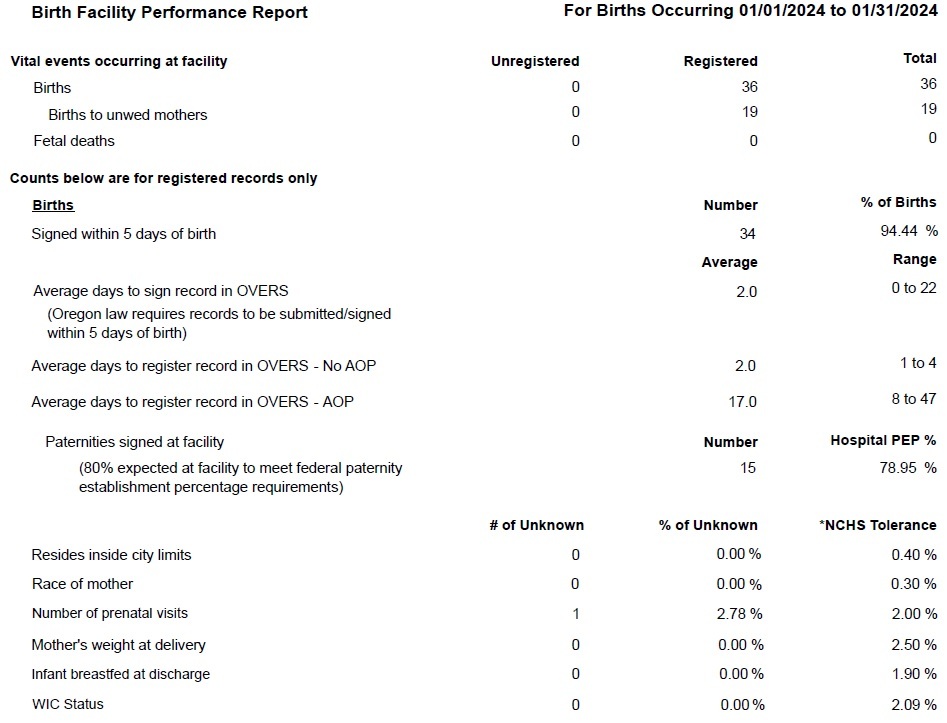 An example of a performance measure contained in the report is the average number of days between the date of birth and the date a record is certified in OVERS. Oregon law requires that records be submitted (signed) within five days of birth.
Another performance measure is for paternities signed at the facility. The goal for each facility is to have a hospital paternity establishment percentage (PEP) of 80 percent or more. Meeting that goal ensures that federal funds for programs that serve families and children can continue like Temporary Assistance to Needy Families (TANF).
In addition to state requirements, the report includes national standards. NCHS has tolerance levels for “unknown” values on several key measures. This report will identify which, if any, of these areas need improvement at your facility. The national standards are for:
- Resides inside city limits
- Race of mother
- Number of prenatal visits
- Mother’s weight at delivery
- Infant breastfed at discharge
- WIC status
These areas are important targets for data collection because they allow NCHS to guide program and policy decisions to improve our nation’s health. Click here for more information on the National Center for Health Statistics and how the critical data that you provide is used.
We encourage you to review this report with all members of your staff to understand how you are doing as a facility. This will allow you to determine if there are items that could be improved upon or to celebrate meeting the required goals.
Thank you for all your help in entering birth records!
If you have any questions about the Birth Facility Performance Report, contact CHS.PartnerSevices@oha.oregon.gov.
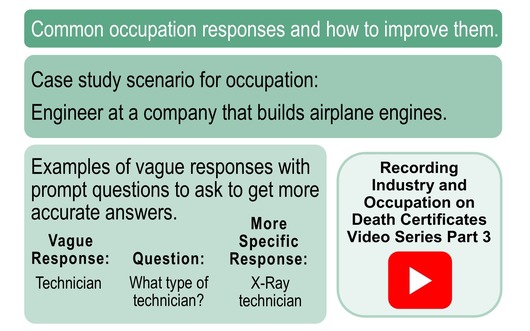
Video Series for Funeral Directors: Common Occupation Responses and How to Improve Them
Part 3 of the video series produced by The National Occupational Mortality Surveillance (NOMS), a subset of the Center for Disease Control and Prevention (CDC), provides concrete examples of responses you may receive for a decedent’s occupation and tips about what questions you can ask to make those responses more accurate.
The third video (Part 3: Common Occupation Responses and How to Improve Them) will cover the following points:
You may access the entire series at the NOMS web page and bookmark it as a resource for future use.
If you need additional assistance with completing the occupation and industry information for the death record, contact the Registration Unit at CHS.Registration@oha.oregon.gov.
Updated Instructional Memo
Oregon has a statewide vital statistics system. This means the state registrar is responsible for the system, including forms and procedures. The state registrar works cooperatively with county vital records offices to provide secure, consistent service across the state. To support this goal, Oregon law requires county registrars and deputy registrars to comply with all instructions of the state registrar. (ORS 432.035)
While the great majority of vital records requirements are found in statute (Chapter 432 – Vital Statistics) and administrative rule (Chapter 333, Division 11), procedures are also needed (supported by law or rule). These procedures are shared through Instructional Memos (IM).
In the past, there were two Instructional Memos. IM 2016-06 addressed compliance issues that were part of County Vital Records Triennial Reviews but that did not have specific citations in statute or rule. IM 2017-10 clarified the roles and responsibilities of County and Deputy Registrars.
We have recently issued a new Instructional Memo, IM 2024-03, which is available in the County Triennial Review section on our website. This memo replaces Instructional Memos 2016-07 and 2017-10. It combines information from the previous memos and has updated guidance based on revisions that were made to the Triennial Review Tool in late 2022. It provides specific written instructions on procedures necessary for a vital records system that maintains the confidentiality and security of records consistently throughout Oregon.
Please share the updated memo with your Vital Records staff and keep it with other compliance documents.
For questions about the Instructional Memos, please contact CHS.PartnerServices@oha.oregon.gov.
Joint Exercise with Lincoln County for Continuity of Operations
On April 26, the Center for Health Statistics will conduct a comprehensive Continuity of Operations Plan (COOP) exercise in collaboration with Lincoln County Vital Records. The COOP ensures our essential functions and services are accomplished during unforeseen circumstances like an earthquake, wildfire or extended closure due to extreme weather. This will be our third exercise and we are excited to partner with Lincoln County to test our emergency communications protocols.
During the exercise, we will simulate various scenarios including relocating to a new worksite and establishing an Incident Management Team. This tests our ability to adapt to new environments, reposition staff and supplies, and resume all aspects of standard operations. We will remain open at our Portland office throughout the exercise, and you can expect our usual level of service.
Thank you, Lincoln County, for partnering with us for our April exercise! In future exercises, we may reach out to additional community partners to test the COOP.
We hope counties are making progress on their own Continuity of Operations Plans. We are happy to share any lessons we learn from our practice exercises.
For questions about Continuity of Operations Plans, please contact CHS.PartnerServices@oha.oregon.gov.
The County Work Group
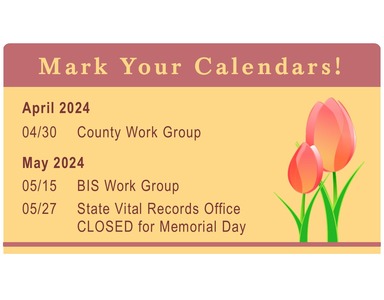
The County Work Group is an optional meeting for county vital records staff to learn about current vital records topics, ask questions and share ideas with each other.
County Work Group
April 30, 2:00 - 3:00 p.m. Pacific Time
Register here!
|
|
 |
|