|
A recent analysis of nearly 2 million people found that one in four adults age 65 and older who had COVID-19 experiences at least one of 26 health complications that may be a result of the infection. One in four COVID-19 survivors ages 18-64 is also at risk of longer-term health complications. Additionally, people who had COVID-19 have twice the risk of developing a respiratory condition or blood clots that travel to the lungs. These types of lingering health complications linked to a COVID-19 infection are commonly referred to as Long COVID.
These data highlight the importance of being up to date on vaccinations and boosters and taking steps to prevent COVID-19 infection. However, Omicron is highly contagious and even people taking precautions can get infected. If you have had COVID-19 it is important to continue to monitor changes in your health and to seek routine care.


The availability of pediatric vaccines for kids under age 5 is growing in Oregon. Check out our blog for an updated list of events and clinics that offer these new vaccines. The July 4th holiday will not affect the operating hours for vaccination clinics listed on our blog, but check our testing site blog as the holiday may affect testing site hours.
Additionally, in this Tuesday’s newsletter we announced the availability of Moderna’s COVID-19 vaccine for 6- to 17-year-olds. There are two different vaccines for this age group: one for ages 6-11, and one for ages 12-17. The Moderna vaccine supply in Oregon for the 6-11 age group will not arrive until next week. The Moderna vaccine supply for the 12-17 age group is here in Oregon and widely available.
|

 |
Hot weather has arrived, and with it, outdoor fun. But the summer months also bring unique hazards, and Oregon Health Authority (OHA) has tips on staying safe and healthy as you head out for family gatherings, camping trips and other outdoor activities over the Fourth of July holiday weekend.
“Here in Oregon, summer doesn’t really kick off until Independence Day, when we finally start seeing those regular stretches of sunny weather,” said Dean Sidelinger, MD, MSEd, health officer and state epidemiologist at OHA. “But with those long, hot days comes health hazards people should be aware of and take steps to protect themselves.”
Summer safety tips:
- Apply sunscreen (at least SPF 15) when spending time in the sun.
- Apply a chemical insect repellent (containing DEET) to avoid mosquito and tick bites, which can spread diseases such as West Nile Virus and Lyme disease.
- Use cool compresses and take cold showers and baths to keep yourself cool during the hottest hours of the day (between 10 a.m. and 4 p.m.).
- Avoid brown or foamy water, which could be a sign of a harmful algae bloom.
- Some animals, such as bats, can carry rabies. Do not approach or feed any wildlife, and call your local Oregon Department of Fish and Wildlife office if you encounter a sick animal.
- Stay indoors if the area becomes smoky due to wildfires.
- Never swim alone, and avoid swimming in bad weather.
See OHA’s full press release for more guidance on how to enjoy the summer months safely.
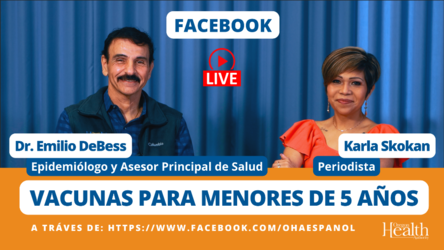
Earlier this week, Dr. Emilio DeBess, epidemiologist and senior health advisor for Oregon Health Authority (OHA), joined Karla Skokan, OHA en Español, to discuss the latest news regarding COVID-19 vaccines for children under age 5. The live Spanish-language Facebook forum included answering questions from the public about the new pediatric vaccines.
The COVID-19 Biweekly Data Report, released yesterday, June 29, shows a decrease in COVID-19-related cases, hospitalizations and deaths since the previous biweekly period.
Oregon Health Authority (OHA) reported 20,451 new cases of COVID-19 from June 12 to June 25, a 2.8% decrease over the previous biweekly total of 21,038. Over the last six weeks, reported hospitalizations and deaths have increased slightly.
During the two-week period of June 12 to June 25, test positivity was 13.6%, up from 12.3% in the previous two-week period.
The COVID-19 Biweekly Outbreak Report was also published yesterday, and there are changes to OHA’s data dashboard content and reporting frequency.
Dr. Paul Cieslak, medical director for communicable diseases and immunizations at Oregon Health Authority, answered today’s questions. We’ll continue to answer your questions on COVID-19 topics in upcoming newsletters.
Q: Are unvaccinated people with COVID-19 more contagious than vaccinated people with COVID-19? (Assuming neither person knew at the time of exposure that they had COVID-19 and I had the same level of contact with each.) – Lori, Portland
A: “Since Omicron hit, one study found that the amount of virus shed by vaccinated and boosted people (who get infected despite it) is lower than that shed by unvaccinated people. Therefore, people with COVID-19 who are fully vaccinated and boosted might be somewhat less contagious. People who were vaccinated but not boosted, however, shed virus in amounts similar to unvaccinated people. Immunity does wane after boosting, so this effect might be short-lived. The bottom line is that we can’t know in any individual case who is contagious and who isn’t, but a good rule of thumb is consider anyone with COVID-19 to be contagious for 10 days after their symptoms begin.”
Q: I recently talked to a medical staff person in the ER department of a hospital. He said he has worked throughout COVID-19 but has never been tested for the virus and because he has never shown symptoms, there was no need for him to be tested. However, in his work he is at high risk for exposure, and infected asymptomatic people can still pass on the virus. I am very concerned. Is this an acceptable hospital policy? – Sandra, Milwaukie
A: “Oregon rules require health care workers to be vaccinated, although they may obtain a medical or religious exception to the requirement. Health care workers are still required to mask. Testing for COVID-19 is not recommended in the absence of symptoms, even among health care workers, unless one has been recently exposed.”
Q: Is lap swimming outdoors safe? – Jeffrey, Bend
A: “Lap swimming outdoors is unlikely to put one at risk of catching COVID-19. In general, outdoor exposures are much less concerning, given the unrestricted air flow; and any virus that gets into a swimming pool or other body of water would be significantly diluted.”
If you have questions about topics related to COVID-19, submit your question here. While we are unable to answer every question, we try to address questions of interest to a broader audience. Please understand we are unable to provide specific medical advice for personal medical conditions.






Did someone forward this to you? You can subscribe here.
|