|
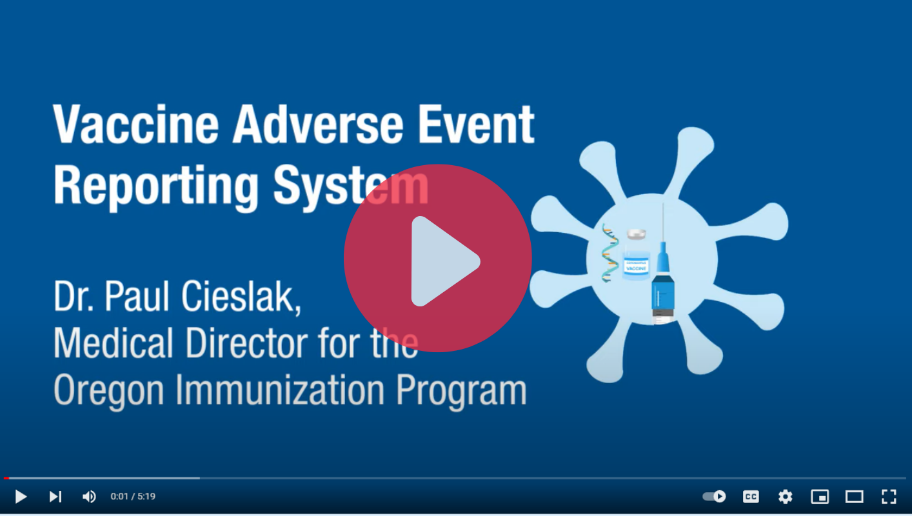
The Vaccine Adverse Events Reporting System (VAERS) is an early warning system that allows health care providers, vaccine manufacturers and the general public to report health concerns (adverse events) after vaccination. Established in 1990, VAERS can monitor for increases in known vaccination side effects, such as a sore arm or shortness of breath. It also helps scientists detect patterns and identify rare adverse events after vaccination. With the COVID-19 vaccinations, for example, VAERS has helped identify adverse events such as severe allergic reactions or myocarditis.
A report to VAERS does not mean a vaccine caused the adverse event. Scientists must investigate patterns in VAERS to determine if an adverse event is caused by vaccination.
Read on to learn more about how VAERS works and is used by scientists.

One Community Health (OCH), with locations in The Dalles and Hood River, is now participating in the federal COVID-19 Test to Treat (T2T) program. The T2T program allows someone who tests positive for COVID-19 to be assessed by a health care professional and receive a prescription for oral antiviral medication in one location. It’s important to start taking the medication within five days of symptom onset.
At this time, the two OCH sites are open only to current OCH patients and individuals from underserved communities. In the coming months, OCH plans to expand its T2T access to the entire Columbia Gorge community.
The OCH sites are located in:
-
The Dalles - 1040 Webber Street
-
Hood River - 849 Pacific Avenue
Oregon now has 13 T2T sites, which you can find by using the online T2T locator tool. Appointments are required.
For more information about COVID-19 treatments, go to our website or click on “Information about COVID-19 treatments” near the bottom of this newsletter.
COVID-19 booster doses have been recommended for every adult since last fall.
A second COVID-19 booster dose has been available to everyone age 50 and up, and anyone age 12 and up with compromised immune systems, since late March. On May 19, the Centers for Disease Control and Prevention strengthened its advice to say a second booster dose is recommended for these groups.
If you got your first and/or second booster, do you mind telling us why?
Is it because you plan to travel? Or want to play on a sports team? Or gather in person for your book club? Maybe you’re at high-risk for COVID-19 complications or live or work with someone who is? Maybe you work in a crowded indoor space?
If you have a moment, we’d love to understand your reasoning. We’ll publish some responses in upcoming newsletters. Thank you.
Oregon Health Authority (OHA) published its monthly COVID-19 Breakthrough Report today.
OHA reported 44,363 cases of infection during the month of May. Of those cases, 21,100, or 47.6%, were unvaccinated people, and 23,246, or 52.4%, were vaccine breakthrough cases. Among the breakthrough cases, 14,506, or 62.4%, were fully vaccinated and boosted.
To date, there have been 233,873 COVID-19 vaccine breakthrough cases in Oregon. Of those cases, 69,105, or 29.5%, were fully vaccinated and boosted at the time of infection.
 Dr. Melissa Sutton, medical director of respiratory viral pathogens at Oregon Health Authority, answered today’s questions. We’ll continue to answer your questions on COVID-19 topics in upcoming newsletters.
Q: What are “viral” COVID tests that are required by the CDC to return to the United States? Are at-home tests viral tests? – Janice, Bend
A: “Viral COVID-19 tests required by the Centers for Disease Control (CDC) to return to the United States include antigen and molecular (e.g., PCR) tests. At-home self tests that have been authorized for emergency use by the U.S. Food and Drug Administration may be used if the testing procedure includes a telehealth visit in which a provider confirms your identity, observes the testing procedure, confirms the test result and issues a report.”
Q: Is the government still offering free COVID home tests? I see USPS offering them online, but is that legit? – Sylvia, Salem
A: “Yes. The free at-home COVID-19 tests you found offered on the Unites States Post Office (USPS) website are legitimate. The federal government started offering free at-home tests in January 2022 and has slowly increased the number of tests each residential address in the U.S. may order. Currently, each residential address can order a total of 16 tests, which arrive by regular mail. The database will keep track of how many tests your household may have already ordered. When you go to this government website, and click on “Order Free At-Home Tests,” you will be taken the USPS website, which is absolutely legitimate.”
Q: When I got COVID about a month ago (a few weeks after receiving my second booster), I was feeling ill for well over a week but tested negative twice. Finally I tested positive. If someone is feeling sick for that long, why doesn’t the at-home test pick it up until later… when it’s already too late to take advantage of the antiviral medication, for example? Are the new subvariants evading the tests? – Anonymous, Portland
A: “That is a great question! The at-home tests appear to detect COVID-19 variants and subvariants with similar accuracy. We believe different people shed the virus in different parts of the body at different times during their infection. So, it’s probably not that the test isn’t picking up the virus in the nose, but that the virus isn’t yet in the nose to be detected. This is not uncommon, and it’s why we encourage people to wear a mask and stay home if they are sick to help protect others.”
If you have a questions about topics related to COVID-19, submit your question here. While we are unable to answer every question, we try to address questions that may be of interest to a broader audience. Please understand we are unable to provide specific medical advice for personal medical conditions.

 Did someone forward this to you? You can subscribe here.
|