Tricia Pemberton Assistant Director of Communications 405-521-3371, 405-431-7195-cell tricia.pemberton@sde.ok.gov
NAEP Scores Show
Oklahoma Students up in Three Areas, Still Behind Nation
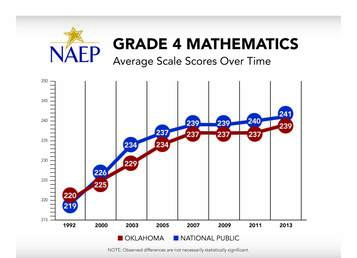
Oklahoma math and reading scores in the 2013 National Assessment of Educational Progress (NAEP) are a mixed bag. While the fourth-grade math scores are the highest in 10 years — and 19 points up from 1992 — state education officials note that other results point to the need for stronger academic rigor that is beginning to take shape.
Oklahoma fourth-graders taking the national assessment earned an average score of 239, up from 229 in 2003 and 220 in 1992. That still placed the state behind this year’s national average of 241.
The NAEP results were released earlier today.
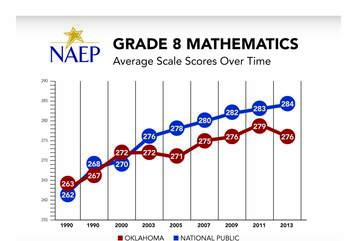
Eighth-grade math scores also were higher than they were a decade ago — 276 in 2013 as opposed to 272 in 2003. That’s an improvement over the 262 average score earned in 1992, but lower than the 279 earned two years ago and lower than this year’s national average of 284.
In
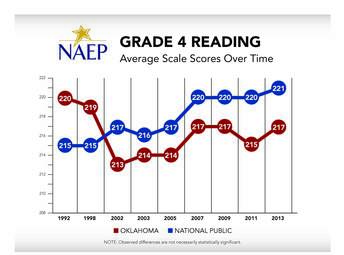
reading, Oklahoma fourth-graders posted an average of 217, up from 214 in 2003
and 215 in 2011. Despite the jump, it remains below the national average of 221
and below the state average score of 220 earned in 1992. From 1992 to 2002,
fourth-grade reading scores plummeted to 213 but have been on an upward trend since
the mid-2000s.
Oklahoma’s
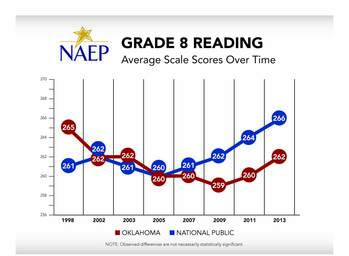
eighth-grade reading score average was 262, better than 260 in 2011 but
unchanged from 2003 and down from 265 in 1992.
The
national average for eighth-grade reading this year is 266. Oklahoma’s reading
scores in this grade have been climbing since a low of 259 in 2009.
“The
fact that our scores are on the upswing in three areas is exciting,” said State
Superintendent Janet Barresi. “Overall, however, the NAEP report confirms what
we’ve long known. Oklahoma students lag behind their national counterparts in
these key subject areas. This is why we must build on the momentum of the
education reforms we’ve enacted in recent years.”
Barresi
said reforms such as the end to social
promotion for third-graders reading significantly below grade level, Teacher and Leader
Effectiveness and the implementation of rigorous Oklahoma Academic Standards
will have a significant and positive impact.
“Oklahoma
students can be at the top of math and reading scores, but it will take all of
us engaging and working together to prepare them for college, career and
citizenship,” she said.
Barresi
said the NAEP results indicate that additional focus is needed on middle
school. She said she will gather a task force to examine math scores from sixth
grade and higher.
“This
will help us knock down college and workforce training remediation rates,” Barresi
said.
The
NAEP scores also show the wisdom of increasing the rigor of Oklahoma Academic
Standards and the Oklahoma College and Career Ready Assessments, both of which
will be implemented in schools by the start of the 2014-2015 school year.
“For
the first time, we will see state scores that better reflect how are students
are actually performing,” Barresi said. “While it might seem painful at this
moment, a clear-eyed look at where we are realistically will help us achieve
true and meaningful change to best equip our students for the future.”
NAEP
reveals that the percentage of Oklahoma students scoring at or above
proficiency is 36 percent in fourth-grade math and 25 percent in eighth-grade
math.
The
national percentage at or above math proficiency is 41 percent for fourth grade
and 34 percent for eighth grade.
In
reading, the percentage of Oklahoma students scoring at or above proficient is 30
percent in fourth grade and 29 percent in eighth-grade. The national percentage
at or above proficiency is 34 percent for both fourth and eighth grade.
Compared
to the nation, Oklahoma is:
below 30 states, not
significantly different from 14 states and above seven states in fourth-grade
reading;
below 35 states, not significantly
different from 10 states and above six states in eight-grade reading;
below 31 states, not significantly
different from 12 states, and above eight states in fourth-grade math; and
below 42 states, not significantly
different from five states and above four states in eighth-grade math.
In
comparison to regional states, only New Mexico had a lower average score than
Oklahoma on all assessments. Texas, Arkansas and Kansas had higher average
scores in each assessment in both fourth- and eighth-grades.
In 2011, Oklahoma was the only state in the U.S. to show a low inclusion rate for special education students and
English Language Learners. In fourth-grade math, for example, only 49 percent
of Oklahoma special education students had been tested as compared to 84
percent nationally.
In the wake of that
revelation, Barresi implored districts to look closely at testing children with
special needs to assure each child’s needs were being met.
Oklahoma increased its
inclusion rate this year more than any other state in the nation: 98 percent in
fourth-grade reading, 99 percent in eighth-grade reading and 98 percent in
fourth- and eighth-grade math. All are well above NAEP parameters.
Federal law requires that
states and districts, receiving Title I funding, participate in the NAEP
reading and mathematics assessments every two years. A sample of students
representing the entire student population —about 3,000 students per grade and
per subject — are tested.
State scores are reported for
students in grades four and eight. Scores for students in grade 12 are reported
only as part of the national picture. Samples for long-term trend are based on
age (9, 13 and 17) rather than grade.
Other NAEP testing is optional and
can be used for comparing our state to regions with similar demographics, others
states and the nation.
NAEP is designed to measure
what students across the nation know and can do in 10 subject areas, including
mathematics, reading, writing, and science. The results of these tests are
reported in the Nation's Report Card.