|
Contents:
Spotlight on Forgan Public Schools: Big Literacy Wins in a Small Oklahoma District
Nestled in the Oklahoma Panhandle, Forgan Public Schools proves that size doesn’t limit success—especially when a community rallies around literacy. Though small in number and resources, this dedicated team of educators has embraced innovation, collaboration, and a relentless commitment to student growth.
Over the past year, Forgan educators have made remarkable strides in implementing the Science of Reading and evidence-based instructional practices. Many teachers have completed LETRS training and actively participate in Oklahoma’s Literacy Communities of Practice professional learning. Their efforts have transformed classroom instruction and created a shared language of literacy across grade levels.
Tatum Radcliff, principal of Forgan Public Schools, reflected on the school’s journey, saying:
“When our HERO walked through our front door last fall, it was exactly what we were in desperate need of. We knew we had to amp up our reading programs and find a better way to provide intervention to the students in our school who were so desperately needing it. Our teachers immediately got to work. We had several begin and finish LETRS training, attend conferences and professional development, and a librarian aide who spearheaded the first-ever reading challenge with the help and guidance of our HERO. Oftentimes in rural schools, we are the last to receive any kind of assistance, and we often have to go looking for it ourselves. This is the first time we have had that help show up at our front door.”
|
That spirit of initiative and teamwork shines across the district. One of the year’s biggest highlights was the school-wide reading challenge, where students set an ambitious goal to collectively read 1,000 books. The entire staff—teachers, paraprofessionals, and administrators—joined in the fun. When students met their goal, they earned a sight few will forget: the principal duct-taped to the gym wall in celebration!
Behind the laughter and spirit lies a culture of intentional collaboration. Forgan teachers meet regularly in Professional Learning Communities (PLCs) to analyze data, adjust instruction, and design targeted support for every learner. Everyone has a role to play, and everyone steps up to ensure success.
Forgan Public Schools exemplifies what’s possible when a school embraces teamwork, data-driven decision making, and the belief that every student can grow. As their story shows, when determination meets evidence-based practice, even the smallest schools can make the biggest impact.
|
Reading Universe is a free, research-based online platform designed to support teachers, reading coaches, and paraprofessionals in delivering effective, evidence-based literacy instruction. At its heart it is an interactive “Reading Universe Taxonomy” that breaks down the essential components of reading (e.g. phonological awareness, phonics, fluency, vocabulary, comprehension) into step-by-step lessons, showing how each skill builds on the others.
The site offers classroom videos of real teachers, printable lessons and activities, decodable texts, and concrete strategies for differentiating instruction. Because it is grounded in the “science of reading,” provides explicit instructional guidance, and packages resources in a teacher-friendly, scaffolded format, Reading Universe is a powerful tool for elementary teachers to deepen their knowledge, refine their literacy instruction, and help more students become confident, competent readers. Check this resource out at Readinguniverse.org.
Activating prior relevant knowledge is a cornerstone of comprehension, and both the Science of Reading and the Science of Learning affirm its importance in helping students connect new information to existing mental frameworks. For PreK–5 classrooms, this means intentionally surfacing what students already know — even if that knowledge is partial, experiential, or non-academic — and using it as a bridge to new content. Teachers can use strategies like concept maps, Collect-Correct-Connect charts (similar to K-W-L charts), picture walks, and “turn and talk” routines to elicit background knowledge before reading. For younger learners, tapping into lived experiences such as, “Have you ever planted something?” before a gardening text or using familiar routines such as “What do we do when we get ready for school?” before a procedural text, helps anchor abstract ideas in concrete understanding.
To maximize impact, teachers should pair activation with visual supports, oral language scaffolds, and explicit vocabulary instruction. For example, before reading a historical fiction text aligned to Oklahoma 5th grade ELA standards, a teacher might show a relevant map, introduce key terms such as exploration, conflict, or adaptation, and ask students to imagine what it would feel like to experience life in a different time period. In PreK–2, teachers can use puppets, role play, or realia to activate schema around topics like friendship, weather, or community helpers. The key is to make activation purposeful and connected — not just a warm-up, but a strategic move that prepares students to engage deeply with text. When done well, it builds equity, boosts engagement, and sets the stage for meaningful learning.

Meet Literacy Coordinator, Lindsay Sizemore!
Lindsay Sizemore has been a dedicated HERO since the program’s inception, bringing 19 years of experience in elementary and middle school education and leadership. She holds a Master’s degree as a Reading Specialist and is currently completing her doctorate. Lindsay is passionate about supporting school leaders and teachers, helping them create meaningful learning experiences grounded in the Science of Reading. Her goal is to maximize student success by empowering educators with the knowledge and skills to teach every learner effectively.
When she’s not traveling around the state in her role, Lindsay enjoys watching her middle schooler play football, cheering on her husband’s team, painting with her sons, and spending quality time with her family.
|
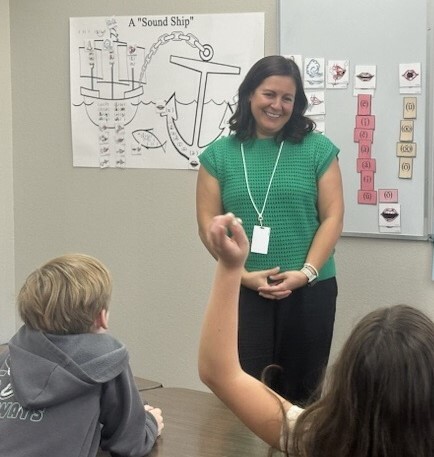
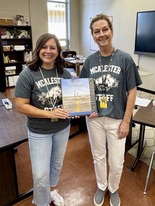
McAlester Public Schools is setting a high standard in Oklahoma by creating a dyslexia-friendly environment to help all struggling readers thrive. They are implementing multisensory structured literacy and making three key administrative changes to support both educators and students. McAlester Public Schools is committed to developing talent from within, leveraging experts to expand services, and seeking highly qualified educators to build sustainable systems that ensure all children read proficiently.
Molly Brenner, a Reading Specialist at McAlester Public Schools, is completing her final year of the Structured Multisensory Language Foundations program at the Payne Education Center in Oklahoma City. She is dedicated to closing the gaps for struggling readers and ensuring they have the necessary tools to succeed. Through her studies at the Payne Education Center, she will complete over 200 hours of course instruction and provide more than 700 hours of therapy to students in her community. Upon completion, she will qualify to become a Certified Academic Language Therapist (CALT) through the Academic Language Therapy Association (ALTA) in the spring.
|
|
|