October 2025
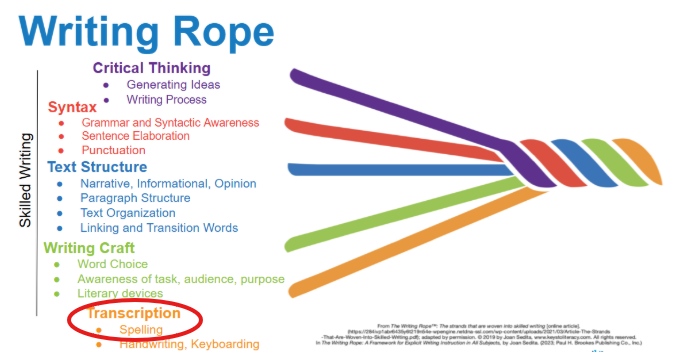 Last month (September 2025), the newsletter focused on the transcription skill of spelling. This month, the focus shifts to another vital transcription skill, handwriting. Strong handwriting serves as a foundation for writing fluency and lessens the cognitive load of skilled writing.
Handwriting: A Foundational Skill for Writing Success
Decades of research demonstrates that directly teaching handwriting in the primary grades enhances both legibility and fluency (Graham, 2009–2010). In dozens of studies, researchers have found that, when taught effectively, early handwriting instruction improves not only legibility but also the quantity and quality of students’ writing.
Fluent transcription frees up cognitive resources for idea generation (Berninger & Wolf, 2009). Both legible handwriting and fluent handwriting benefit composition in the early grades, as the motor skills necessary for letter formation are considerable (Graham & Weintraub, 1996).
Cognitive and Academic Benefits
- Enhances memory and comprehension
- Supports reading and spelling development
- Increases writing fluency and idea generation
Motivation and Confidence
- Reduces frustration and increases engagement
- Builds foundational skills for long-term writing success
Key Components of Effective Handwriting Instruction
- Letter formation and spacing
- Pencil grip and posture
- Direct and explicit instruction, including:
- modeling letter formation
- leading guided practice
- checking for independent performance
- Speed and legibility practice integrated into daily lessons
Best Practices for Instruction
- Provide 10–15 minutes of daily practice.
- Combine handwriting practice with reading and spelling activities.
- Encourage note-taking and written expression to build fluency.
- Give timely, specific feedback to guide improvement.
For more information, view the webinar, Handwriting: Foundational Skill in Writing .
Grades K-2
Sky-Table-Paper Writing
-
How it works: Students “air write” a letter large in the sky with their arm, trace it with a finger on the table, and finally write it on paper.
-
Why it works: This multi-sensory practice (kinesthetic + tactile + visual) reinforces correct letter formation and builds automaticity. (Berninger & Wolf, 2009)
Trace, Copy, Cover, Write, Check
-
How it works: Students trace a letter or word, then copy it, cover the model and write it from memory, and finally check their accuracy.
-
Why it works: This builds gradual independence and strengthens memory for letter forms. (Graham, 2009–2010)
Say and Write
-
How it works: As students form each letter, they say aloud a “verbal pathway” aloud (e.g., for lowercase a: “around, up, down”).
-
Why it works: Verbal cues paired with movement support motor planning and automaticity. (Graham & Weintraub, 1996)
Grades 3-5
Copy, Cover, Compare (Fluency Practice)
-
How it works: Students copy a model passage for 1 minute, then write from memory for another minute. Then, they compare both versions for legibility and accuracy.
-
Why it works: This strengthens handwriting fluency, speed, and memory. (Graham & Harris, 2016)
Quick Write Challenges
-
How it works: Students respond to a simple prompt (e.g., “What superpower would you want?”) for 2–3 minutes. Afterward, they underline any words that are hard to read and rewrite them clearly.
-
Why it works: This builds automaticity while teaching self-monitoring of legibility. (Santangelo & Graham, 2016)
Peer Legibility Check
-
How it works: Students exchange notebooks and read each other’s work, circling any unclear words. Writers then rewrite those words correctly.
-
Why it works: This provides immediate, authentic feedback and emphasizes handwriting as a communication tool. (Graham & Weintraub, 1996)
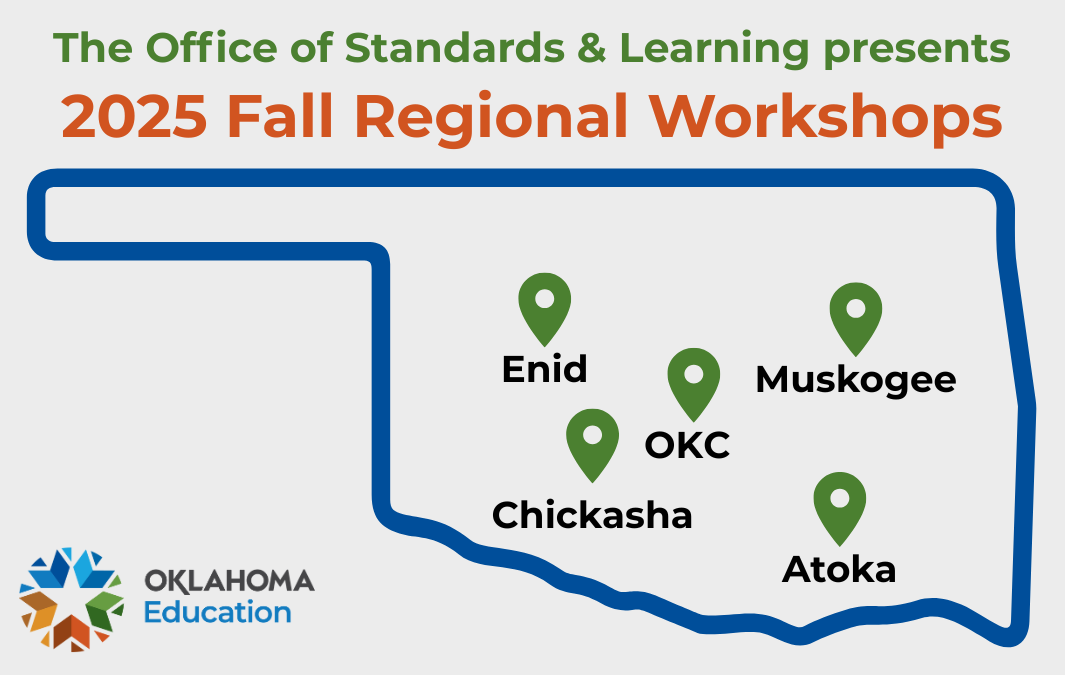 The Office of Standards and Learning at the Oklahoma State Department of Education is offering free professional development opportunities for the 2025-2026 school year. These workshops will be held in various regions across the state and will focus on instructional strategies aligned with the Oklahoma Academic Standards in different subject areas.
The Power of a Sentence: Building Skilled Writers in the Elementary Classroom
Time: 8:30-11:30 a.m.
Unlock the power of strong sentences! This interactive session focuses on sentence-level instruction designed to boost students' writing fluency and confidence. Explore practical strategies for sentence generation, expansion, and combination, and leave with hands-on activities you can immediately use in your elementary classroom to help young writers build skill and stamina.
Register here for the Elementary English Language Arts session:
- This 90-minute session will provide a summary of the three-hour in-person regional meeting.
- Register here.
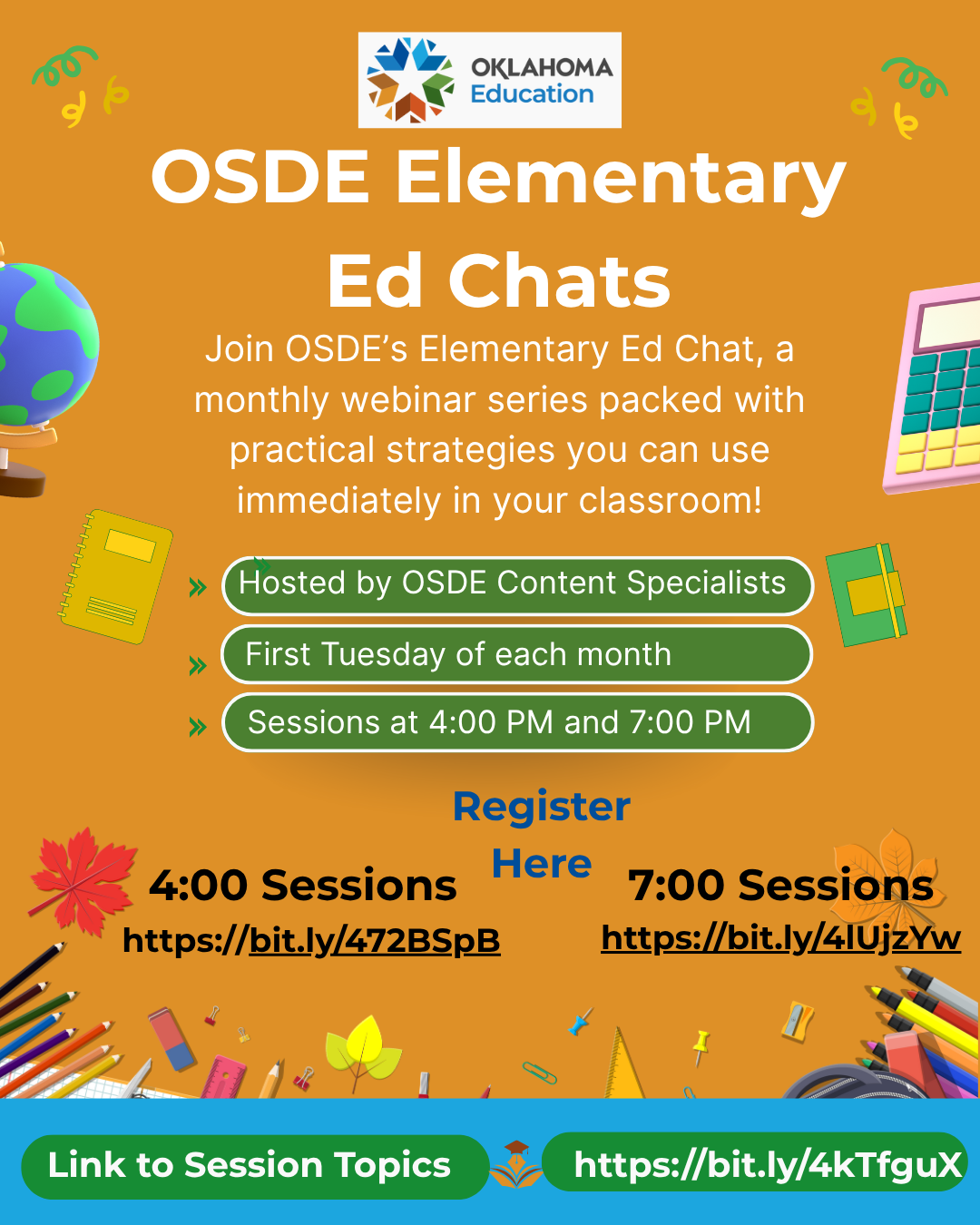 2025-2026 Ed Chat Sessions
4:00 PM Registration: https://bit.ly/472BSpB
7:00 PM Registration: https://bit.ly/4lUjzYw
-
When: The first Tuesday of each month at 4:00 PM and 7:00 PM.
-
Where: Via Zoom
-
Note: You only need to register once to attend all sessions.
Upcoming Sessions:
-
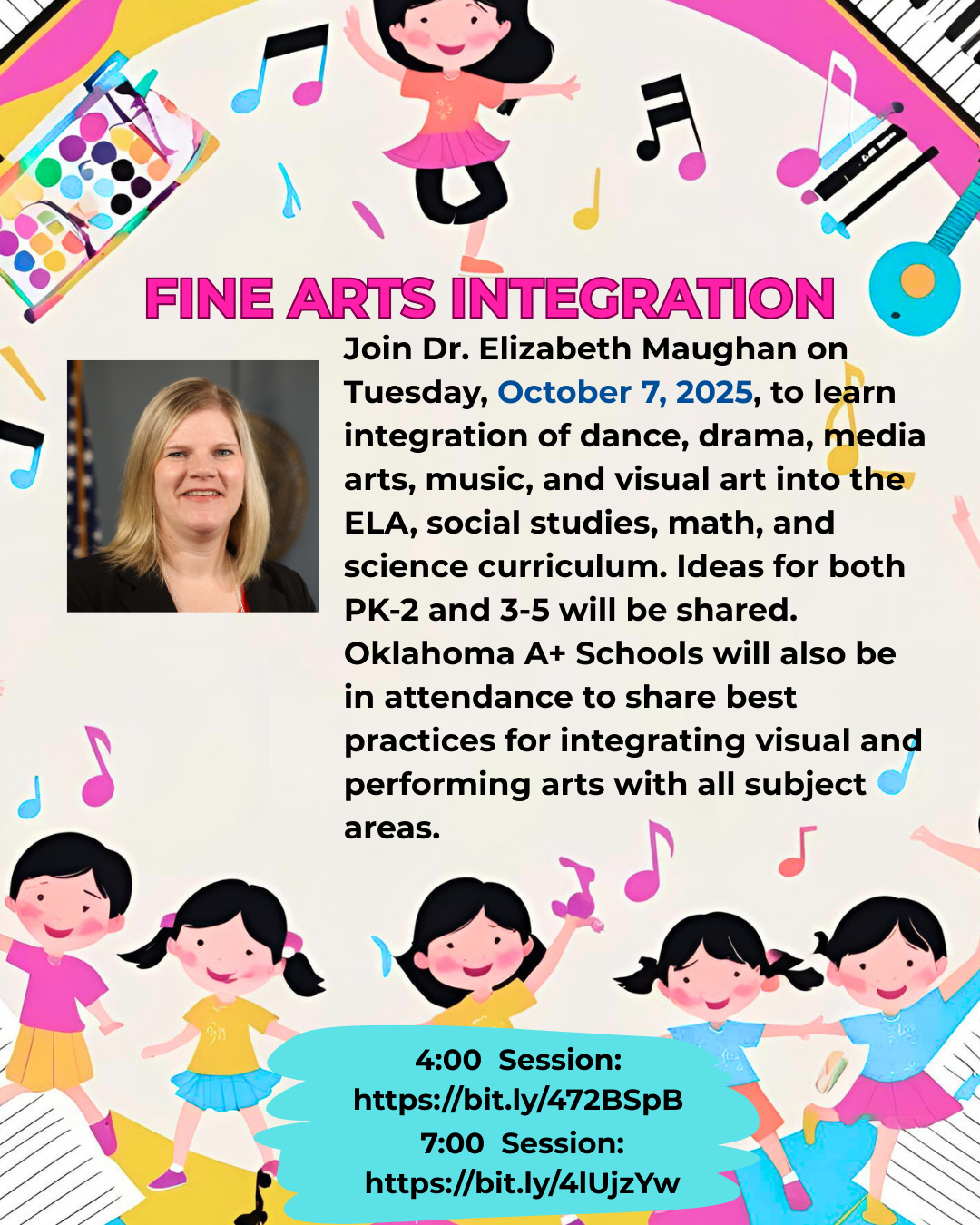
October 7, 2025: Fine Arts Integration
-
November 4, 2025: Movement in the Classroom
-
December 2, 2025: Gifted Education
-
January 6, 2026: Computer Science and Math
-
February 3, 2026: World Languages
-
March 3, 2026: Building Background Knowledge with Social Studies and ELA
-
April 7, 2026: Science Education
-
May 5, 2026: Avoiding the Summer Slump with Family Engagement
Past Sessions:
-
August 5, 2025: Play-based Learning: Recording Link
-
September 2, 2025: AI in the Elementary Classroom: Recording Link
- If you are unable to attend a session, recordings will be available here.
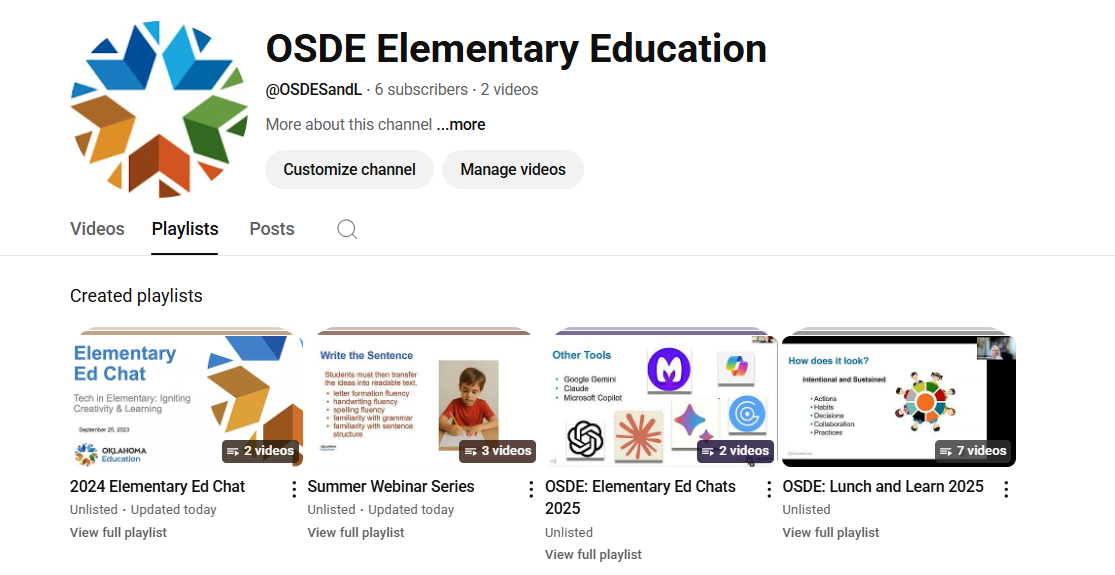
The Office of Standards and Learning offers many opportunities for virtual learning opportunities designed for Oklahoma educators. If you’ve missed any of our live sessions, you can view the recordings on our YouTube channel. You’ll find a growing collection of videos to support your learning. Click on Playlists to see videos organized by event and easily find the ones that interest you.
 The OKCTE Fall conference will be held on Friday, October 24, 2025, at MetroTech Springlake Campus in Oklahoma City. The conference will run from 8:15 a.m. to 4:30 p.m.
Keynote Speaker: Kristin Ziemke, co-author of Read the World: Rethinking Literacy for Empathy and Action in a Digital Ag
Register and view Breakout Sessions here.
Registration deadline is October 10, 2025.
Don't forget to check out the extensive resources found at the ELA Framework Website.
To learn more details about the ELA standards for a specific grade level, explore the Objective Analysis of the "Resources by Topic" section.
In Objective Analysis, you will find Teacher Actions, Students Actions, Recommendations, and Key Terms and Related Standards for each of the ELA standards.
Let's Share! What's Working Well with Students?
Each month, our newsletter will highlight an English Language Arts teaching tip or strategy from one of our state’s educators. Teachers have a wealth of innovative ideas, and we all benefit from collaboration and sharing.
Share your own idea or nominate a colleague who has done something outstanding in ELA, please email Christie Barris at christie.barris@sde.ok.gov with your submission, including:
- Your Name
- School District
- ELA Skills Addressed
- Grade Level
- Description of the Tip or Strategy
Feel free to include pictures as well! Let’s inspire one another and create engaging classrooms that foster a love for reading and writing. Thank you for being a valued member of the ELA community!
|