August 2025
Contents:
The new school year offers a new opportunity to build on past successes and explore new ways to engage students in meaningful math learning. This time of year marks a fresh start to inspire curiosity, deepen understanding, and support every learner’s growth.
This newsletter is here to support you by highlighting upcoming learning opportunities, sharing resources, and spotlighting strategies that can enhance instruction. Take a moment to explore the latest updates and get ready for a fantastic year ahead!
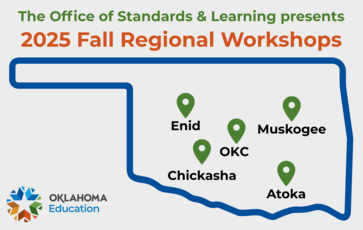 |

Building Strong Foundations in Number Sense (Grades PK-5)
Explore practical, engaging strategies for building strong foundations in number sense across the elementary grades. Through hands-on use of manipulatives, number talks, and visual models, teachers will learn how to help students develop a deep understanding of numbers, operations, and flexible thinking. From early skills like subitizing and place value to more advanced concepts like mental math and reasoning with the four operations, this session will provide adaptable tools to support all learners.
Making Thinking Visible: Using Formative Assessment to Strengthen Algebraic Reasoning (Grades 6-12)
Discover how formative assessment strategies can deepen students’ algebraic reasoning and reveal their thinking in meaningful ways. Participants will engage with rich algebra tasks—centered on expressions, equations, functions, and patterns—and explore how to use student work, questioning techniques, and real-time feedback to uncover misconceptions and guide instruction. Through hands-on activities and analysis of student thinking, secondary math teachers will leave with practical tools for assessing understanding and promoting reasoning in the algebra classroom.
To find sessions in other subject areas, please visit this link.
|
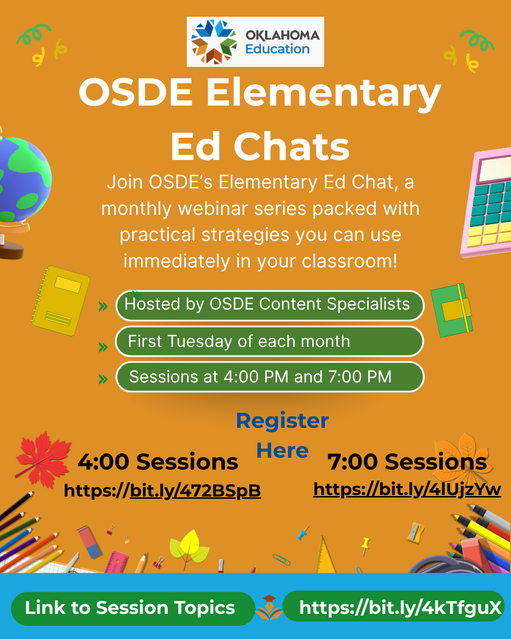 |
2025-2026 Ed Chat Sessions
4:00 PM Registration: https://bit.ly/472BSpB
7:00 PM Registration: https://bit.ly/4lUjzYw
-
When: The first Tuesday of each month at 4:00 PM and 7:00 PM.
-
Where: Via Zoom
Upcoming Sessions:
-
September 2, 2025: Artificial Intelligence
-
October 7, 2025: Fine Arts Integration
-
November 4, 2025: Movement in the Classroom
-
December 2, 2025: Gifted Education
-
January 6, 2026: Computer Science and Math
-
February 3, 2026: World Languages
-
March 3, 2026: Building Background Knowledge with Social Studies and ELA
-
April 7, 2026: Science Education
-
May 5, 2026: Avoiding the Summer Slump with Family Engagement
The Imagine Math grant is provided free to students in grades 3 through 8. Additional student licenses for grades PK-2 and/or 9-12 are available for district's to purchase.
Unlimited professional learning is available at no additional cost to qualifying districts.
Imagine Math is a comprehensive, skills-based online program that is fully aligned with the Oklahoma Academic Standards for Mathematics. It offers adaptive learning pathways, authentic assessments, embedded scaffolds, student motivation opportunities, and actionable data. The platform enhances classroom instruction by personalizing learning to each student’s needs and offers live, after-school 1:1 support from certified math teachers in both English and Spanish.
School/District Application: APPLY HERE to bring Imagine Math to your students.
Early numeracy is critical for long-term success in mathematics. A strong foundation in quantity, number relationships, and pattern recognition supports future problem-solving and reasoning. This month’s focus is subitizing. Subitizing is the ability to instantly recognize the number of objects in a set without counting.
Quantities up to four can typically be subitized when presented randomly. For quantities beyond four, use structured patterns (e.g., ten frames, dice, dominoes) to support visual grouping and part-whole understanding. Structured patterns promote part-whole relationships and are essential for operations and place value. Instructional routines may include brief flashes of dot cards followed by discussion using targeted questions.

Effective subitizing instruction includes visual models, hands-on materials, and intentional questioning, such as:
- “Without counting, how many are there?”
- “What parts make up that number?”
- “Can this be shown a different way?”
- “What patterns do you see?”
|

Useful materials include dot cards, dice, ten-frame cards, dominoes, rekenreks, and counters. Direct instruction should be visual, interactive, and brief, followed by opportunities for student explanation and justification.
Math Center Ideas:
- Match numeral cards to dot arrangements.
- Roll-and-build games using ten frames.
In a student-centered environment, expect to hear mathematical language that reflects quantity recognition and part-whole reasoning, such as “four and three make seven.”
|
The Oklahoma Math Frameworks are a valuable resource designed to support instructional planning aligned with the Oklahoma Academic Standards for Mathematics (OAS-M). Each objective is unpacked with a clear rephrasing ("in a nutshell"), along with suggested Teacher and Student Actions, Key Understandings, and Common Misconceptions. Explore grade-level frameworks to discover free, ready-to-use tools that support effective instruction.
Image Attributions
Numbers, Domino, Dice
|