May 2025
To all Oklahoma elementary teachers, thank you for your dedication, care, and the countless ways you support your students every day. Your commitment and the sacrifices you make truly matter, and the impact you have reaches far beyond the classroom. We’re grateful for all you do, this week and throughout the year.
|

We’ve made it to the end of another school year! This is a special time to celebrate all the reading and writing growth students have made. As attention starts to shift toward summer break, it can be a challenge to keep engagement high, but the end of the year also brings opportunities for fun and meaningful learning. Below are some reading and writing activities to keep students motivated while encouraging them to carry their literacy skills into the summer months.
|
Writing Activities
-
Summer Bucket List
- Invite students to brainstorm and write a list of fun, safe, and exciting activities they’d like to do over the summer
- Encourage creativity—think beyond swimming and popsicles!
- “I’m Ready for Summer Because…”
- Challenge students to write a persuasive piece explaining whether they are ready (or not quite ready) for summer break.
- Have them include at least three strong reasons to support their opinion.
-
“I Used to… But Now I…”
- Guide students in writing reflective sentences that show how much they’ve learned this year.
- Example: “I used to write only a couple of sentences, but now I can write a whole page with details and good word choice!”
-
Letters to Next Year’s Student
- Have students write a letter to the student who will sit at their desk next year.
- They can offer helpful tips about the class (or teacher) and advice on how to be successful.
-
Summer Writing Journal:
- Send students home with a small journal or create a packet of daily/weekly writing prompts.
- Include fun topics like:
- A new adventure I’d love to go on
- My dream ice cream flavor
- A letter to my future self
- The best day of summer vacation
Reading Activities
-
Reading Picnic
- Host a reading picnic outside.
- Invite students to bring beach towels, sunglasses, and their favorite books.
- Enjoy snacks or lunch while reading under the sun.
-
Genre Scavenger Hunt
- Create a checklist of book genres (mystery, fantasy, nonfiction, poetry, etc.) and have students search the classroom library to find examples of each.
- This can be done individually or in teams.
- Have students write down discovered titles they want to read over the summer.
-
Summer Reading Passport
- Give students a blank “passport” to record the fun places they read over the summer.
- For every location, they can draw a stamp or place a sticker.
- Invite students to bring their passports back to school in the fall for a small reward.
- Encourage reading in spots like:
- Under the stars
- At the park
- In a blanket fort
- On a car ride
- At a friend’s house
- With a pet
-
Reading Bingo
- Create a bingo card filled with fun reading challenges.
- Students can mark off each square as they complete it.
- Try ideas like:
- Read in your pajamas
- Read with a flashlight.
- Read a book with a silly character.
- Read a nonfiction book.
- Read a poem out loud.
-
Book Character Awards Day
- Celebrate story characters with a class vote!
- Choose fun award categories and have students nominate characters they’ve met this year.
- Present certificates or medals for:
- Bravest Character
- Funniest Character
- Kindest Character
- Best Problem-Solver
- Most Mysterious
- Best Hero
- Best Villain
Did you have success with one of these activities? Please share by contacting christie.barris@sde.ok.gov.
Throughout the school year, key components of reading comprehension development have been explored. This month highlights research-based instructional practices that support and strengthen those skills in the classroom.
1. Build Strong Decoding and Fluency Skills
- Why it works: Students must read words accurately and automatically to focus on meaning.
- How to do it:
- Provide daily phonics instruction (especially in K–2)
- Practice high-frequency word recognition.
- Use repeated readings and fluency passages.
2. Explicitly Teach Vocabulary
- Why it works: Vocabulary knowledge is directly tied to understanding text.
- How to do it:
- Teach Tier 2 words in context before and during reading.
- Use student-friendly definitions, visuals, and examples.
- Teach word morphology (prefixes, roots)
3. Activate and Build Background Knowledge
- Why it works: Students comprehend better when they know about the topic.
- How to do it:
- Preview key concepts before reading.
- Use videos, images, or quick write prompts to create background knowledge.
- Connect new information to prior knowledge.
4. Model and Practice Comprehension Strategies
- Why it works: Strategies help students think actively about the text.
- How to do it:
- Use teacher think-alouds to model strategies (e.g., predicting, questioning, summarizing, inferring)
- Scaffold strategy used with graphic organizers.
- Gradually release responsibility to students.
- Teach comprehension strategies within the context of meaningful texts rather than in isolation for greater effectiveness.
5. Teach Text Structure and Features
- Why it works: Recognizing structure supports understanding and retention.
- How to do it:
- Identify structures (sequence, compare/contrast, cause/effect)
- Use anchor charts and signal words.
- Explore nonfiction text features (headings, captions, charts)
6. Use High-Quality and Varied Texts
- Why it works: Rich, complex texts expose students to new ideas and vocabulary.
- How to do it:
- Include both literary and informational texts.
- Align texts to content areas to deepen knowledge.
7. Provide Opportunities for Collaborative Discussion
- Why it works: Talking about texts helps students process and deepen their understanding.
- How to do it:
- Use turn-and-talk, literature circles, and text-based discussions.
- Ask open-ended, text-dependent questions.
8. Encourage Writing in Response to Reading
- Why it works: Writing helps clarify thinking and solidify comprehension.
- How to do it:
- Use reading response journals or sentence frames.
- Ask students to explain or justify their thinking in writing.
- Incorporate opinion writing or text evidence prompts.

The Office of Standards and Learning at the OSDE is excited to offer a free, self-paced professional learning opportunity for educators: Navigating the ELA Standards. This course was developed for any educators who want to deepen their understanding of the Oklahoma Academic Standards for English Language Arts (OAS-ELA).
This course provides information on the OAS-ELA, including their purpose, development, review process, historical context, and implementation. The course teaches learners how academic standards guide instruction and ensure students receive high-quality, evidence-based education. Completing this course will provide a foundational knowledge of the standard development process.
After completing this module, learners will be able to:
- Explain the purpose, role, and statutory requirements of the Oklahoma Academic Standards (OAS).
- Describe the process for reviewing and revising standards.
- Understand the guiding principles of clarity, coherence, and purpose.
- Identify the eight over-arching standards in English Language Arts.
- Understand how to read a standard code.
Access this professional learning at your convenience on OSDE Connect.
|
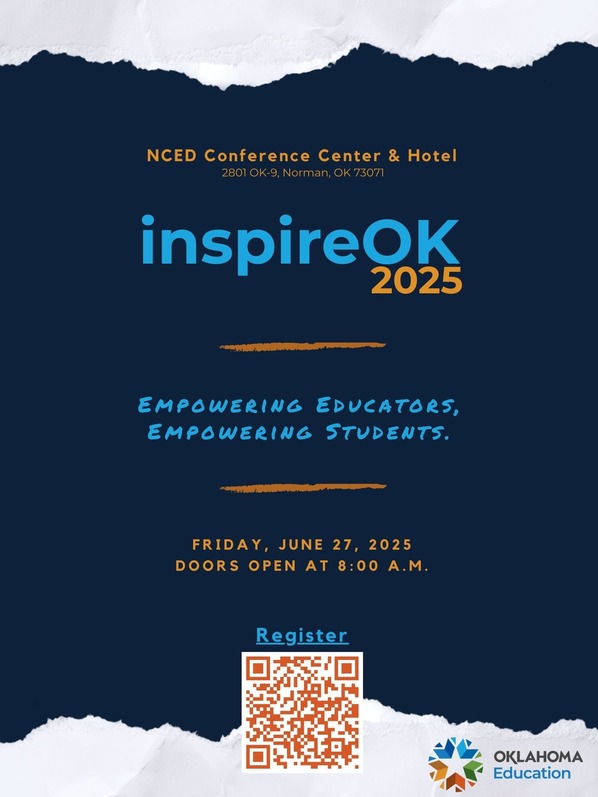 Please make plans to attend the free annual conference hosted by the OSDE.
- NCED Conference Center & Hotel (Norman, OK)
- Friday, June 27, 2025
- 8:00 AM – 3:00 PM
Register today! https://events.bizzabo.com/712704
The following Elementary English language arts sessions will be offered at InspireOK.

The Power of a Sentence: Building Skilled Writers:
This session covers sentence-level instruction to improve students' writing skills. Attendees will explore sentence expansion, combination, and generation to improve writing proficiency. Participants will learn engaging sentence activities and strategies to support writing instruction in the elementary classroom.
|
Spelling Matters: Connecting Spelling and Reading in the Elementary Classroom
This session examines how explicit, systematic spelling instruction supports reading development in elementary classrooms. Focusing on research-based strategies, the session explains why spelling matters, identifies key instructional components, and outlines methods to improve decoding, fluency, and comprehension. Participants will leave with practical, ready-to use classroom activities for classroom use.
|
|
 |
 |
|
Writing Development in Early Childhood: Understanding Stages and Supporting Growth
Join us for a session on writing development, from early scribbles to sentence formation. Learn to support children at each stage, strengthen fine motor skills, and build handwriting readiness. Explore strategies to create a writing-rich environment, foster confidence, and encourage growth through effective, research-based practices.
|
For teachers unable to attend in person, select sessions will be offered as webinars during the week of July 21–24. An additional session focused on teaching handwriting to support writing development will also be available. See registration codes below for details.
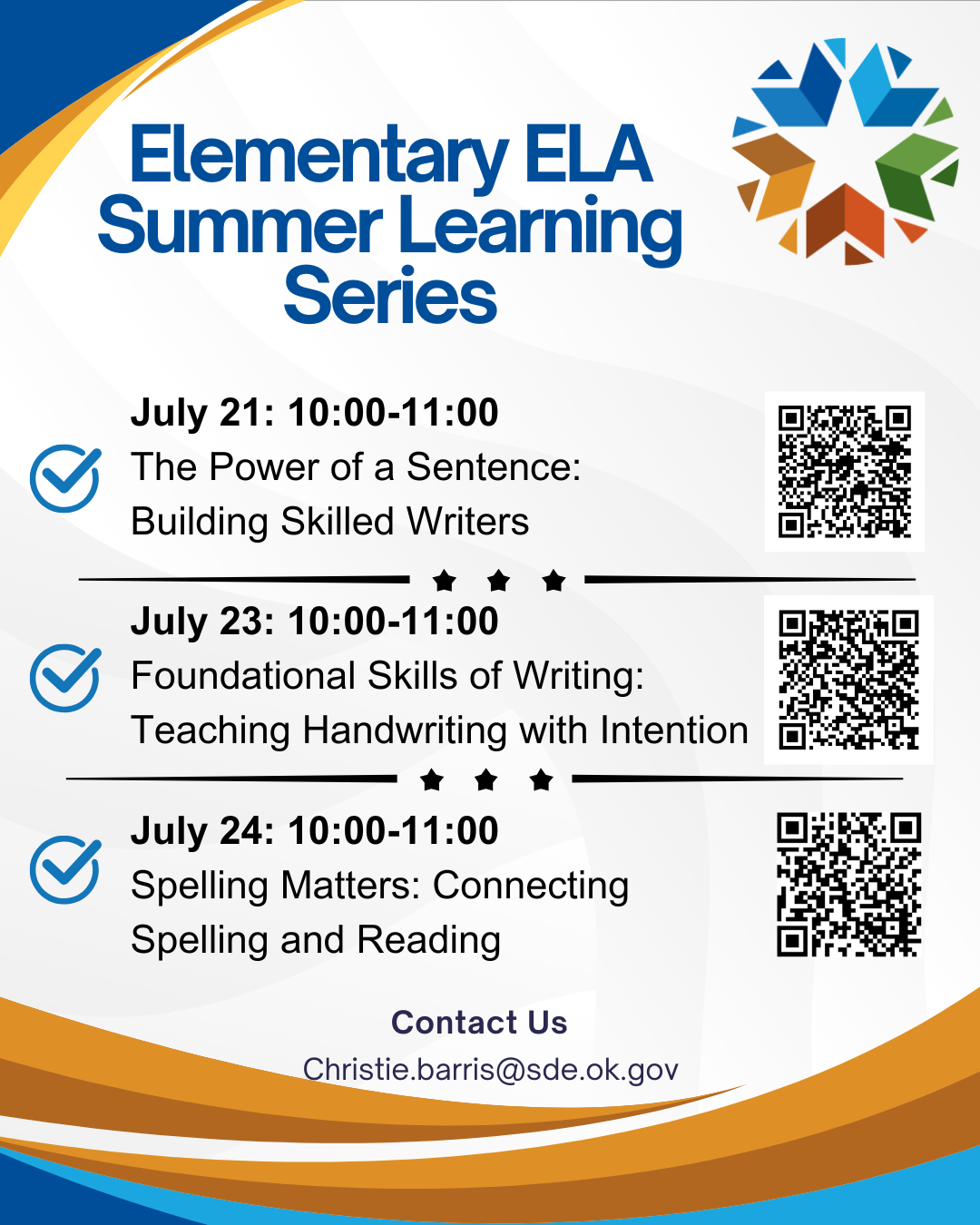 Register here:
July 21, 2025 @ 10:00: The Power of a Sentence: Building Skilled Writers
July 23, 2025 @ 10:00: Foundation Skills of Writing: teaching Handwriting with Intention
July 24, 2025 @ 10:00: Spelling Matters: Connecting Spelling and Reading
|