February 2025
In This Issue:
The OKCompSci Framework is a comprehensive resource designed to support educators in implementing computer science standards in Oklahoma. It provides a clear foundation to help teachers effectively teach computer science, whether as a standalone course or integrated into other subjects.
Key Features of the OKCompSci Framework
-
Standard in a Nutshell: Concise summaries of each standard's core objectives.
-
Student Actions: Clear descriptions of how students can demonstrate their understanding of the material.
-
Teacher Actions: Practical guidance for educators on facilitating student learning and supporting the achievement of standards.
-
Key Concepts: Identification of the essential ideas and principles central to each standard.
-
Misconceptions: Awareness of common student misunderstandings and strategies for educators to address them.
Additional Resources
-
Bundled Standards and Lesson Ideas: Standards for each grade level are being bundled together with lesson ideas, providing educators with ready-to-use resources for instruction.
-
Glossary of CS Terms: A glossary defines key computer science vocabulary words, helping both teachers and students develop a common understanding of concepts.
-
Progression Chart for Vertical Alignment: The framework includes a progression chart that outlines how computer science concepts build from one grade level to the next.
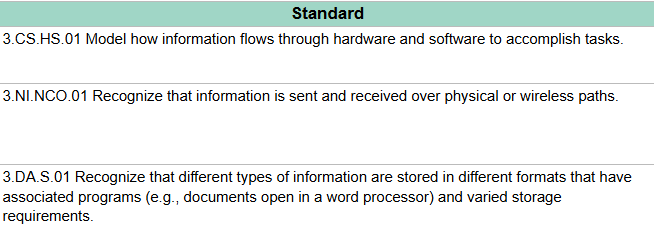
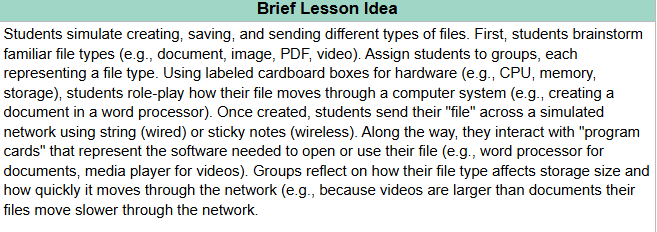
(Example of a standard-aligned resource available on the OKCompSci Framework)
 |
|
To support schools in developing robust computer science programs, the Oklahoma State Department of Education has introduced the Computer Science Implementation Rubric.This tool serves as a practical guide for educators and administrators to assess and enhance their computer science offerings in alignment with state legislation (70 O.S. § 11-103.6m). |
What is the Computer Science Implementation Rubric?
The rubric outlines a clear framework for schools to progress through three levels of implementation:
-
Bronze – Foundational efforts ensuring aligned curriculum and access to basic computer science education.
-
Silver – Expanded learning opportunities, certified educators, and deeper student engagement.
-
Gold – Full integration across subjects, broad student access, and strong professional learning communities.
Key Areas of Focus
The rubric is structured around three core categories:
-
Teaching & Learning – Ensuring high-quality, standards-aligned instruction with engaging and differentiated learning experiences.
-
Student Access & School Environment – Promoting opportunities for all students, from elementary to high school, to engage in computer science.
-
Professional Learning – Providing teachers with ongoing training and collaboration opportunities to sustain and grow computer science education.
Why This Matters
By leveraging this rubric, schools can strategically enhance their computer science programs, equipping students with essential skills for a technology-driven future. Whether just beginning or refining an existing program, districts can use this tool to build sustainable and impactful computer science education pathways.
In mid-November, the State Textbook Committee reviewed and finalized recommendations from the HQIM review committees. Approved computer science instructional materials are now on the state textbook list, and districts may begin reviewing their options. Districts may begin purchasing materials after July 1, 2025.
Questions? Contact Carolynn Bristow, Project Manager of HQIM, or Jeremy Maker, Project Manager of Computer Science Education.
Check out these opportunities for 1-hour professional learning that is relevant to you!
-
Engaging Pedagogy in Computer Science Education (K-12 Teachers)
- Discover innovative teaching strategies to effectively engage students in computer science. This session explores pedagogical approaches, providing practical tools to foster curiosity, creativity, and collaboration in computer science education.
- March 4, 4 pm - 5 pm
-
Click here to register.
-
Integrating Computer Science Across the Curriculum (K-8 Teachers)
- Learn how to seamlessly weave computer science concepts into core subject areas like math, science, and language arts. This session offers hands-on strategies and examples to empower teachers to make computer science a natural and engaging part of their instruction.
- April 8, 4 pm - 5 pm
-
Click here to register.
All sessions will be presented by Oklahoma State Department of Education (OSDE) Project Manager of Computer Science Education - Jeremy Maker
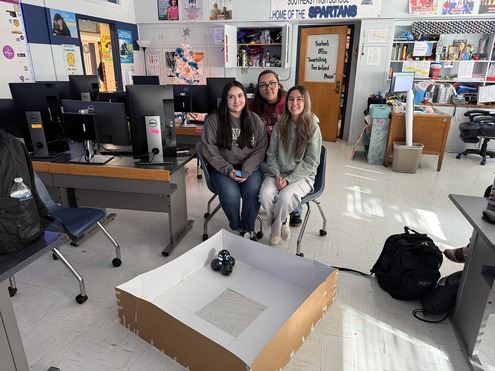
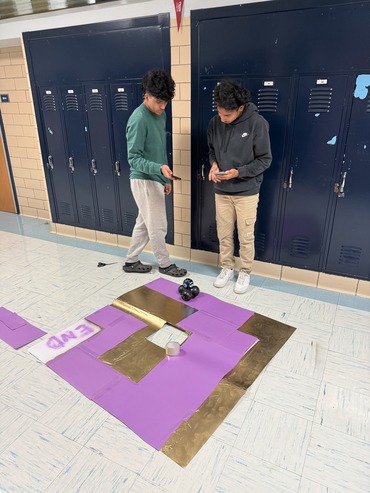
During the week of December 9–15, public school students across Oklahoma participated in Computer Science Education Week. Students from Ms. Melissa Bullen's computer science class at Southeast High School honed their coding skills by creating mazes and coding robots to successfully complete those mazes.
Ms. Bullen's passion for high-quality computer science education was evident as she guided her students through this project. In addition to coding skills, her students developed their knowledge in computational thinking, troubleshooting, debugging, creativity, and collaboration.
Do you know a teacher who’s doing amazing work in computer science education? We’d love to feature them in an upcoming edition of our newsletter! Contact me at Jeremy.Maker@sde.ok.gov.
|