In this issue:
Resource for Oklahoma Science Phenomena
Are you always searching for ways to showcase science in Oklahoma with your students? Check out the social media accounts for the Oklahoma Department of Wildlife Conservation (ODWC)! The ODWC's Instagram and Facebook accounts often share examples of science throughout Oklahoma. Take a look at a few of the examples below, then give them a follow. Both you and your students will love it!
|
Bryozoans
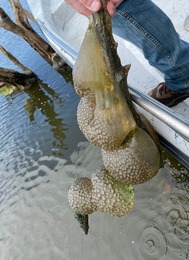
If you're out boating somewhere, like McGee Creek Reservoir, you may notice these strange jelly-like balls hanging from submerged tree limbs. These are Bryozoans, and they'll likely show up in large numbers this summer. Don’t be alarmed, these microorganisms are native and are of no danger to you or wildlife. In fact, they are an indicator of good environmental quality and clear water!
Individuals called "zooids" continually clone themselves until they create a large mass where they filter tiny particles out of the water for food. What makes them look and feel like jelly? Well, that is a soft shell made of a substance called chitin that can harden when dried up to preserve the organism until rehydrated.
These animals are an important part of the ecosystem because they help clean the water and serve as prey for mussels, snails, and even small fish. They often spread through water connectivity or even by passing through the intestinal tract of fish or birds!
|
Invasive Species Awareness
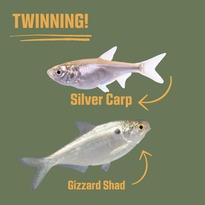
During #InvasiveSpeciesAwareness the ODWC would like to remind Oklahoma anglers of a destructive lookalike that can be found in Oklahoma's waters! As you may know, juvenile invasive carp look similar to shad. Anglers should NEVER move bait from one body of water to another and risk spreading invasive species.
Silver and Bighead Carp (invasive species) are both present in the Red River basin. These fish can grow extremely large with the current Bighead record at 118 pounds! Fish of this size offer anglers a unique opportunity to land a monster, and the idea of fishing for a fish of this size can be exciting. However, they are planktivores. These fish compete with early life stages of many of our native fishes and directly compete with adult planktivorous native species (like paddlefish). If these invasive species become established, it will be extremely detrimental to our native species.
Not only could their presence lead to the demise of native species, but they can also become dangerous to boaters with their propensity to jump high out of the water at the sound of a boat. Anglers and boaters alike have been struck and injured by their jumping. ODWC asks anglers to make a conscious effort to prevent any chance of spreading invasive species.
|
ODWC's Outdoor Oklahoma Journal
The ODWC also has a free, Outdoor Oklahoma Journal, that's focused on helping Oklahomans pursue and engage in Oklahoma's vibrant outdoor lifestyle. This journal includes hunting and fishing stories, wildlife features, insider information about unique opportunities, and tangible details on how to go out and be a hunter, angler, and conservationist.
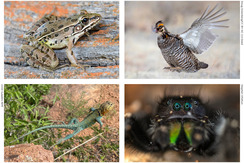
One February topic was "Four Wild Leaps for Leap Day" where they highlighted four leaping animals that can be found in Oklahoma: coastal plains leopard frog, greater prairie-chicken, Eastern collared lizard, and the bold jumping spider. The journal entry provides information on each animal and describes where you can look for them in Oklahoma.
|
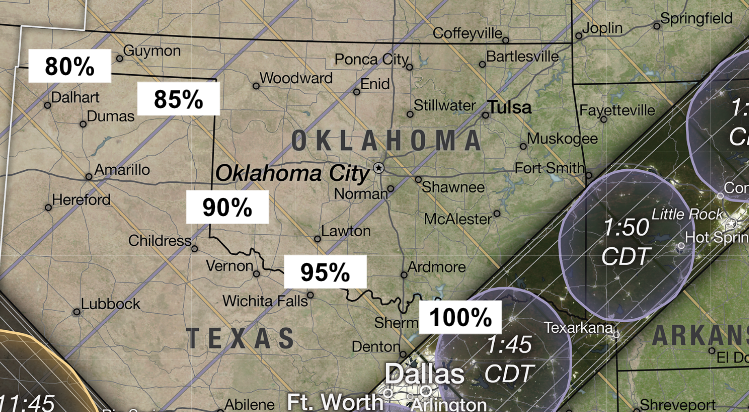 Did you know that southeastern Oklahoma is in the path of totality for the next total solar eclipse on Monday, April 8, 2024? This means that ALL of Oklahoma will have a great view of the Moon passing between the Sun and Earth!
In January, I hosted a virtual OKSci session to discuss the science behind a total solar eclipse and shared various resources that could engage every student in learning about and viewing the eclipse. Below you'll find a link to that session's slide deck and a few of the resources shared. (All resources can be found in the slide deck.)

When you begin to think about summer break, we hope you'll include science professional development in your plans! Below you'll find a few opportunities, with more details to come later. Be sure to follow #OKSci on Facebook to keep up with the latest events!
OSDE Office of Assessments
The OSDE Office of Assessments will be hosting two workshops this summer for science.
-
Item Review Workshop: Participants in this workshop will review and provide feedback on science assessment questions that may be included on Grade 5, Grade 8, and/or Grade 11 state tests or in the Science Item Specifications documents.
-
Location: Virtual
-
Dates:
- Grade 5: June 10-12
- Grade 8: June 10-13
- Grade 11: June 10-13
-
Who: Grade 5, Grade 8, and high school biology, physical science, chemistry, and physics teachers
-
Item Writing Workshop (IWW): This workshop is an opportunity for educators to learn how to write assessment questions similar to items on the Grade 11 College and Career Readiness Assessment (CCRA) and develop assessment items aligned to the OAS-S for biology and physical science.
-
Location: in person, TBD
-
Dates: July 8-11
-
Who: High school biology, physical science, chemistry, and physics teachers
Advanced Placement (AP) Summer Institute
The AP Summer Institutes will have both in-person and online options this year, all hosted by Northeastern State University - Broken Arrow.
-
June 10-13 (in person): Biology and Chemistry
-
June 17-20 (in person): Environmental science and Physics I
-
July 15-18 (online): Biology and Physics 1
-
July 22-25 (online): Chemistry, Environmental Science, and Physics C Electricity and Magnetism, combined with Physics C: Mechanics
For more information or to register, visit the AP Summer Institute webpage. There is a $50 registration fee.
Oklahoma Science Teaching Association Summer Conference
The Oklahoma Science Teaching Association (OSTA) will host their annual summer conference on June 7-8, 2024. This year the Celebration of Science Education banquet (June 7) will be hosted at the Tulsa Zoo and the one-day conference (June 8) will be at OU-Tulsa. Be sure to follow OSTA on Facebook to keep up with the latest details or visit the OSTA website for registration information.
|

Calling All Middle School Science Teachers - 3D Assessment Pilot Test
As part of a National Science Foundation (NSF) funded project to investigate the validity of 3D assessment tasks, BSCS Science Learning is interested in pilot testing 3D tasks with students across the country. BSCS Science is recruiting middle school science teachers willing to administer the assessment task to their students in April or May.
Assessment tasks for this study are being designed to assess students' opportunity to engage with science and engineering practices, crosscutting concepts, and disciplinary core ideas to figure out real-world phenomena. The test will be administered using a web-based testing platform and should take one class period (45-50 minutes) to complete.
If you are a middle school science teacher interested in participating or want to learn more information, check out the BSCS Science Learning website.
|

Tulsa Regional STEM Alliance Opportunities
Recognizing Excellence in STEM: Nominate or Apply Today!
Open to Oklahoma educators and administrators, this prestigious award from the Tulsa Regional STEM Alliance (TRSA) honors innovation, creativity, and positive student outcomes in integrated STEM teaching strategies. TRSA has four category awards designed to recognized educators at all grade levels and leadership positions:
- Elementary Educator, PreK-5
- Middle School Educator, 6-8
- High School Educator, 9-12
- Leadership Award, school administrators and district leaders
Finalists will receive a $4,000 grant, a $1,000 personal award, and the opportunity to be recognized as the Siegfried STEM Educator of the Year! To learn more about this award, to apply, or to nominate a teacher, visit the TRSA website. Submission deadline is June 2, 2024.
|
Become a Pilot School for a Meteorology Curriculum
Tulsa Regional STEM Alliance, in partnership with the NOAA Cooperative Institute for Severe and High-Impact Weather Research and Operations at the University of Oklahoma, invites your school district to apply to pilot the career exploration course "Weathering the Storm: Exploring STEM Careers in Severe Weather" in the 2024-25 academic year.
The curriculum is designed for Grades 6-8 and is structured as a 9-week or 18-week elective, or can be adapted for an afterschool program/club. Visit the TRSA website to learn more about this opportunity.
Youth Engineering Solutions, Free Engineering Curriculum
The Museum of Science (MS) and Engineering is Elementary (EiE) are excited to share their long-awaited released of Youth Engineering Solutions (YES), now available for FREE download.
Each YES unit aligns with the Next Generation Science Standards (NGSS), which have similarities with the Oklahoma Academic Standards for Science. The units are designed to provide meaningful engagement in authentic tasks by having students participate in activities that connect to their lives, expand their horizons, and engage them in disciplinary practices.
Each YES unit consists of 8-10, 45-minutes lessons. A suite of resources, including a Teacher Guide, student Engineering Notebooks, Family Resources, and Assessment Tools support the unit. For more information, visit the YES website.
|

Science Teacher Workshop: Integrating Bioinformatics and Molecular Genetics
Oklahoma State University (OSU) Bioinformatics and Molecular Genetics research team is hosting a science teacher workshop called "Integrating Bioinformatics and Molecular Genetics to Modernize Science Curricula." This summer workshop will be hosted on June 10-14, and teachers must commit to attend all 5 days, plus a 1-day follow up meeting in the fall.
The research team is looking for applicants who teach high school biotechnology, bioinformatics, AP Biology or advanced biology. Check out this flyer for more information, including the link to the application, or contact Dr. Julie Angle at julie.angle@okstate.edu. Application deadline is Monday, April 15.
|
|