In This Issue:

Cybersecurity is the practice of protecting computers, networks, and data from unauthorized access, use, or damage. Cybersecurity is essential for everyone who uses technology, especially in the digital age. As computer science teachers, you have the opportunity to introduce your students to the basics of cybersecurity and help them develop the skills and awareness they need to stay safe online. Below, you will find suggestions for activities that align with the Oklahoma Academic Standards for Computer Science, focusing on the cybersecurity subconcept. You will explore four grade levels: 2nd, 5th, 8th, and Level 1 high school.
|

2nd Grade
2.NI.CY.01 Explain what passwords are, why we use them, and use strong passwords to protect computing devices and information from unauthorized access.
At this grade level, students should learn what passwords are, why they are important, and how to create and use strong passwords. A strong password is hard to guess, has at least eight characters, and includes a mix of uppercase and lowercase letters, numbers, and symbols. Here are some suggested instructional strategies for this grade-level standard:
- Engage students in class discussions about personal information and the importance of protecting it.
- Introduce the concept of passwords and explain why we use them for security.
- Provide examples of weak and strong passwords and discuss the characteristics of strong passwords.
- Teach students how to create strong passwords that include a mix of letters, numbers, and symbols.
- Demonstrate how to securely enter and save passwords on different devices.
- Discuss the importance of keeping passwords confidential and not sharing them with others.
|
5th Grade
5.NI.CY.01 Discuss real-world cybersecurity problems and identify strategies for how personal information can be protected.
At this grade level, students should learn about some common cybersecurity threats and how they can affect them and others. They should also learn how to protect their personal information online, such as their name, address, phone number, email, and passwords. Here are some assessment ideas you can use for this grade-level standard:
- Ask students to research and present a real-world cybersecurity problem and explain its impact.
- Have students create a poster or digital presentation highlighting the importance of protecting personal information.
- Ask students to create a cybersecurity plan or checklist outlining strategies for protecting personal information.
- Have students write a persuasive essay or create a video tutorial on how to protect personal information online.

8th Grade
8.NI.CY.02 Compare the advantages and disadvantages of methods of encryption to model the secure transmission of information.
At this grade level, students should learn what encryption is, how it works, and why it is used. Encryption is the process of transforming information into a secret code that only authorized parties can read. It is used to protect the confidentiality, integrity, and authenticity of information. Here are some grade-level instructional strategies for this standard:
- Introduce different methods of encryption through interactive lessons, videos, and real-world examples.
- Provide opportunities for students to research and present information about specific encryption methods.
- Encourage critical thinking by asking students to evaluate the effectiveness of encryption methods in different contexts.
- Have students work in groups to create a model or simulation demonstrating the secure transmission of information using encryption methods.
|
High School
L1.NI.CY.03 Explain trade-offs when selecting and implementing cybersecurity recommendations from multiple perspectives, such as the user, enterprise, and government.
At this grade level, students should learn how to analyze and evaluate different cybersecurity recommendations and solutions, considering the trade-offs and impacts from multiple perspectives. They should understand that there is no one-size-fits-all solution for cybersecurity, and that different stakeholders may have different goals, needs, and preferences. They should also be able to communicate their reasoning and justify their choices. Here are some activities and resources that you can use to teach this standard:
- Have your students participate in a debate on a controversial cybersecurity topic, such as encryption backdoors, data breaches, or cyberwarfare.
- Have your students analyze a real-world cybersecurity case study, evaluating the solutions from different perspectives.
- Have your students design and implement a cybersecurity project, such as a website, an app, or a game that considers the perspectives of different stakeholders.
Cybersecurity is a dynamic and exciting field that offers many opportunities for learning and innovation. By introducing your students to the basics of cybersecurity, you can help them develop the skills and awareness they need to protect themselves and others online. You can also inspire them to pursue further education and careers in cybersecurity.
Opportunities
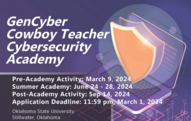
The Department of Computer Science at Oklahoma State University in Stillwater is hosting the GenCyber Cowboy Teacher Cybersecurity Academy for Oklahoma educators. This summer camp experience is tailored for Oklahoma middle and high school science, technology, engineering, and mathematics (STEM) teachers. Elementary teachers are welcome if spots are available. The program focuses on GenCyber cybersecurity concepts, ethics, careers, and simplicity in cybersecurity, aligning with the Oklahoma Academic Standards for Computer Science (OAS-CS). Prior computer science and cybersecurity experience is not required. Please see below for important dates and more information.
-
Application Deadline - March 1, 2024 (or when all seats are filled)
- Pre-Academy Activity - March 9, 2024
- Summer Academy - June 24 - 28, 2024
- Post-Academy Activity - September 14, 2024
- There is no cost, and stipends are awarded after completing all activities.
- Click here for additional information
|
Resources
-
Cyber.org: This resource offers a wealth of cybersecurity education materials, including lesson plans, curriculum resources, and professional development opportunities tailored to K-12 educators.
-
TeachCyber.org: This platform provides free access to comprehensive cybersecurity curricula designed specifically for K-12 classrooms, ensuring that teachers have the tools they need to effectively impart these critical skills.
-
Security.org: This is a resource to test the security of passwords. It can be used to show students how quickly a weak password can be compromised. Students can use it to explore the differences between weak passwords and strong passwords.
Winter/Spring Virtual Professional Learning - Something for Everyone!
Check out these opportunities for 1 hour professional learning that is relevant to you!
- Unpacking the Oklahoma Academic Standards for Computer Science (OAS-CS) for Middle School and High School Educators:
- A time to explore what the OAS-CS really mean and how to unpack them
- February 29, 4 pm - 5 pm
-
Click here to register.
- Integrating Meaningful Computer Science Education into the Elementary and Middle School Classroom:
- A time to discover how to make meaningful connections between computer science and other content areas
- March 7, 4 pm - 5 pm
-
Click here to register.
- Q & A for School Administrators - Frequently Asked Questions Regarding Computer Science Education.
- A time to discuss legislative requirements and best practices for computer science education
- April 4, 4 pm - 5 pm
-
Click here to register.
All sessions will be presented by Oklahoma State Department of Education (OSDE) Project Manager of Computer Science Education - Jeremy Maker
Curricular Resources
-
Learning Blade
- Free to all Oklahoma educators
- Targets Grades 5-9
- Integrates STEM, computer science (CS), and career and technical education (CTE) into other content areas
-
Click here for more information
-
Defined Learning
- Free to all Oklahoma educators
- Targets grades K-12
- Computer Science (CS) and STEM project-based content that integrates authentic career situations
|
|
 |
 Have you joined the Oklahoma Chapter of the Computer Science Teachers Association (CSTA)? Oklahoma CSTA meets virtually each month throughout the school year. These meetings are rich with information about upcoming professional development, resources for the classroom, and student opportunities. Announcements will soon be made about dates and times for this year's meetings. For more information, please email cstaok@gmail.com.
|