May 2023
Happy Teacher Appreciation!! Thank you for all you do for your students and their families. We appreciate you!
As the 2022-2023 school year comes to close and we look towards this summer and next school year, this newsletter contains a variety of professional learning opportunities over the next few months, some practical suggestions from the Plain Talk conference for literacy instruction for next year, and new additions to the Oklahoma Academic Standards for English Language Arts curriculum frameworks. Please reach out if you have any questions.
Sharon Morgan, sharon.morgan@sde.ok.gov
|
As we look reflect on the past school year and look towards the next, I want to share some of the suggestions from another Plain Talk session I attended in March. Dr. Mary Dahlgren (a native Oklahoman!) and Dr. Antonio Fierro facilitated the session entitled, The Science of Reading: Moving Away from Ambiguity to Real Classroom Practices. This session included an overview of the science of reading including the Simple View of Reading and then suggestions on how to modify common classroom practices to better align instruction to research in a Do This! Not That! format.
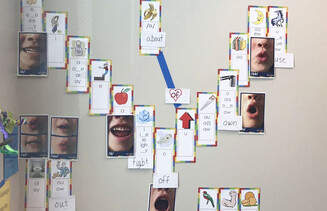
1. Use Sound Walls, Not Word Walls
Traditional word walls include the letters posted in alphabetical order and words with the corresponding beginning letter posted under them. When students are still learning sound/symbol relationships, putting words like owl, open, on, or under O on the word wall is not helpful because the O represents a variety of sounds in those words. If a students want to remember how to spell the word knife then they will likely look for the /n/ sound instead of the letter k. These are just a few examples of how word walls can be problematic.
Sound walls organize words and letters by sound to help students make connections between sounds and spelling patterns. See the picture above, this article from Reading Rockets, and this template for more information about implementing Sound Walls in your classroom. Note: If your students are older, then you could organize words by common spelling or syllable patterns, prefixes, suffixes, or roots to help students see more advanced phonic patterns.
|
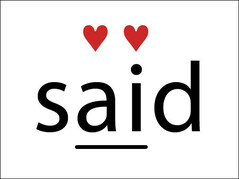
2. Teach Decoding and High-Frequency Words, Not Pictures and Flashcards
Brain research tells us that students need systematic, explicit instruction to read. Decoding instruction should include a logical scope and sequence that moves from simple to complex and strategies that clearly teach the connections between sounds and letters or spelling patterns. Having students figure out a word by looking at a picture, skipping the word, or similar strategies does not align with what we know about how the brain learns to read. These are strategies that struggling readers use when they cannot decode a word. See here for more information on phonics instruction.
When teaching high-frequency words, have students notice the spelling patterns and make note of any irregularities instead of trying to memorize words on flashcards. The heart word strategy teaches students how to identify regular spelling patterns and irregular patterns that have to be learned by heart. Once a word has been taught explicitly in this manner a teacher may use flashcards for practice.
3. Spelling, Not Memorization
Similar to the second suggestion, teach spelling words and lists using patterns instead of memorizing a list of unrelated words. Since 50% of English words include common spellings, 36% have one sound irregularity, and 10% can be spelled based on word origin, English is very predictable and spelling patterns are a more effective way of teaching spelling. See articles How Spelling Supports Reading and How Words Cast Their Spell: Spelling Is an Integral Part of Learning the Language, Not a Matter of Memorization.
|
4. Explicit Sentence Comprehension, not Implicit Grammar Instruction
To comprehend, students must understand how words work together in sentences, paragraphs, and larger texts. This should be done with explicit instruction of sentences instead of hoping they gain that knowledge through reading or grammar worksheets. Words have specific functions in sentences which must be understood to comprehend. See This pre-K through 12th grade progression on the parts of speech from the Oklahoma Academic Standard for English Language Arts on how this is applied in Oklahoma.
Having students build, expand, and combine sentences is a great way to support their understanding of how words, phrases, and clauses work together to make meaning. Download Sentence Sense: Developing Sentence Skills in Student Writers by Dr. William Van Cleve for more information.
There are many other aspects to the science of reading that are not captured here, but I will continue to provide resources and information in future newsletters to help support other literacy in your classroom.
Some schools have already transitioned to the 2021 Oklahoma Academic Standards for English Language Arts. Now is a good time to familiarize yourself with the standards if you have not made the transition.
During the 2023-2024 school year, all schools should shift to the 2021 standards. The 2024 OSTP assessment will be fully aligned to these standards.
The ELA standards webpage has a number of implementation resources including crosswalks, vertically aligned standards, an appendix, and training slideshows and videos.
|
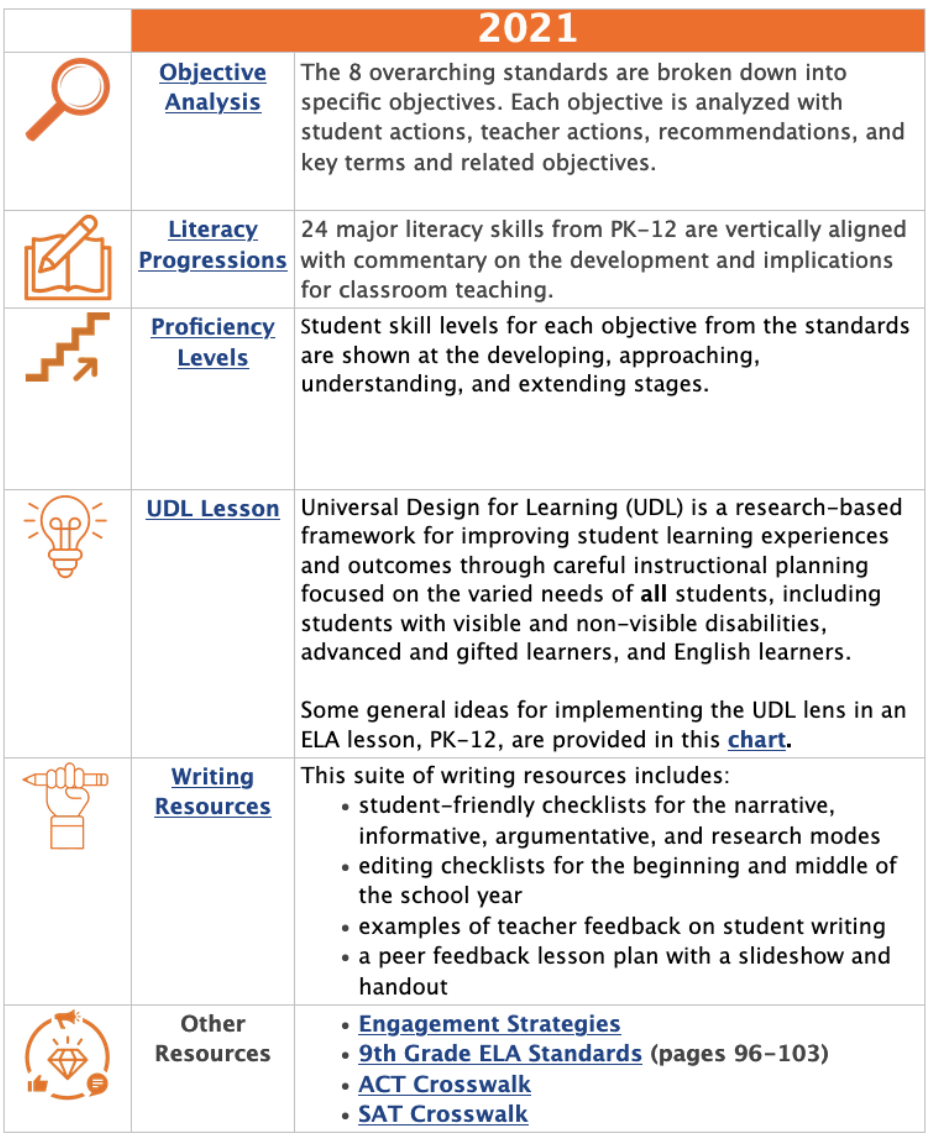
From November 2022 through April 2023, a team of sixteen Oklahoma educators has been creating new resources for the English language arts curriculum framework, including proficiency levels, Universal Design for Learning lessons, and writing resources. All resources should be finalized and posted by June 1. See below to learn more about the helpful contents.

"Universal Design for Learning (UDL) is an approach to teaching and learning that gives all students equal opportunity to succeed.
To understand what UDL is, it helps to understand what it’s not. The word universal may throw you off. It may sound like UDL is about finding one way to teach all students. But UDL actually takes the opposite approach.
The goal of UDL is to use a variety of teaching methods to remove any barriers to learning. It’s about building in flexibility that can be adjusted for every person’s strengths and needs. That’s why UDL benefits all learners.
This approach to teaching or to workplace training doesn’t specifically target people who learn and think differently. But it can be especially helpful for kids with these challenges — including those who have not been formally diagnosed. It can also be very helpful for English language learners." [Source]
The updated ELA Curriculum Framework has information about UDL along with a lesson for every grade level. You might already be implementing some UDL practices without even realizing it. Learn more at the link!
|
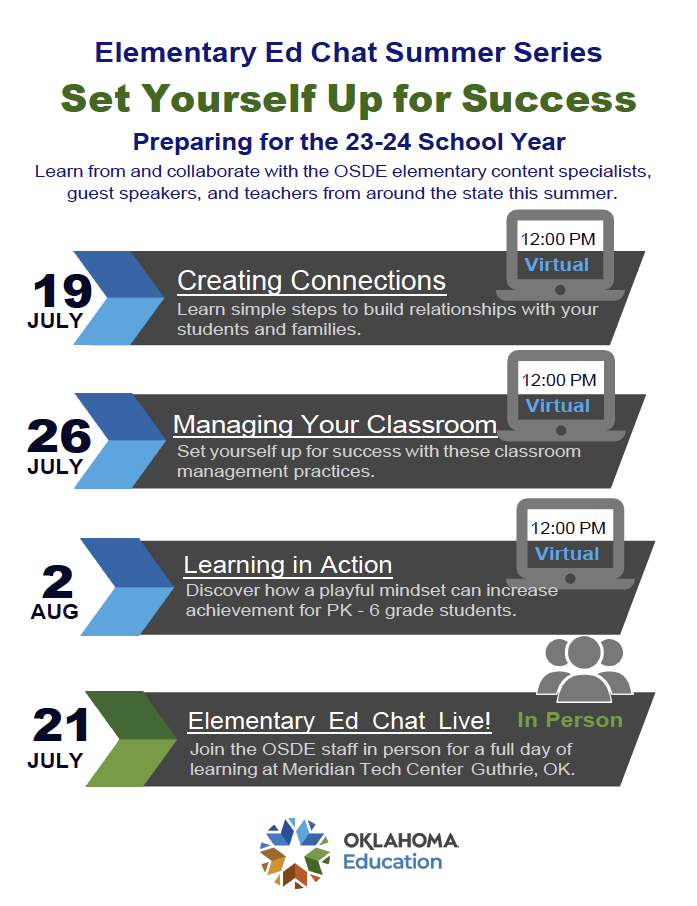
The Oklahoma State Department of Education elementary team will be hosting both virtual and in-person opportunities this summer to help you set yourself up for success in the upcoming school year. These opportunities include time to network with other teachers, learn from curriculum experts, and get access to resources.
All Oklahoma elementary teachers are invited to learn about resources and share ideas to get ready for a successful 2023-2024 school year! Register at the links below for any or all of the sessions offered. Virtual sessions will be 1 hour.
Virtual Elementary Ed Chat Live: Set Yourself Up for Success!
-
July 19, 12:00 p.m. - Creating Connections Learn simple steps to build relationships with your students and families.
-
July 26, 12:00 p.m. - Managing Your Classroom Set yourself up for success with these classroom management practices.
-
Aug. 2, 12:00 p.m. - Learning in Action Discover how a playful mindset can increase achievement for PK - 6th grade students.
Elementary Ed Chat Live: Set Yourself Up for Success!
The Elementary Ed Chat Live will have a variety of networking and breakout sessions for Oklahoma elementary teachers. Topics from the virtual sessions will be presented along with many other topics to support elementary teachers with instruction and classroom management.
Join us in person on Friday, July 21st from 9 a.m. to 3:30 p.m.
Meridian Technology Center, South Campus, 3025 S. Division St., Guthrie, OK
 The OSDE Elementary Ed Chat Notes and Resources document includes information about previous OK Elementary Ed Chats.
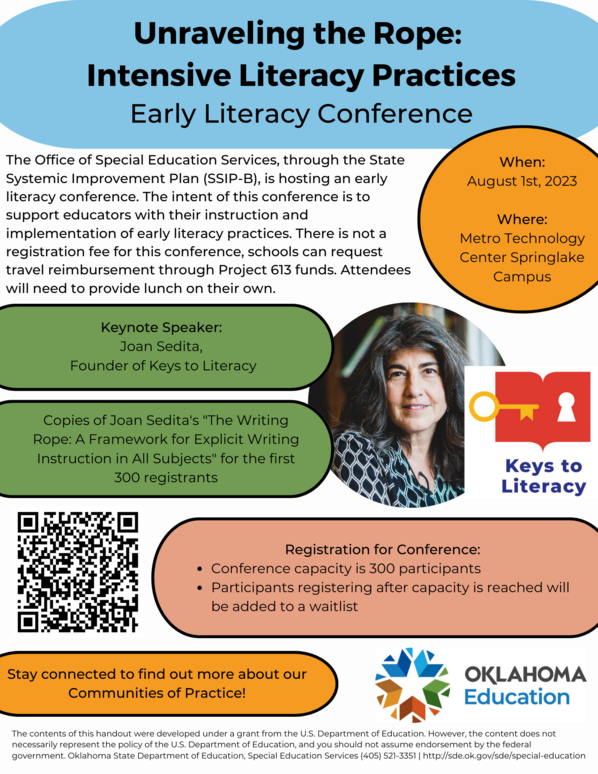 This one-day conference will be held at Metro Technology Springlake in the OKC Metro on August 1st, 2023, and is intended to support all educators who work with K-3 students in early literacy instruction. The keynote speaker will be Joan Sedita, author of The Writing Rope: A Framework for Explicit Writing Instruction in All Subjects.
The OSDE is hosting this event as a program element of the State Systemic Improvement Plan through the Office of Special Education (SSIP). There will not be a registration fee for this conference. However, attendees will need to provide lunch on their own.
Register at this link.
Please reach out to Alexa Hudak at alexa.hudak@sde.ok.gov for more information.
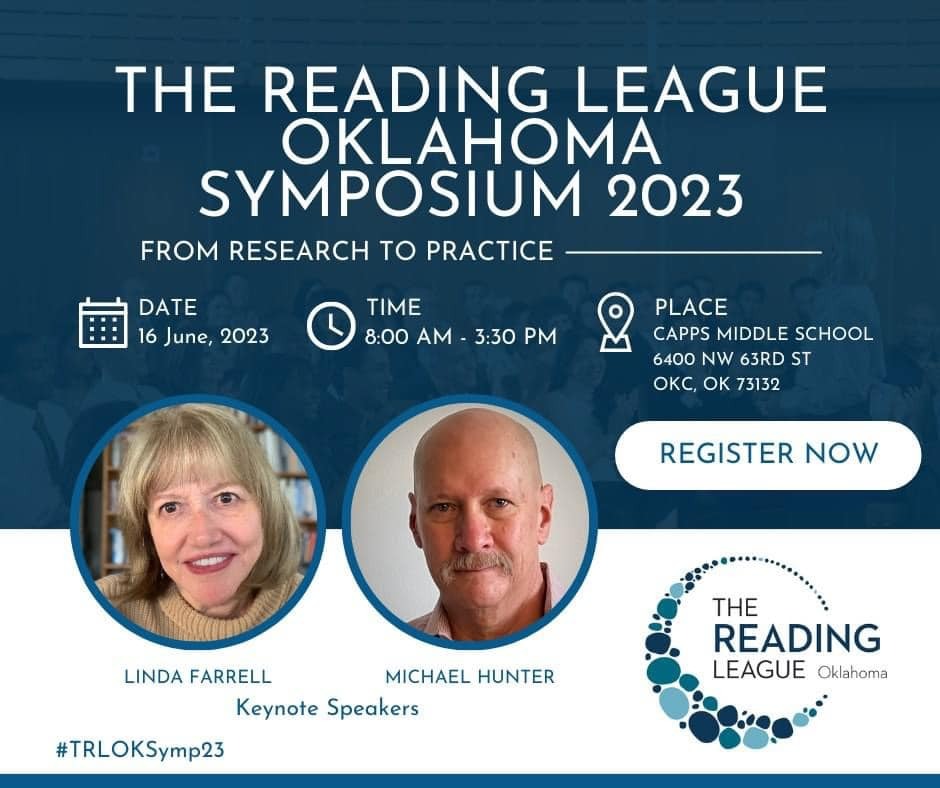
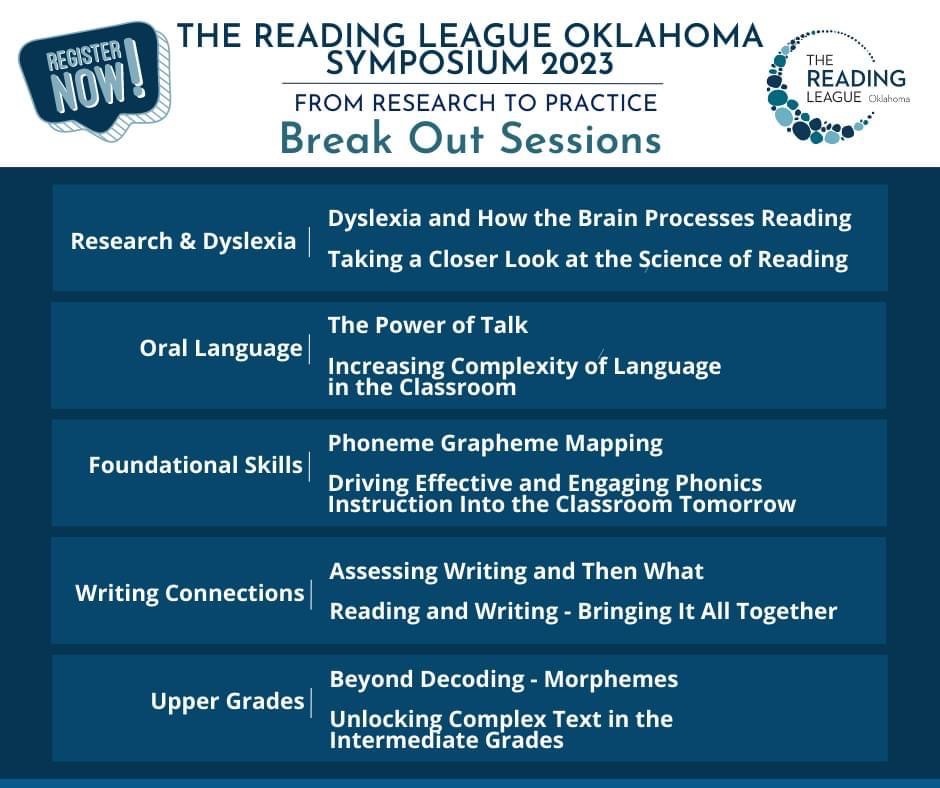
The Reading League Oklahoma will be hosting a symposium on June 16, 2023 at Capps Middle School in Putnam City. Discover practical techniques for teaching literacy at the TRLOK Symposium 2023 with keynote speakers Linda Farrell and Michael Hunter and a variety of breakout sessions from literacy leaders across the state.
Register at this link.
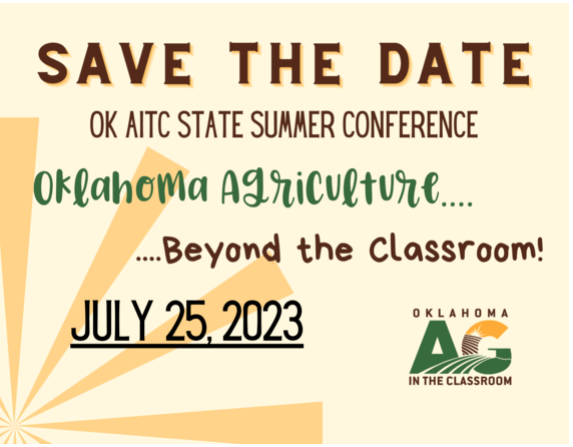
The Ag in the Classroom (AITC) State Summer Conference is a great day of learning from excellent teachers from around the state about how they use the AITC resources to enhance student learning about the world around them. Ag in the Classroom offers many great resources and lessons that are aligned with the science of reading. The conference is free, and lunch is provided.
Make plans to attend the Ag in the Classroom State Summer Conference today! Oklahoma Agriculture...Beyond the Classroom!
Join us July 25, 2023 from 8:30 to 4:00 at Metro Technology Center in OKC.
Share with a friend. You won't want to miss this conference. Some of your favorite presenters will be back to share new ideas to use AITC in YOUR classroom, and we have some first-time presenters! Don't miss all the fun! Register at this link.
|
|