|
Summertime is the perfect opportunity to relax and decompress from a long school year. Hopefully, you can spend time doing things you find interesting, whether it's school related or not. One thing I love doing in the summer (and really all year long) is exploring Oklahoma. Did you know Oklahoma contains 10 distinct ecological regions? That's more than any other state! While visiting these different areas in Oklahoma, I can't help but notice and wonder about the things I see - wonder what caused a pattern in the landscape, or how/why a particular organism is living in that area and not elsewhere, or what causes all the beautiful colors that I see (Hello Gloss Mountain!). Later, these experiences help me think of contexts in which I can engage students in investigating science phenomena so that students can apply the topics in science class to something they might see in Oklahoma.
This month's OKSci Newsletter includes information about two local contexts students might be interested in, dinosaurs and stars, both within the Earth and Space Science standards. July's newsletter also shares information about our newly released Oklahoma Science Framework, summer science readings, and different student opportunities coming this next school year.
The Oklahoma State Department of Education (OSDE) is excited to announce the publication of the new and revised Oklahoma Science Curriculum Framework aligned to the 2020 Oklahoma Academic Standards for Science (OAS-S). With the revision of the OAS-S in Spring 2020, it has been a priority of the OSDE to ensure Oklahoma educators are provided with the opportunity to deeply understand the intent of the standards, while also supporting educators with a vision and resources that promote effective implementation of the standards.
The OSDE began collaborating with Oklahoma educators to revise and add to the existing Oklahoma Science Framework during the 2020-2021 school year (Phase 1). This involved updating the bundle analyses and the development of new Science Frameworks for Pre-Kindergarten, Physics, Environmental Science, and Earth and Space Science. The OSDE will continue to collaborate with Oklahoma educators this fall for Phase 2 of the Oklahoma Science Framework Project. Phase 2 will focus on incorporating instructional resources that support implementation of the new bundle analyses, and the completion of the Environmental Science and Earth and Space Science frameworks.
Check Out the EngageOK Recording
At EngageOK in June 2021, the OSDE Science Team hosted a session called "Navigating Science Learning: Are You Looking for a Map?" This session focused on exploring how to use the updated Science Curriculum Framework as a guide in planning student-driven investigations, including how to incorporate the 3-Dimensional Science Vertical Learning Progressions to address potential unfinished learning. Participants also explored the new student and teacher actions found in each bundle analyses and discussed how leveraging the crosscutting concepts and science and engineering practices in these actions support students with figuring out science ideas. If you missed this session or would like to review what we did, check out the EngageOK session recording and the presentation slide deck.
We will have more sessions on how the Oklahoma Science Framework can support science teaching and learning throughout the 2021-2022 school year. Be sure to keep an eye out for announcements about these opportunities in future OKSci Newsletters and in the #OKSci Facebook group.

The Phase 1 Science Framework Writers are Oklahoma educators who were selected from a large pool of applicants. The process for application and selection included criteria related to knowledge of the content and practices of the Oklahoma Academic Standards for Science, as well as classroom experience, professional leadership, and curriculum development. The process of selecting the very best educators contributed to an effective and dedicated group, reflecting a diverse range of experience and expertise. The Oklahoma State Department of Education is deeply appreciative of their hard work.
Phase 1 Science Framework Writers included:
- Alana VanDeventer, Yukon Public Schools
- Ashleigh Morton, Kingston Public Schools
- Caitlin Trail, Oklahoma Science Teacher
- David Powell, Norman Public Schools
- Dominique Poncelet, Oklahoma City Public Schools
- Dr. Jennifer Miller, Tulsa Public Schools
- Jeramey Tamez, Yukon Public Schools
- Dr. Karen Jennings, El Reno Public Schools
- Karla White, Bethany Public Schools
- Kelsey Deal, ASTEC Charter Schools
- Leiha Chaisson, Mustang Public Schools
- Lisa Pitts, Oakdale Public Schools
- Marya Alawneh, Edmond Public Schools
- Taylor Woodard, Edmond Public Schools
- Traci Richardson-McVicker, Stillwater Public Schools
- Tyler Miller, Tulsa Public Schools
To learn more about each of the Phase 1 Science Framework writers, check out this Meet the Writers slide deck.
|
Become a Phase 2 Framework Writer
Phase 2 of the Oklahoma Science Framework Project will begin Fall 2021. Phase 2 will focus on incorporating instructional resources that support implementation of the new bundle analyses and are aligned to the 2020 Oklahoma Academic Standards for Science (OAS-S). More information about participating in Phase 2 is coming soon! If you have any questions, contact heather.johnston@sde.ok.gov.
|
"Learning, interest, and motivation to learn are essential when considering students' involvement in science investigations and engineering designs" (Investigation and Design at the Center, p. 33). Research provides strong evidence that by engaging students in science investigations that are relevant to them, students are more likely to see the importance of understanding the content and doing what is asked of them.
One instructional practice that supports this type of learning is using local contexts. Oklahoma is full of phenomena that can be used in a science classroom. Below are two Oklahoma contexts that can be used to investigate Earth and Space Science disciplinary core ideas, particularly Earth's Place in the Universe.
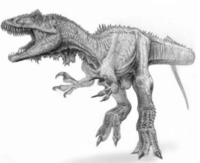
Dinosaurs in Oklahoma
Did you know Oklahoma has an official State dinosaur and State fossil? Oklahoma designated Saurophaganax maximus (photo on the left) as the official state fossil in 2000. This dinosaur's fossils were first discovered near Kenton in Cimarron County, Oklahoma. The name "Saurophaganax maximus" means "the lord of lizard-eaters," and is believed to be even larger than the T-Rex! A skeleton of this dinosaur can be seen in the Jurassic Hall of the Sam Nobel Oklahoma Museum of Natural History in Norman, Oklahoma.
|
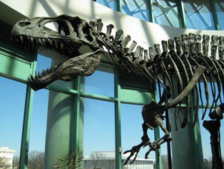
Oklahoma designated Acrocanthosaurus atokensis (photo on the right) as the official state dinosaur in 2006. The name "atokensis" is reflective of where the first evidence of this dinosaur was found - Atoka County, Oklahoma. You can check out the skeleton of the Acrocanthosaurus atokensis at the Museum of the Red River in Idabel, Oklahoma. Admission to this museum is free, thanks to local sponsors.
|
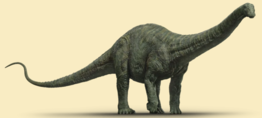
Another dinosaur that is found in Oklahoma belongs to the sauropod family - Apatosaurus. Apatosaurus fossils have been found in Cimarron County, the same area as the Saurophaganax maximus that was mentioned earlier. A skeleton of the apatosaurus can also be found at the Sam Nobel Oklahoma Museum of Natural History.
|
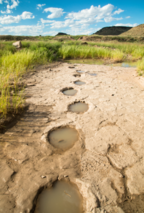
Want to see dinosaur tracks in Oklahoma? You can! Dinosaurs left tracks near a creek bed in Black Mesa, Oklahoma. Discovered in the 1980s, scientists have identified the tracks as having been left by theropods (a classification for bipedal carnivorous dinosaurs, such as the Maximus or T-Rex), but they cannot be sure of the specific species. Unfortunately, due to erosion, only a third of the original 47 tracks are still visible. So, get out there soon before they all disappear!
|
Starry Oklahoma Skies
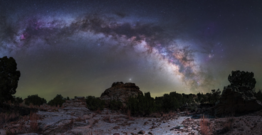
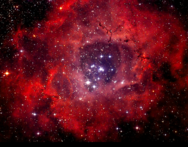
While you are exploring the creek beds in Black Mesa State Park, you should stay a night for stargazing! With no nearby town centers to pollute your view with city lights, this area in the Oklahoma panhandle is truly ideal for looking up at the night sky in wonder. There is an annual 8-day Okie-Tex Star Party, hosted by the Oklahoma City Astronomy Club, that includes speakers, food, and observing lists. Using a telescope, maybe you'll be able to view Oklahoma's official State Astronomical object, the Rosette Nebula (shown in the picture below). This nebula is in the Monoceros region of the Milky Way Galaxy, about 5,000 light-years from Earth, and became an official state symbol in 2019.
|
If traveling isn't an option, you can always view the stars from your backyard! While fewer stars may be visible if you live in or near a city due to light pollution, you can use free phone apps, such as SkyView Lite, to help you identify the celestial bodies in your night sky.
|
Looking for something to read this summer? Visit your local library or the provided links to check out the following recommendations!

The Poisoner's Handbook: Murder and the Birth of Forensic Medicine in Jazz Age New York by Deborah Blum
This non-fiction is a perfect read for anyone who enjoys true crimes and science history. Before the 1920s poisoners could easily get away with murder as science had yet to be applied to investigating how someone might have died. That all changed when New York City appointed two people, Charles Norris (a chief pathologist) as their first scientifically trained medical examiner, and Alexander Gettler, as the city's first chief toxicologist. These two individuals would turn New York City's medical examiner's office into a department that set forensic standards for the rest of the country, laying the foundations of forensic toxicology. This book explores several cases these two investigated and how they creatively developed new ways to tease out even the tiniest traces of chemical compounds from human tissues.
|
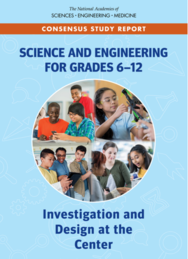
Science and Engineering for Grades 6-12: Investigation and Design at the Center by the National Academies Press
The majority of Americans learn most of what they know about science and engineering as middle and high school students. During this time students' knowledge, attitudes, and interests rapidly change, making it a challenge to keep students interested in learning. Research provides strong evidence that by engaging students in science and engineering investigations that pique their curiosity about real-world situations relevant to their local surroundings and to their culture, students are more likely to want to learn, as the information is relevant to them. This report, Science and Engineering for Grades 6-12: Investigation and Design at the Center, considers how to engage today's middle and high school students in doing science and engineering through an analysis of evidence and examples. It also provides guidance for educators on how to support students as they make sense of phenomena, gather and analyze data, construct explanations and design solutions, and communicate reasoning to self and others during science investigations and engineering designs.
|
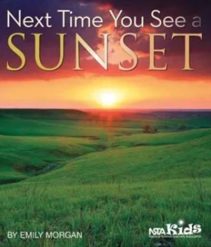
Next Time You See a Sunset by Emily Morgan
The "Next Time You See a..." series of books by Emily Morgan invites children and adults to take a closer look at daily phenomena with fresh eyes, reawakening that sense of wonder and excitement about something that seems so ordinary. Several of the books in this series have also been translated into Spanish (including this one).
Next Time You See a Sunset connects the reader to think about the spinning of the Earth, the progress of day into night, and the reason for the spectacular colors and shadows that accompany sunrise and sunset. This book was also a part of "Story Time From Space," in which an astronaut reads this book to you, while floating in space!
|
NASA TechRise Student Challenge
In August 2021, the NASA TechRise Student Challenge will invite teams of sixth- to 12th-grade students to submit ideas for climate or remote sensing experiments to fly on a high-altitude balloon, and space exploration experiments to fly aboard a suborbital rocket. Teachers are invited to join a NASA TechRise Educator Summer Workshop, which will dive into the basics of electronics, coding, and designing for flight. Teacher workshops will be held July 28, 2021, and repeated August 11, 2021. For challenge details, and to pre-register for the competition, please visit the contest website, or view the YouTube announcement.
|

Decoding Science: How Does science know what it knows?
The National Academies of Science Engineering and Medicine (NASEM) recently launched Decoding Science, an interactive website featuring topics on scientific processes, building scientific knowledge, the role of repetition and consensus, and using science. The site’s content is based on Reproducibility and Replicability in Science, a NASEM consensus report, funded by the Alfred P. Sloan Foundation and the National Science Foundation (NSF) and vetted by experts in the practice, interpretation, and application of science.
|
Oklahoma EPSCoR Programs
OK EPSCoR, in collaboration with partner groups and agencies, is working to foster K-12 student interest in STEM areas through educational opportunities, curriculum, and training for teachers and their students.
For detailed information regarding opportunities available for teachers, access the individual program links on the EPSCoR website. Program opportunities include Native American Student STEM Competition and Teacher Conference, Tinkerfest, and Women in Science Conferences. You may also access the OK EPSCoR outreach program brochure here. For more information, contact Gina Miller, OK EPSCoR outreach coordinator, at 405.744.7645 or email gmiller@okepscor.org.
|
|