|
Contents:
The 2022 Oklahoma Teacher of the Year application is now available.
NEW: Traditionally, the Oklahoma Teacher of the Year is selected from a pool of district Teachers of the Year who apply and participate in a comprehensive selection process. Because some districts do not select a local Teacher of the Year, amazing educators may never have an opportunity for well-deserved recognition at the state level.
To ensure every exceptional Oklahoma educator is eligible for this prestigious award, one teacher from every school site in Oklahoma can submit an application for Oklahoma Teacher of the Year.
Please encourage your local teachers to apply.
Download the 2022 Teacher of the Year applications packet and learn more at https://sde.ok.gov/oklahoma-teacher-year.
Applications are due August 31.
If you have questions, contact Justin Newton at justin.newton@sde.ok.gov.
As a reminder, indicator and overall school letter grades for the Oklahoma School Report Cards have been suspended by the Oklahoma State Board of Education for the 2020-21 school year. Therefore, the Office of Accountability will not be calculating or reporting the accountability indicators found within the “Indicators” tab on the Oklahoma School Report Cards website.
However, OSDE encourages districts to view data already displayed in the Accountability Reporting application to help identify students who are most at-risk due to COVID-19 disruptions.
For example: Using the Attendance table in the Accountability Reporting application, identify which students missed 10% or more of the instructional days in which they were enrolled. Doing so will allow school staff to plan interventions to support students in the upcoming year and address learning gaps within the context of grade-level work.
In addition, this data informs other reports (e.g., NFAY status as displayed in the upcoming Assessment Correction Window, students' status within a future Enrollment Graduation Review and Dropout Report). Because of this, please review the Student Data-Enrollment, Coursework and Attendance tables in the Accountability Reporting application in Single Sign-On before June 30 to check that absences, grades, exit dates and exit codes accurately reflect students' status at the end of the school year.
Doing so will allow district staff to make updates in their local SIS and then confirm that updates have been made in the Accountability Reporting application so that the most accurate data is displayed. This will also save school data users considerable time when the SY21 Enrollment Graduation Data Verification Review window opens in the fall, as edits to SY21 data cannot be made after the Wave “rolls over” at the end of June.
If you have questions, contact Lesa Rohrer at lesa.rohrer@sde.ok.gov or the Office of Accountability at accountability@sde.ok.gov.
While the Office of Accountability will not be calculating accountability indicators this school year, OSDE must still publish certain SY 2020-21 data regarding state summative assessment participation rates and proficiency rates.
As a result, the Office of Accountability anticipates that the Assessment Correction Window will open mid-June in the Accountability Reporting application in Single Sign-On.
During the upcoming Assessment Correction Window, districts should review assessment records for students in grades 3-8 and 11, and all students who participated in the Oklahoma School Testing Program (OSTP), Oklahoma Alternate Assessment Program (OAAP) and College- and Career-Readiness Assessment (CCRA) program.
We strongly encourage district staff to engage with this review process, as the upcoming Assessment Correction Window serves as the only opportunity to review SY 2020-21 student-level assessment data.
For assistance with this upcoming correction window, attend an informational webinar on June 16. Register by clicking on a preferred time slot below.
10 a.m. session
11:30 a.m. session
1 p.m. session
A step-by-step guidance document for reviewing student data will be available soon.
Thank you for your partnership in ensuring the highest quality data, which will allow meaningful interpretations by district and school staff.
If you have questions, contact the Office of Accountability at accountability@sde.ok.gov or (405) 522-5169.

The 2020-21 Vision Screening Report was due June 1. As of today, only about half of school districts have submitted reports.
If you have not already done so, please complete the report in Single Sign-On ASAP.
Each year, OSDE requires schools to report the vision screening results of Kindergarten, first-grade and third-grade students in response to state law 70 O.S. § 1210.284.
View more information about the Vision Screening Report.
If you have questions, contact Shana Classen at shana.classen@sde.ok.gov.
The USDA has issued an extension to when direct certification must be pulled by districts considering Community Eligibility Provision (CEP) for school year 2020-21.
LEAs electing CEP, establishing a new identified student percentage (ISP) or conducting a grace year for SY 2021-22, may calculate the ISP using data drawn at any time during the prior school year (July 1, 2020 through June 30, 2021). LEAs must print a district enrollment list for the same time period as the direct certification from the WAVE.
LEAs should also compile documentation for any foster students (verified by the local foster agency), tribal students who receive Indian Commodities (verified from the tribe), a list of students in a federally-funded Head Start program (verified from the Head Start agency) and any homeless, migrant or runaway students determined by the district’s liaison for that program.
Districts must confirm their decision to elect CEP for school year 2021-22 to OSDE by Sept. 30.
If you have questions, contact Nikki Assad at (405) 521-3327.

Oklahoma Excel is a year-long professional learning experience open to all PK-12 teachers. Participating teachers form small improvement teams and join a content-specific Networked Improvement Community (NIC) in either ELA, math, science, or early childhood. Members of the NIC engage in continuous improvement cycles in their classrooms to implement and refine high-leverage, evidence-based instructional strategies regardless of whether learning is face-to-face, blended or virtual.
Teachers and teacher leaders who participate have access to:
- 45-75 hours of sustained, job-embedded, data-driven, classroom-focused professional learning
- Instructional coaching
- Networking opportunities with other educators from across the state
- Practice in implementing evidence-based, high-leverage instructional strategies
- Ongoing opportunities to collect and analyze data related to instructional practices
- A chance to participate in a cutting-edge, nationally recognized endeavor
Access the application here.
Applications are due June 25.
Learn more about this opportunity on the Oklahoma Excel webpage.
If you have questions, contact Dawn Irons at dawn.irons@sde.ok.gov.

A number of new education laws are now in effect or will become effective at a later date. View bill language and effective dates below.
HB 1236: Updates the Attorney General’s official duties to include monitoring federal actions including executive orders, agency rules or regulations, or acts of Congress, to determine if an action violates the Tenth Amendment of the U.S. Constitution. Creates the State Reserved Powers Protection Unit within the Office of the Attorney General to assist in the performance of these duties. Upon determining that an action violates the Tenth Amendment, the Attorney General must decide whether the state should seek an exemption from the application of the action or seek to have the action declared unconstitutional. Additionally, authorizes the Legislature to review any action by the federal government to determine its constitutionality. Upon the Legislature’s recommendation, the State Reserved Powers Protection Unit will conduct a further review to determine whether an exemption or a ruling on constitutionality is warranted. The Legislature may override the Attorney General if he/she does not wish to pursue action as recommended. Lastly, notwithstanding any other provisions of law, all political subdivisions and other publicly funded organizations are prohibited from adopting or enforcing any federal action declared unconstitutional by the courts regarding issues such as pandemics or other health emergencies, the regulation of education and other powers reserved by the State. Effective July 1, 2021.
HB 2293: Creates a second matching contribution rate within the Teachers’ Retirement System for service performed by members during a participating employer’s summer school program, as defined in the bill. Participation in a summer school program will only be counted if service is provided according to a separate summer school contract between the member and employer. Clarifies that extended school year services and services conducted under a 12-month contract do not qualify. In establishing this new matching rate, the Board of Trustees may consider the extent to which summer school service will add to members' service credit or final average salary, provided the second rate does not exceed one-half of the conventional rate for regular school year service. Effective August 25, 2021.
HB 2646: Makes comprehensive changes to the state’s medical marijuana statutes, including the areas of licensing, growing and packaging. Additionally, the measure clarifies that the minimum distance of 1,000 feet between a dispensary or disposal facility and a school is to be measured from the nearest school property line to the nearest perimeter wall of the facility and that school property not used for instruction will not constitute a school for the purposes of required distancing. Lastly, includes middle schools alongside elementary and high schools in the 1,000-foot distancing requirement. Effective November 1, 2021.
HB 2900: Makes general appropriations (GA) for fiscal year 2022 to the various agencies of the executive, legislative and judicial branches of state government. It appropriates $3,164,386,184 to the State Board of Education, a $171,656,370 (5.7 percent) increase from the prior year. Notable differences from the prior year include an additional $136 million to the school funding formula, $60 million for textbooks and instructional materials (nearly doubling the customary amount) and an additional $8 million for Public School Activities. The Flexible Benefit Allowance (FBA) amounts for both certified and support personnel remain steady from the prior year. These appropriations are sufficient to bring total funding to the levels needed to trigger class size requirements for kindergarten and first grade established by HB 1017 (1990). Effective July 1, 2021.
SB 48: Creates the Student Athlete Name, Image and Likeness Rights Act and the Revised Uniform Athlete Agents Act to repeal and replace the Uniform Athlete Agents Act. Creates new definitions for “athlete agent” and “student athlete," adds requirements to the signing of an agency contract and provides greater flexibility to student athletes when choosing between a professional draft or the continuation of their college education. Student athletes include those participating in interscholastic sports while representing public schools and are authorized to earn income by use of their name, image and likeness once enrolled in a postsecondary institution. Additionally, the bill provides that an educational institution or student athlete will have grounds for legal action against any athlete agent who adversely impacts the institution or athlete by violating the provisions of the Act. Now in effect.
SB 54: Requires the State Department of Education to designate a school district or individual campus as a Purple Star Campus if the school or district applies for the designation and agrees to provide certain services benefiting military-connected students and their families in addition to offering related professional development for staff. Effective November 1, 2021.
SB 66: Exempts surplus line policies sold to school districts from the surplus lines premium tax. Effective November 1, 2021.
SB 229: Creates the Redbud School Funding Act, directing roughly $38.5 million medical marijuana excise tax revenues to be deposited in the State Public Common School Building Equalization Fund to be distributed to Eligible Charter Schools and school districts in fiscal year 2022. Beginning fiscal year 2023 and for all subsequent years, directs a maximum of 3/4s of medical marijuana sales tax revenue received in the preceding fiscal year to be deposited in the State Public Common School Building Equalization Fund to be distributed to Eligible Charter Schools and school districts. Eligible charter schools include those not sponsored by the Statewide Virtual Charter School Board and that provide in-person or blended instruction to at least 2/3s of enrolled students as the primary means of instructional service delivery. The bill defines “blended instruction” as a combination of brick-and-mortar and virtual learning environments that require participating students to engage in at least one unit or set of competencies at a physical school building, which is the equivalent of one hour per day for each instructional day in the school year. The amount to be distributed is calculated by dividing the amount of building funds plus 25% of the total amount of county four-mill levy funds received by districts in the prior year by the Average Daily Membership (ADM) in each district. Allocations will be made to bring each district below the state average per ADM up to that amount. Should medical marijuana tax revenue be insufficient to cover the full amount needed, an additional apportionment will be made from the medical marijuana sales tax. The bill allows the Department of Education to retain 1/2 of 1% to administer the Fund. Directs any money apportioned to the Fund to be included in the determination of whether or not the funding requirement has been met in order to enforce class size requirements in kindergarten and first grade. The bill also clarifies that charter schools are only eligible to receive State Aid, federal funds and any other state-appropriated revenue, grants or other aid for which they are eligible; directs charter ADA to be calculated separately from the ADA of sponsoring districts for the purpose funding; and requires charter schools to receive all state appropriated and federal funding directly. Now in effect.
SB 609: Doubles the required investment amount (from $250,000 to $500,00) for new manufacturing construction, acquisition or expansion in order to qualify for the state’s existing 5-year ad valorem tax exemption in calendar year 2022 and establishes a mechanism to increase the required threshold in each subsequent year based upon the previous year's increase in the Consumer Price Index-All Urban Consumers (CPIU). It expands the Tax Commission’s oversight of the program, including the assessment of county property values. The bill expands the definition of qualifying facilities while specifying that the exemption be exclusive to manufacturing. Data processing businesses, such as Google, are eligible to receive ad valorem tax incentives or exemptions through local Tax Increment Financing (TIF) districts for up to 25 years for new investment. These businesses may also apply for the 5-year ad valorem exemption for personal property located within previously exempted real property and placed in service by December 31, 2036. Estimated to have an unknown fiscal impact on claims made against the Ad Valorem Reimbursement Fund in fiscal years 2022 and 2023. Effective November 1, 2021.
SB 1033: Creates “grandfather” provisions to ensure a retail marijuana dispensary established on or after June 26, 2018 will not be in jeopardy of losing its license in the event that a school building came to be located within 1,000 feet of the dispensary at a later date. Clarifies that the distance between a dispensary or disposal facility and a school is to be measured from the nearest school door to the front door of the facility. Creates a mechanism for municipal governments to object to a dispensary’s continued licensure upon determining that the dispensary violated the required setback distance from a school. Makes numerous changes related to bolstering enforcement of existing marijuana laws while establishing licensing requirements for publicly traded companies. Lastly, requires OSDH to contract with the Tax Commission (OTC) to collect the 7 percent tax on retail medical marijuana sales with OTC retaining 1.5 percent of gross proceeds to cover related administrated costs. Now in effect.
SB 1057: Authorizes motor license agents to issue REAL ID compliant driver licenses and allows for issuance of licenses that are valid for either four or eight years. Amends language created by HB 1059 (2021) to allow the Department of Public Safety (DPS) to enter into agreements with local school districts, the Oklahoma Department of Career and Technology Education or institutions of higher education to act as approved written examination proctors for written examinations relating to driver licenses, effectively aligning the statute with the provisions of HB 2465 (2021). Now in effect.
SB 1067: Sets budget limits and uses on FY22 funds directed to the State Board of Education by HB 2900. Notable increases include an increase of $1 million for the Reading Sufficiency Act (RSA) for a total of $12 million and an increase of $2 million for Alternative Education for a total of $12 million. Effective July 1, 2021.
Supporting Students Through the Pandemic & Beyond
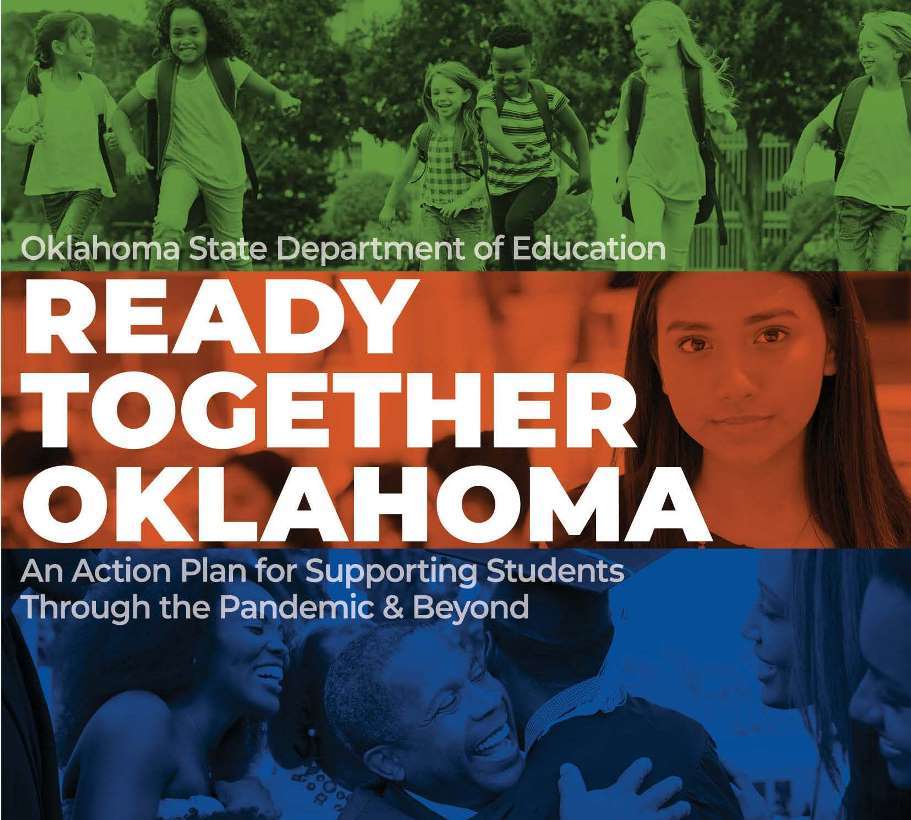 "Ready Together Oklahoma: An Action Plan for Supporting Students Through the Pandemic & Beyond" includes initiatives to bolster accelerated learning, strengthen instruction and address social-emotional issues due to disruptions caused by COVID-19.
View resources and strategies at https://readytogether.sde.ok.gov/.
 OSDE’s annual summer education conference, EngageOK on the Road, has once again been transformed into EngageOK in the Cloud.
Mark your calendars for June 21-23 and join us for free online professional development. This three-day conference will feature a variety of breakout sessions via Zoom.
Register today to secure your spot. Registering will allow you to access conference details and receive event-specific communication before, during and after the event.
View the conference agenda and other details at http://engage.ok.gov/in-the-cloud/.
|