Greetings Science Educators! For those I haven't had a chance to meet yet, my name is Tiffany Neill and I am the Executive Director of Curriculum and Instruction at the Oklahoma State Department of Education. As you may remember, Megan Cannon, the former Director of Science and Engineering Education at the Oklahoma State Department of Education, returned to her home district of Sapulpa to serve as the STEM and Science Curriculum Coordinator soon after having her first child. Until we fill the position, I'm thrilled to have the opportunity to support science educators again! I served as the Director of Science and Engineering Education at OSDE for five years prior to Megan. If you have any questions regarding science education this year, please feel free to email me at Tiffany.Neill@sde.ok.gov or call 405-522-3521.
|
The Oklahoma State Department of Education (OSDE) is seeking feedback on the revised Draft Oklahoma Academic Standards for Science (PreK-12), which are up for review and revision during the 2019-20 school year. The OSDE facilitates a revision of academic subject matter standards every six years in accordance with 70 O.S. § 11-103.6a.
Academic subject matter standards are concise, written descriptions of what students are expected to know and be able to do at a specific stage of their education. Academic standards describe educational objectives (i.e., what students should have learned by the end of a course, grade level or grade span), but they do not describe a particular teaching practice, curriculum or assessment method.
OSDE asks that all interested stakeholders provide feedback on the standards by following the process below:
- Gather a team of stakeholders and set aside approximately one hour to complete a review for each grade band you choose.
- Download the Draft Oklahoma Academic Standards for Science.
- Submit feedback by December 17, 2019, to publiccommentscience@sde.ok.gov.
All feedback received during the Public Comment period will be reviewed by the Oklahoma Academic Standards Review/Revision Executive Committee and Writing Committee for consideration in the revision process.
For additional information about the Oklahoma Academic Standards for Science Review/Revision Process, go to https://sde.ok.gov/oklahoma-academic-science-standards-review-process or contact Tiffany Neill, the Executive Director of Curriculum and Instruction at Tiffany.Neill@sde.ok.gov
|
 Nominate a deserving K-6 mathematics or science teacher within your district to win $10,000. Nominate a deserving K-6 mathematics or science teacher within your district to win $10,000.
Anyone – including principals, teachers, parents, students, business leaders or members of the general public – may nominate exceptional mathematics or science teachers who are currently teaching grades K-6 for the 2019-20 award year.
Teachers may also apply directly on the PAEMST website.
Nomination Deadline: March 1, 2020
- If a teacher will be applying for science and/or engineering, nominatethem in the science category.
- If a teacher will be applying for math and/or computer science, nominate them in the math category.
- Unsure which category to use to nominate a teacher? Nominees can choose their application category when they confirm their nomination.
Application Deadline: May 1, 2020
The Presidential Award for Excellence in Mathematics and Science Teaching (PAEMST) is the highest honor bestowed by the United States government specifically for K-12 mathematics and science teaching.
For more information, please visit the PAEMST website.
Congratulations to our latest national PAEMST Winners!
In October, four Oklahoma educators were named recipients of the prestigious Presidential Awards for Excellence in Mathematics and Science Teaching (PAEMST).
The following educators, recognized as the 2017 and 2018 awardees, travelled to Washington, D.C., for an awards ceremony and received a $10,000 award from the National Science Foundation:
- Gena Barnhill of Yukon Public Schools
- Julie Klingensmith of Norman Public Schools
- Jayci Harris of Byng Public Schools
- Megan Cannon of Sapulpa Public Schools
Learn more about the latest PAEMST winners for Oklahoma by reading this press release.
Science Fest is a day of interactive activities for 4th and 5th grade students in Oklahoma focused on Science, Technology, Engineering and Math (STEM) as they relate to environmental conservation and alternative energies.
Science Fest Oklahoma is designed to foster scientific literacy while educating children about protecting the environment, conserving natural resources, and using alternative fuels and technologies.
Educators plan a day packed with exciting exhibits, presentations, and hands-on activities all developed to show the importance of scientific applications in the environment.
To sign your school or class up, go to https://sciencefestok.org/register/
|
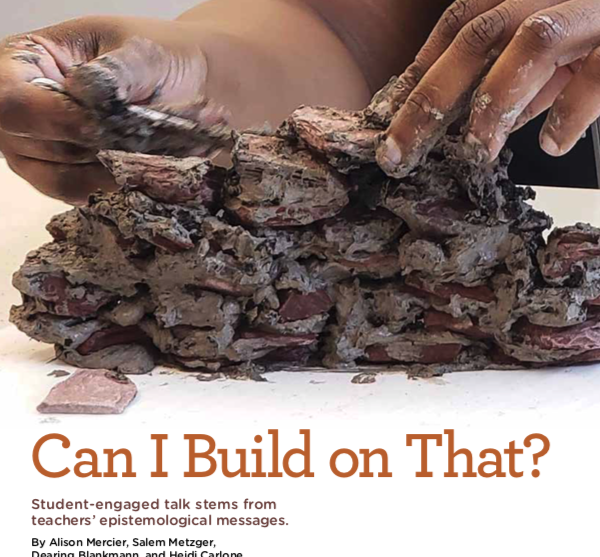
This powerful, FREE, article from NSTA's Science and Children Journal, highlights the power of classroom discourse for promoting equitable teaching and learning. The article highlights three messages that were sent, taken up and internalized by students when their teacher leveraged specific strategies for science talk aimed at student sense-making. Those three messages were:
- Knowledge is emergent; not linear.
- Peers’ thinking helps individual and group knowledge production.
- Students have “good” thinking, which can take many forms.
The students referenced in the article are early elementary students, many who are emerging bilingual. I love being reminded how powerful slight changes in our instruction can be for all students, especially those that often feel unsuccessful in school settings. The article is a great read, no matter what grade level you may teach!
Download the "Can I Build on That?" article today and join in the conversation with other Oklahoma teachers about this article and other #oksci topics on Twitter or Facebook.
|
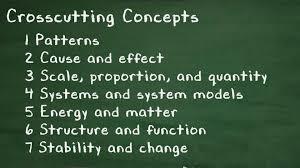
Crosscutting concepts (CCCs) are the second dimension of the new vision for science education. Crosscutting concepts are essential tools for teaching and learning science because students can understand the natural world by using crosscutting concepts to make sense of phenomena across the science disciplines (i.e., physical sciences, life sciences and earth and space sciences).
As students move from one science idea (sunlight warms the earth’s surface) to another science idea (sounds can make matter vibrate, and vibrating matter can make sound) within a class or across grade-levels, they can continually utilize the crosscutting concepts.
The crosscutting concepts can be utilized as consistent cognitive constructs for engaging in sense-making when presented with novel, natural phenomena (observable events that occur in the universe we can use science ideas to explain or predict).
The crosscutting concepts provide a consistent language for teachers to communicate with students. When teachers’ prompts are structured with the crosscutting concepts, the focus of student thinking can be directed to key aspects of the phenomenon, the system being investigated, and/or patterns that may be used as evidence to support explanations or arguments for the causes of a phenomenon. See an example of possible prompts using crosscutting concepts and sample student responses below (taken from the document Using Crosscutting Concepts to Prompt Student Responses):
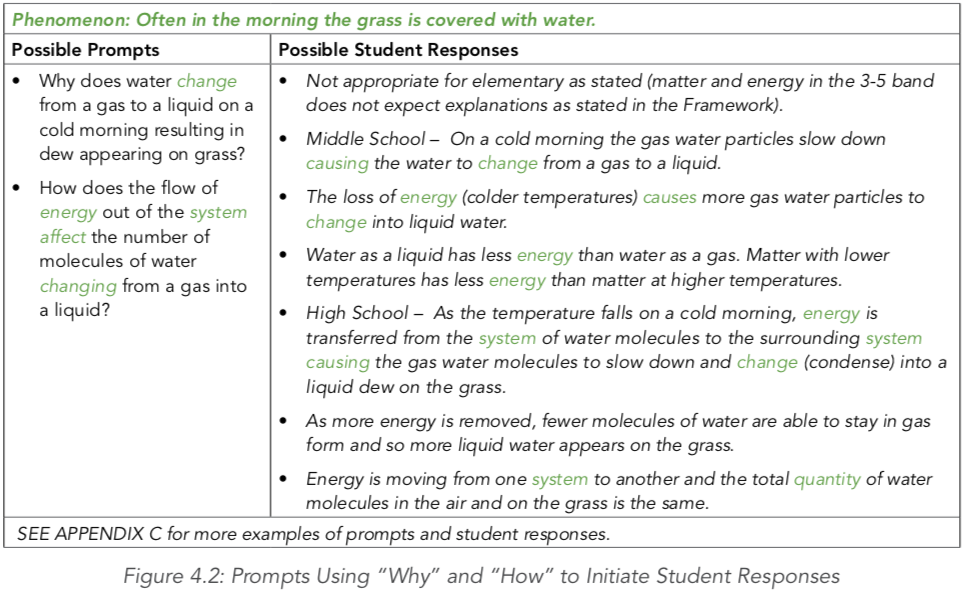 Using crosscutting concepts to focus student thinking creates a productive way to help students focus their thinking on specific aspects of a phenomenon (e.g., proportion of salt in water, scale of thickness of crust compared to diameter of Earth, flow of energy into or out of the system of a chemical reaction).
The crosscutting concepts become powerful when used as familiar touchstones of language initially by the teacher to prompt science performances and then by students to reason with and communicate their reasoning for the causes of phenomena. To learn more about how to utilize crosscutting concepts to prompt student thinking and responses download “Using Crosscutting Concepts to Prompt Student Responses”, created by CCSSO Science SCASS Committee on Classroom Assessment.
The document includes numerous crosscutting concept prompts like the ones found in STEM Teaching Tools #41. You can also read more about my personal journey of discovering the power of crosscutting concepts here and download two different forms of posters you can print for you classroom.
- Crosscutting Concepts Symbol Posters
- Crosscutting Concepts Single Poster
|