Volume I: Issue 1 September 2019
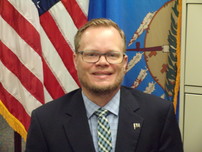
In late July of 2019 Todd Gragg entered into a brand-new role at the State Department of Education – the position of Personal Financial Literacy and Business Education Specialist. Todd is a lifelong Oklahoman, having grown up in the southeastern area of the state. After graduating from McAlester High School, Todd attended Oklahoma Baptist University where he studied psychology, ministry, and religion. Upon leaving OBU Todd spent over a decade working in the business and non-profit fields. After experiencing a measure of success in these areas, Todd had a chance to examine where he wanted to invest his time and energy the most. Being raised by two parents who were lifelong educators and then marrying an educator, it was an easy choice for him to move to the classroom.
For the previous three and a half years, Todd taught at Midwest City High School, teaching a diverse set of subjects including: Personal Financial Literacy, U.S. History, World History, AP® World History, AP® U.S. History, & AP® Macroeconomics. During that time, he was honored as the 2017 Next Gen Personal Finance Innovative Teacher of the Year, a 2017 National Endowment for the Humanities Summer Fellow, and the 2018 Oklahoma Council for the Social Studies Clara Luper Memorial Rising Star Award recipient. Todd brings a wealth of connections to this new position, with his roles on boards and councils with the Oklahoma City Branch of the Federal Reserve Bank of Kansas City, the Oklahoma Jump$tart Coalition, and the Oklahoma Council of Economic Education. Todd also served on the 2018 Social Studies Standards Revision Writing Team focusing on Economics and Personal Financial Literacy.
Todd and his wife Stephanie (an Instructional Coach and Title 1 Coordinator at Midwest City High School as well as a budding photographer) have 3 children: Bowman, Lorelai, & Cohen. In his free time, Todd loves being with his family and friends, reading, photography, playing board games, and watching his beloved Chicago Cubs. Todd can be reached at Todd.Gragg@sde.ok.gov or found online at www.mrgragg.com or via Twitter at @mrgragg.
|
Invest Ed® STARS (Students Tracking and Researching the Stock Market) is a free program created and implemented by the Oklahoma Department of Securities and is designed to promote investor education among Oklahoma students. STARS differs from similar programs because the focus of the stock portfolio is on long-term investing principles instead of short term gains. Performance is not judged on a small sample of stock performance: rather, it is assessed on what the students learn through the experience. STARS innovatively combines math, civics, financial literacy, and ELA skills as it requires students who compete to write a paper detailing what they have learned. Generous monetary awards are given to five regional winners and one state winner during each award period. For more information or to sign up to become a STARS teacher, visit their website.
PFL.1: The student will describe the importance of earning an income and explain how to manage personal income through the use of a budget.
PFL.1.1: Using decision-making models, evaluate how career choices, educational/vocational preparation, skills, and entrepreneurship affect income and standard of living (e.g., postsecondary degree/ certification, needs versus wants, and the ability to live on less than you earn).
PFL.1.2: Identify the components of a personal/family budget (e.g., income, savings/investments, taxes, emergency fund, expenses, and charitable giving) based on short, medium, and long-term goals (e.g., financial, personal, educational, and career).
As you begin the school year and think through how to manage covering all fourteen PFL Standards, let me encourage you not to rush through 1.1 to get to the meat of the content in 1.2. The decision-making processes and career exploration covered in 1.1 can set the course for much of what is to come, especially if addressing these topics with students not yet earning a paycheck. In this scenario use the career(s) they are interested in to develop a profile that they will utilize throughout the semester as you continue through the standards. This will help the students connect with concepts later in the course that otherwise might seem too far off to care about at the present time.
Career Exploration Tools
Decision Making Processes
Online Budgeting Tools & Games
-
Mint – a free budgeting app students can use to track their spending.
-
SPENT – an online interactive game requiring students to make financial decisions.
-
Visa Practical Money Skills Apps – A curated list of various apps designed to help students learn budgeting skills in an engaging and entertaining fashion.
Founded in 2010, The Penny Hoarder is one of the nation’s largest personal finance websites. Its mission is to make personal finance less intimidating and accessible. They seek to help people take control of their personal finances and make smart money decisions by sharing actionable and inspirational articles and resources on how to earn, save, and manage money. Check out their newly designed Academy and sign up for their daily emails here.
- Upcoming PD Opportunities – Register now for Fall 2019 Regional Workshops
- Title – Navigating the Maze of the 14 PFL Standards.
- PLC Focus – Intentional Sequencing of the Standards.
- When & Where
- Monday, September 23, 2019 – Broken Arrow
- Tuesday, September 24, 2019 – Ada
- Wednesday, October 01, 2019 – Lawton
- Wednesday, November 06, 2019 – Woodward
- Friday, December 06, 2019 – Oklahoma City
- The Financially Literate Educator – A weekly podcast, focused on Personal Financial Literacy in Oklahoma debuting Late Fall 2019.
- Information about updated Personal Financial Literacy curriculum.
- New presentation slides to accompany curriculum.
- Potential new Student Personal Financial Literacy Contests coming Spring 2020, stay tuned.
For my initial financial tip of the month I want to explore the relationship between savings and checking accounts. If you are like most people, the bulk of your income goes into your checking account, and it stays there to carry you through the month, and you place what is left into savings at some point before the next payday. Managing your accounts like this might be costing you money, especially in the digital age when all it takes is a few taps on the screen and money can be moved almost instantaneously from one account to another. If you want to maximize what your money can do for you, then the bulk of your money should always be in your savings. Even if your savings account earns the current national average interest rate of 0.09%, that is higher than the 0% interest your checking account is earning. This is especially true if your bank uses daily balance averages to calculate the interest paid. To maximize your interest earnings, you have to keep more money in your savings account for longer periods. But what about paying bills and spending money? That is easily handled by logging onto your online account or your app each morning and moving over what you might need for the day. If you pay all bills typically once a month, I would recommend moving the needed funds into checking a day or two ahead of the date you will be paying bills, and if it is typically right after payday, then let your salary be deposited into your checking account, pay bills, then transfer the bulk into savings. For those bills being auto drafted, inquire to see if you can pay them directly from your savings account to save a step of transferring money. For more information on this topic, I recommend reading Winning The Money Game by Adam Carroll and Chad Carden.
|