|
Dear Administrator,
The Oklahoma State Department of Education (OSDE)
has received a number of questions relating to the pay raise(s) provided for in
recent legislation, particularly in light of the Oklahoma Supreme Court’s
ruling in Oklahoma’s Children, Our Future,
Inc. v. Coburn, 2018 OK 55. This document is not intended to serve as legal
advice, but is general in nature relating to questions that the OSDE has
received as of June 22, 2018.
Best regards,
 Joy Hofmeister
State Superintendent of Public Instruction
Pay Raise/Referendum
1. What is the result of the challenge to Referendum
Petition 25/State Question 799?
On Friday, June 22, 2018, the Oklahoma Supreme Court issued a 36-page Opinion in Oklahoma’s Children, Our Future, Inc. v. Coburn, 2018
OK 55, concluding that both the gist of the Petition
and the Petition itself were legally insufficient and must be stricken from the
ballot. While the Court noted that nothing prohibits a new referendum petition,
it would be required to meet all referendum requirements (including the initial
filing of a petition with the Secretary of State and obtaining and filing 41,242 new signatures)
by July 18, 2018.
2. What does the Court’s ruling mean for public
schools? When does the teacher pay raise bill (House Bill 1023xx) go into
effect?
House Bill 1023xx, and the new minimum salary
schedule provided therein, is effective Aug. 1, 2018. This is true regardless
of any referendum petition.
3. Is the effectiveness of the new salary schedule
absolute?
Yes.
4. How was that conclusion derived?
Though questions have been raised as to what
effect Referendum Petition 25/State Question 799 against House Bill 1010xx
might have on the effectiveness of House Bill 1023xx, these questions were
clearly answered in Oklahoma’s
Children, Our Future, Inc. v. Coburn, 2018 OK 55. According to the
Court, the answer is “none.” The teacher pay raise bill will take effect on Aug.
1, and will do so regardless of any referendum petition. The Court’s opinion, effectively striking
Referendum Petition 25 from the ballot, means that the sources of revenue to
help fund the teacher pay raise provided in House Bill 1010xx will begin to be
collected by the Oklahoma Tax Commission. House Bill 1010xx was enacted upon the Governor’s signature on March 29,
2018, and will be effective June 27, 2018.
According
to the Court:
HB 1023xx was not made contingent on HB 1010xx’s
effectiveness, but rather on its enactment. A bill is enacted (and becomes law
on enactment) when it is passed by the Legislature and all of the formalities
required to make it a law have been performed….HB1010xx has been enacted. The
contingency requirement of HB 1023xx has been met, and it will become effective
on its specified date. [Aug. 1, 2018]. Id.
5. How is the raise determined?
House Bill 1023xx provides a new State Minimum
Salary Schedule for the 2018-2019 school year, meaning all certified personnel
as defined in 70 O.S. §26-103 will receive salary in the amounts specified. The new salary schedule is as follows:
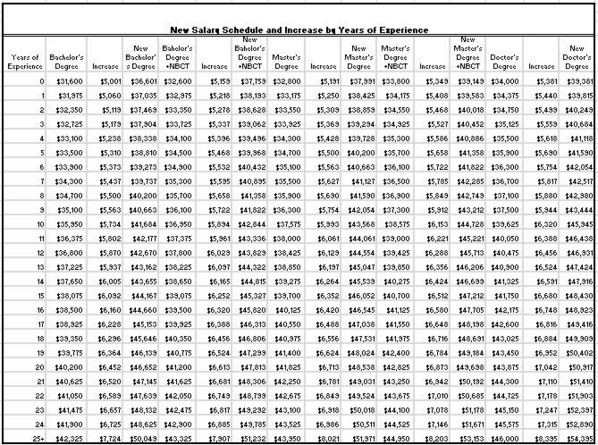 For a larger version, please click here.
6. Who will receive the salary increase provided by
House Bill 1023xx?
House Bill 1023xx provides an increase to the Minimum Salary Schedule
for “certified personnel,” which is defined in 70 O.S. §26-103 to mean a
“certified person employed on a full-time basis to serve as a teacher,
principal, supervisor, administrator, counselor, librarian, or certified or
registered nurse, but shall not mean a superintendent of a school district.”
This definition essentially includes all staff holding a teaching certificate, with
the exception of a superintendent.
7. What if the school district currently pays above
the State Minimum Salary Schedule?
House Bill 1023xx provides that those employed
as “certified personnel” in a school district paying above the Minimum Salary
Schedule during the 2017-2018 school year shall receive a “salary increase
amount equal to the amount indicated on the new minimum salary schedule for the
step level indicated … provided he or she remains employed by the same district
unless the hours or duties are reduced proportionately.” For example, an
individual with 10 years of experience receiving $1,000 above the minimum in the
2017-2018 school year would receive the raise required for 10 years of
experience in addition to the $1,000 currently received.
8. Are principals required to receive the salary
increase on top of what they are currently making?
Yes, see Questions 6 and 7 above.
9. What raise, if any, will a person receive if he
or she moves employment to a new school district?
All school districts must adhere to the new Minimum
Salary Schedule. However, if a person
was employed by a school district that paid above the Minimum Salary Schedule
during 2017-2018 but leaves for a job in a school district that pays at the new
Minimum Salary Schedule, the new school district is not obligated to pay above
the step level at the same amount as the previous district.
10. How will the Salary
Increases (certified and support) be calculated in the State Aid
funding formula?
The funding formula, per
statute, will be calculated per high year weighted average daily membership
(WADM). The additional formula funding dollars will increase the formula
factors, which in turn provide additional funding to districts.
11. If
the district receives very little or no State Aid formula funding, how will the
district receive funding for the salary increases?
The funding formula
takes into consideration several sources of funding (local, county and state
dedicated) to determine the amount of state-appropriated funding a district
will be allocated. If a district only receives transportation dollars or
receives little foundation and salary incentive aid from the state, then the
district relies more heavily on local and/or state dedicated sources and will
need to budget accordingly.
12. Do
you know what the future State Aid factors will be for FY 2019?
No, the data to
calculate those factors will not be available until mid-to-late July.
13. House Bill 1026XX provides a wage increase for
support employees. When does this take effect?
House Bill 1026XX is effective July 1, 2018.
14. What support employees are entitled to the wage
increase provided in House Bill 1026XX?
Though House Bill 1026XX does not reference or
define “support personnel” in any way, the OSDE believes the definition set
forth at 70 O.S. §26-103(4) is most appropriate and consistent with legislative
intent. This section of Oklahoma law defines “support personnel” as “full-time employees of a
school district as determined by the standard period of labor which is
customarily understood to constitute full-time employment for the type of
services performed by the employees who are employed a minimum of six (6) hours
per day for a minimum of one hundred seventy-two (172) days or a minimum of six
(6) hours per day for a minimum of one thousand thirty-two (1,032) hours per
year and who provide services not performed
by certified personnel, which is necessary for the efficient and satisfactory
functioning of a school district, and shall include cooks, janitors,
maintenance personnel, bus drivers, noncertified or nonregistered nurses,
noncertified librarians, and clerical employees of a school district but shall
not include adult education instructors or adult coordinators employed by
technology center school districts.”
15. Will part-time support personnel receive a wage
increase?
Yes. House Bill 1026XX provides that the dollar
amount of a salary increase is to be prorated based on the total number of
hours of work performed by a full-time-equivalent support employee. As such,
any individual who does not meet the definition of full-time support employee,
as defined in 70 O.S. §26-103(4), will receive a prorated wage increase. The
support personnel raise is permanent and not a one-time wage increase.
Retirement
1. If I recently retired, is there
a period of time during which I am not allowed to be employed by Oklahoma
public schools?
After a 60-day break in employment, a retired
member of the Oklahoma Teachers Retirement System (“OTRS”), other than a member
receiving disability retirement benefits, may be employed by Oklahoma public
schools and continue to receive monthly retirement benefits, but earnings
from such employment are limited based on the member’s age and how long he or
she has have been retired (see
Question 2, below).
2. What are the statutorily required limits on earnings from
employment while receiving retirement benefits?
A
retiree employed in any capacity by a public school is subject to the following
earnings limitations per calendar year (the “Earnings Limitations”):
- If he or she is 61 or younger
and has been retired less than 36 months, the earnings limit is the lesser
of one-half of the final average salary used in calculating the monthly
retirement benefit or $15,000.
- If he or she is 62 or older and
has been retired less than 36 months, the earnings limit is the lesser of
one-half of the final average salary used in calculating the monthly
retirement benefit or $30,000.
-
If he or she has been retired
for more than 36 months, there is no limit on earnings.(see
70 O.S. § 16-116.10)
When one’s
annual income from covered employment exceeds his or her earnings limit, notify
OTRS and either have monthly benefits reduced or plan how to repay any
overpayment of retirement benefits by March 1 of the following calendar year.
3. Is
it possible for a retiree to return to full-time employment with an Oklahoma
public school and not be subject to the Earnings Limitations?
Yes.
A retiree who returns to full-time employment may elect to continue monthly
retirement benefits until he or she reaches the Earnings Limitations (described
in Section 2) or elect to return to active contributing status. If he or she
chooses to return to active contributing status, his or her monthly retirement
benefits will be suspended until employment is terminated. He or she will make
contributions to OTRS in the same manner as active members, and upon
termination of employment, his or her monthly retirement will be increased to
include credit for the additional service. OTRS can provide detailed
information to assist in deciding which option is best when returning to
full-time employment.
4. What
paperwork must be completed prior to returning to employment without being
subject to the Earnings Limitations and making active contributions to OTRS?
The retired member must file an
irrevocable election to discontinue retirement benefits for the period of such
employment. The return to membership contributing status must coincide with the
beginning of a school year. If not, the member must refund all benefit payments
received from the start of the school year in which employment begins and make
employee contributions on any compensation earned from the beginning of the
school year to the date of the election to return to contributing status (see Oklahoma Administrative Code
715:10-17-13). For additional information, including what must occur if
post-retirement employment is terminated, contact OTRS at (405) 521-2387 or refer
to the aforementioned administrative rule.
5. What
effect does my post-retirement employment salary have on my future retirement
benefits?
Upon return to membership and contributing
status, service credits will be accumulated and credited to the member’s record.
Upon termination of post-retirement employment, a supplemental benefit for the
year(s) of additional service will be calculated using the standard retirement
benefit formula and retirement plan selected by the retiree when the member
first retired. Further, the average salary used in calculating the supplement
benefit will be the average of the salaries earned during the period of post-retirement
employment. The post-retirement
years of service cannot be used to wear away years that fall under the $40,000
cap.
6. Was
there a change in law pertaining to members who retired on or before July 1,
2017?
Yes. Effective July 1, 2017, Oklahoma law was
changed to provide an incentive for retired classroom teachers to return to
work as classroom teachers without impacting their retirement benefits. Stated
otherwise, legislation was enacted to allow members who retired on or before
July 1, 2017, to return to employment as classroom teachers with no earnings limitations
in certain circumstances (see 70 O.S.
§ 16-110(A)(3)).
7. What
are the circumstances in which someone who retired on or before July 1, 2017,
can return to the classroom without a limitation on earnings?
Notwithstanding as otherwise noted, each of the
following must be met before a member who retired on or before July 1, 2017,
may return to employment in an Oklahoma public school without a limitation on
earnings:
- The member must have been employed as an active classroom
teacher as is defined in 70 O.S. § 17-101(27) for at least one full school year
immediately prior to his or her date of retirement. Members employed as
superintendents, administrators or in other non-classroom teacher positions
(i.e., counselors) during the school year immediately preceding retirement are
ineligible;
- The member can
only be employed as an active classroom teacher as defined in 70 O.S. §
17-101(27) when he or she return to employment;
- The member must
have been retired and drawing an OTRS retirement benefit and not be employed by
any public school or career technology district in any capacity for the 12
consecutive months immediately following the last day of employment prior to
his or her retirement date;
- Prior to the
member’s return to employment, he or she must provide to OTRS documentation
establishing his or her eligibility under this provision. This documentation
must be accepted by and approved by OTRS prior to the member commencing employment
under this provision; and
- This opportunity
is only available for three years total, and will subsequently expire (see also OAC
715:10-1-15 and TRS Frequently Asked Questions).
|