ELEVATE: Coding Cracks Open Job Opportunities
Computer science offers solutions across all disciplines
MOORE (Dec. 6,
2017) – Zoe Berkowitz likes patterns, rules and order. A student at Moore High
School, she has her sights set on law school at Columbia University and is
taking as many classes as she can her senior year to help her once she’s in the
Ivy League.
That’s one of the reasons she picked her high school’s new
Advanced Placement computer science class.
Another reason is it’s fun.
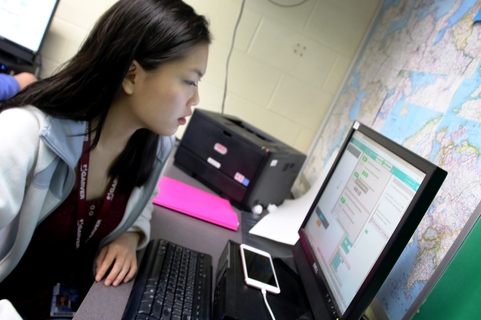
“What I really like is I get to write out exactly what I
want to happen,” Zoe said as she used coding skills to draw a diamond shape on
her computer. “I enjoy putting together the programs, writing the functions and
defining them. I just like putting all the puzzle pieces together.”
According to a nationwide Gallup research study, 93 percent
of parents want their children’s schools to teach computer science; however,
only 40 percent of schools offer classes with coding or programming. In
Oklahoma, only 3 percent of high school students take computer science.
Zoe’s computer science teacher, Vic Rook, is encouraging
other schools in Moore, including elementary and middle schools, to participate
in the Hour of Code, which takes place during national Computer Science
Education Week, Dec. 4-10.
Hour of Code is a grassroots campaign supported by more than
200,000 educators worldwide to introduce students to the creative world of
computer science by trying out coding for 60 minutes. Free interactive lessons
for kids and adults (some even feature Star Wars and Minecraft characters) can
be found at sites like code.org, codeacademy.com and scratch.mit.edu.
Rook argues that even a general knowledge of networks and
computer systems will help make students more responsible citizens in the
digital age.
“Almost everything we do these days is digital, from banking
to social networks, and it’s almost like we’re all driving cars but we don’t
have any idea how they work or just barely know how to put gas in them,” Rook
said.
|
New academic
standards
Rook is part of the review and revision team for the
creation of the new Oklahoma Academic Standards for Computer Science, the first
draft of which will be released and open to public comment Friday, Dec. 8. The
standards are intended to provide a strong learning progression of key concepts
from kindergarten through 12th grade.
“When people read these standards, they should be nodding
their heads, not scratching them. People sometimes get carried away with overly
complex language, and it should be simple, clear and easily executed,” Rook
said.
Levi Patrick, assistant executive director for instruction
at the Oklahoma State Department of Education, said the standards are tied to
research-based practices and are designed for computer science classes but can
even be inserted into general education lessons to give students early exposure
to computer science principles.
Patrick said computer science is deeper than keyboarding or
learning word processing programs. Key concepts for elementary ages are that
information can be communicated across the Internet in small packets and users
have the responsibility to interact online safely and securely.
The high school concepts, such as working with large data
sets to analyze, visualize and draw conclusions from trends, are designed to
build skills so that students can earn college credit through the new Advanced
Placement Computer Science Principles test, which was introduced last year, and give students background knowledge for a broad range of careers.
“You wouldn’t want to hire someone who can’t hold a
conversation, and soon you won’t want to hire someone who can’t manage data,”
Patrick said.
Pat St. Clair started her career as a geologist before
teaching computer science at Edmond Memorial High School. She says at its core,
programming and algorithms are forms of problem solving, a critical skill for
every professional.
“When you follow a recipe, that’s just an algorithm,” said
St. Clair, who is on the executive team for the new computer science standards.
“First responders use algorithms all the time: ‘Are they breathing? If not,
this is what I need to do first. Can I find a pulse? If yes, go on to this next
step.’ So algorithm is a word you see a lot more than you did 10 years ago, but
all it means is just a set of directions.
“I tell students to major in your passion, because whatever
your passion is, you’re going to be able to use computers to leverage that
passion and address real problems,” St. Clair said.
|
The Bureau of Labor Statistics shows that computing jobs are the No. 1 source of new wages in the U.S., but those jobs aren’t just for computer science majors. Sixty-seven percent of computing jobs are outside the tech sector, according to a Georgetown University study.
McKalyn Danner, director of The Div, a nonprofit that offers technology camps for kids and professional development for teachers, said fields like artificial intelligence aren’t science fiction anymore.
“Those jobs of the future are actually right here, right now opportunities, and they’re often found where you’d least expect them. The jobs are in every industry and every state, and they’re projected to grow at twice the rate of all other jobs,” Danner said. “Nearly every single industry has been turned upside down by computer science, and a few examples here in Oklahoma include retail, oil and gas, biosciences, agriculture and aerospace.”
Careers in computer
science
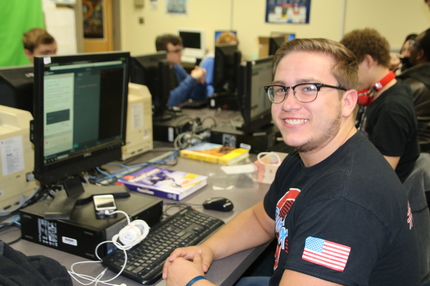
Cainan Nelson, another senior in Rook’s AP computer science
class, is working toward a career in cybersecurity and wants to join either the
Air Force or the Navy. He is learning JavaScript and finding creativity in a
programming language that uses if/then logic.
“What I like about how it works is that it’s not always
straight to the point. You do have to kind of get in there, figure out how it
works and mess up a couple of times. That way you know what not to do. I like
that aspect of computer science – the trial and error,” Cainan said.
Cainan, an offensive lineman for the Moore High School
football team, said the problem-solving skills he’s practiced in computer
science are helpful to him in other areas as well.
“I had an issue where I was trying to do something, and I
told Dr. Vic, ‘I can’t do this. I don’t know how.’ He said, ‘You’re in
here because you can figure it out.’ So I just kept working on it, and 10 to 15
minutes later, I was able to do what I was trying to do. That helps me in other
classes, because if I can’t find the solution to something, I know I can go
back, retrace my steps, see what’s not working and figure out what will help,”
he said.
Col. Charles Gaona, deputy director of engineering and
technical management at the Air Force Sustainment Center at Tinker Air Force
Base, said electrical engineering, computer science, computer engineering and
information technology are all among pathways to come into a career at the
base.
“We can’t hire enough software engineers out here at Tinker.
We’ve got about 1,100 software engineers. It’s been growing at about 10 percent
per year, and we’re behind on meeting our hiring needs,” Gaona said.
Gaona said advancements in mobile applications, driverless
cars and factory automation are just as important to the Department of Defense
as they are to commercial industry, if not more. He believes the key to being
prepared for the future is getting kids excited about science, technology,
engineering and math early.
“Today we defend our country by dropping bombs and shooting
bullets, but some would say tomorrow, others would say right now, we’re
defending our country by manipulating ones and zeros around the network. To be
good stewards of our country, we’ve got to grow our talent. We’ve got to grow
creative, problem-solving citizens who want to understand how computers work,”
Gaona said.
|
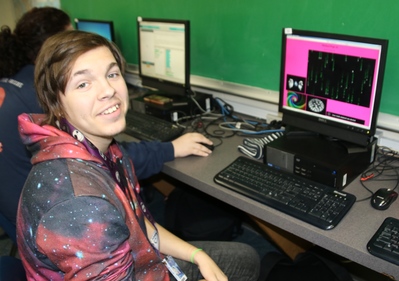
For Michael Pope, computers altered his academic trajectory.
With no interest in college, he changed his mind after taking Rook’s class and
is now headed to Northern Oklahoma College in Tonkawa to study animation after
he graduates in the spring.
In class, Michael adds zombie bears and elephants into a 3-D
gaming environment through a program called Unity. By downloading models and
writing and debugging scripts, he is able to create a video game with a narrative.
He and his classmates have used the program to construct dozens of virtual
reality research projects, including one in which users can don a pair of
goggles and take a trip to the moon to learn about Neil Armstrong.
Michael and his class have even taken their virtual reality
projects into elementary schools to share with children and says he never could
have predicted his future without tinkering with coding first.
“It takes actually doing it to figure out
whether you like it or not,” Michael said. “I’m very much a person who will do
anything once. I’ll dive in head first.”
|
Annette Price is communications and constituent services specialist at the Oklahoma State Department of Education.
###
PHOTOS:
Zoe Berkowitz, a senior at Moore High School, is taking an
Advanced Placement computer science class to be better prepared for a career in
law.
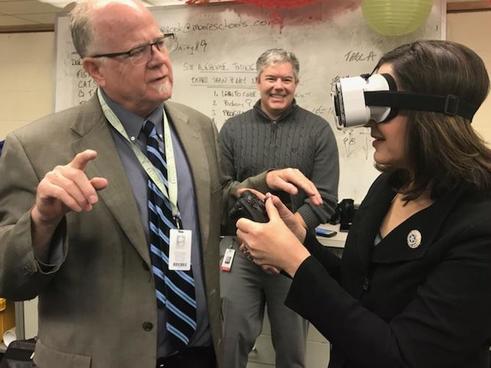
Moore High School computer science teacher Vic Rook shows State
Superintendent of Public Instruction Joy Hofmeister a virtual reality program
one of his students created.
Cainan Nelson, a senior at Moore High School, is taking an
Advanced Placement computer science class to be better prepared for a career in
cybersecurity.
Michael Pope, a senior at Moore High School, is taking an
Advanced Placement computer science class to be better prepared for a career in
animation.
|