Oklahoma ACT participation increase highest in the nation
OKLAHOMA CITY
(Sept. 7, 2017) – Oklahoma increased its ACT participation by 29 percent in one
year – the largest gain of ACT-tested graduates in the country. Oklahoma joins the
collection of states identified by ACT as having 100 percent of 2017 graduating seniors taking the
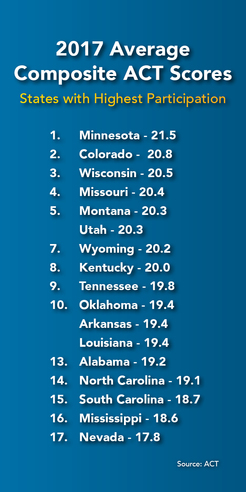
national college entrance exam. Of those states, Oklahoma tied for 10th place for the top average
composite score. Accompanying the dramatic influx of test-takers, Oklahoma’s
average ACT score dropped only one point, from 20.4 to 19.4.
In 2017, participation grew to 42,405 students from 32,854
in 2016. This change reflects efforts of a statewide 2016 pilot program in
which the Oklahoma State Department of Education (OSDE) gave all high school juniors
an opportunity to take the exam free of charge. The graduating class of 2017 was
the first to participate in the voluntary program.
“By opening up the college entrance exam to all students, including
those who otherwise might not have had access to the ACT, we are not only
providing them an on-ramp to postsecondary education, we are gaining valuable
insight into the skills gap we must overcome for our young people to be
competitive nationally,” State Superintendent of Public Instruction Joy
Hofmeister said.
Achieving a benchmark score in an ACT subject area indicates
a student has a 50 percent chance of obtaining a B or higher or a 75 percent
chance of earning a C or higher in a corresponding course in college. The four ACT
benchmark areas are English, reading, mathematics and science. Subject-area
benchmark scores range from 18 to 23.
The 2017 data reveals that 42 percent of Oklahoma graduates
did not meet any of the ACT College Readiness Benchmarks, while 16 percent met
all four.
|
“This is the first time we have had a complete picture that
can predict graduates’ readiness to compete in the global marketplace. Before
now, our state ACT scores did not measure the needs of the ‘hidden’ student –
be it a low-income student who could not afford a college entrance exam or a
rural student who could not reach a testing site. Now we can pinpoint which
students need help to bolster their skills before graduation,” Hofmeister said.
Hofmeister said the more comprehensive Oklahoma Academic
Standards in mathematics and English language arts, which were implemented last school year, will help boost student achievement. More complex assessments measuring those
new standards were first given to students last spring, and results are
expected later this fall.
The state’s new standards and assessments are part of OSDE’s
strengthened efforts to ensure students are nationally competitive and able to
achieve academic excellence, one of four overarching pillars in the state’s
eight-year strategic plan. The strategic plan is a central element of the
consolidated state plan OSDE will submit next week to the U.S. Department of Education,
as required by the Every Student Succeeds Act, or ESSA.
In addition, one of the goals of the state plan is to reduce
the need for college remediation in math and English language arts by 50
percent. Currently, 38 percent of all first-year college students in Oklahoma
require remedial courses before earning college credit, costing Oklahoma
families an estimated $22.2 million each year.
“We must prepare students for the next step once they graduate
from high school. We are confident those efforts will be reflected in higher
numbers of college and Career Tech enrollments and in reduced college
remediation numbers,” Hofmeister said.
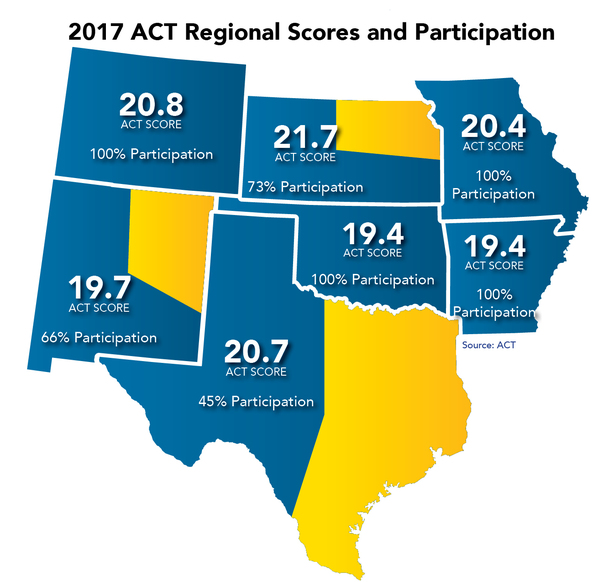
Oklahoma’s average composite ACT score of 19.4 was identical
to Arkansas, which also had 100 percent participation. Colorado and Missouri
were higher-scoring regional states with 100 percent participation.
Nationwide, the average composite ACT score increased
slightly, from 20.8 to 21, while the number of test-takers dropped by about
60,000 students.
In Oklahoma, nearly half (47 percent) of the test-takers expressed
an interest in science, technology, engineering and math careers.
 ###
|