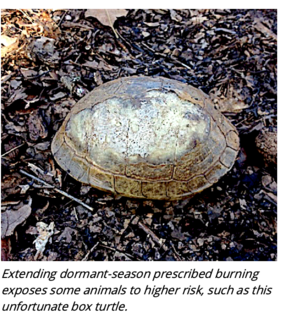
Box turtles, glass lizards, and other reptiles are particularly vulnerable during this period. As the soil temperature increases, many reptiles are emerging from underground burrows. However, they are still lethargic and not always able to move to avoid the fire. To minimize the potential of causing injury or mortality to these animals, there are several things that burn practitioners may consider. First, if your objective is a dormant season burn, get your burns completed prior to mid-March as most reptiles will still be safely buried. Burning during the winter (November-February) typically achieves the same vegetation response as an early spring (March-April) burn. Further, the winter months often have safer weather conditions than March or April as winds are typically lower and the weather is more stable. Also, consider growing season burns. July-October is typically a safe time to burn in Oklahoma unless we are experiencing an extreme summer drought. Humidity is generally high and vegetation has a lot of moisture in it which slows the rate of spread of the fire. Further, burning during the late growing season can be useful for woody plant control and for many wildlife objectives. While reptiles are active during the late growing season, they are mobile and typically are able to move underground or away from fires.
Prescribed fire is a critical land management practice and it may occasionally be necessary to burn during March and April to meet fire frequency objectives. But, by burning some of your land during other seasons and spreading out the burn season, you can minimize the potential negative effects on sensitive reptiles.
Declare War on Bradford Pear
As spring approaches, many flowering trees will begin to show their color. Despite the beauty they provide, some of these blooming trees are problematic. The callery pear, often called Bradford pear, is commonly planted across Oklahoma. Due to its invasive potential, it has now escaped and is spreading across the eastern portions of the state. March is a great time to spot them along forest edges, in pastures and prairies, and near old homesteads. They bloom about the same time as our native plums, so care should be taken for proper identification. Bradford pears can quickly invade and take over pasture and prairie, reducing forage for cattle and competing with many native desirable plants. The Bradford pear is much more difficult to control than eastern redcedar as the pear aggressively resprouts from the root if it is cut down or burned. Therefore, herbicide will be needed on established trees. Herbicide can be applied to the freshly cut stump, sprayed into cuts into the bark, or applied to the foliage of smaller trees. Talk to your county Extension educator for specific recommendations on herbicide application.
There are several things that the public can do to help control this invader. First, remove them from home landscapes as they serve as a seed source that is causing problems for your neighbors. If you have them in pasture, forest, and prairie, control them before they become established. Once the mature plants are removed with herbicide, periodic fire will help keep new seedlings from establishing. If you see them for sale at a plant nursery or greenhouse, explain to the manager about why this plant is a poor choice. There are several alternative plants that are not invasive and are also more wind and ice resistant than Bradford pear including redbud, American plum, and Carolina buckthorn. Municipalities and commercial property owners should also remove Bradford pear and aggressively control resprouts and seedlings. More information about control and alternatives is online at https://extension.okstate.edu/fact-sheets/the-invasive-callery-pear.html.
Quail Ecology and Management Project Report for February 2020
Provided by Oklahoma Cooperative Fish and Wildlife Research Unit, Oklahoma State University
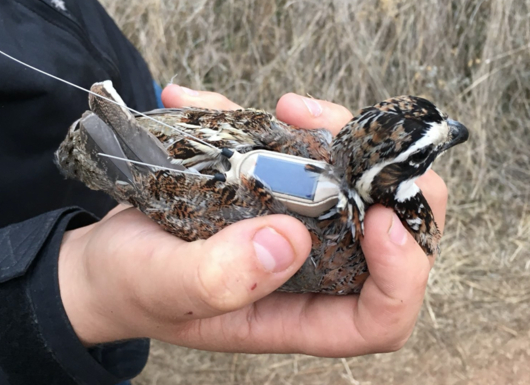
We spent February trapping at Sandy Sanders Wildlife Management Area and were able to deploy 13 transmitters. Curiously, we only saw a total of two quail on the WMA during our first three weeks at Sandy Sanders (of which we trapped one twice; see photo above headline). Our observations were reinforced by conversations with hunters and WMA personnel who also reported few observations of quail on the WMA during this period. Then, during the last week of February, we suddenly observed several coveys on the WMA, resulting in a total of 13 transmitters being deployed. We recovered eight downed transmitters during February, with one recovered from Beaver River WMA, two from Packsaddle, and five from Sandy Sanders. Three showed obvious signs of predation (two attributed to mammal predation and one to raptor predation). No obvious cause of death could be attributed to the other five, mainly due to longer times between when the bird died and when the recovery was made. During February, we had 15 active GPS transmitters across the four WMAs, with two deployed at Cross Timbers and 13 at Sandy Sanders. All transmitters were of the type with satellite-download. We have now collected 44,224 individual locations since the launch of the first transmitter in July 2018. We took delivery of a new batch of 28 transmitters in February.
Two new trapping technicians, Samantha Maywald and Alexis Hamous, were hired during February to replace our outgoing technicians. The 12 wildlife cameras positioned on the research plots at each of the four WMAs continue to record wildlife use at each treatment plot. The cameras captured 42 images of wildlife during February, with 34 images of white-tailed deer, five of coyotes, and one image each of black-tailed jackrabbit, white-crowned sparrow, and an unidentified dove. Since the wildlife cameras were put up at the research plots, they have captured 127 photos of wildlife at growing-season burn plots, 84 at control (no-burn) plots, and 40 at dormant-season burn plots across the four WMAs. Preliminary analyses of bird survey data and vegetation data, as well as movement data from the GPS transmitters, continued during February. Samantha Cady and Landon Neumann presented preliminary results from their respective Ph.D. and M.S. projects at the Oklahoma Natural Resources Conference in Norman.
For the invertebrate work, student workers have identified, counted, and measured the size of invertebrates in 440 of the 480 pitfall trap samples. Jacob Reeves has input more of the data into the spreadsheet and is continuing to learn how to use the software for the multivariate analysis of the arthropod community data. Jacob also presented the results of the lipid and exoskeleton of potential prey of quail at the Oklahoma Natural Resource Conference. Since presenting these data, he has performed another round of lipid assays on samples to increase the sample size of individuals and arthropod orders analyzed. Additional exoskeleton analyses have also been conducted, especially on samples that appeared to be outliers in the initial analysis. We have started preparing the samples for protein analysis by grinding the arthropods and weighing subsamples of the ground tissue. The photo shows subsamples of arthropod tissue in vials as they await protein analysis. The protein analysis involves digesting the tissue in sodium hydroxide, pipetting it onto microwell plates, adding chemicals from a protein assay kit that cause the sample to change color proportional to the amount of protein in the sample, and reading the color change on a microplate reader.
* * *
(This project is funded in part by the Oklahoma Department of Wildlife Conservation, Federal Aid Project F18AF001-10: Quail Ecology and Management II.)
|