This year marks the 51st anniversary of the Rehabilitation Act of 1973, which prohibits discrimination on the basis of disability in programs conducted by federal agencies, in programs receiving federal financial assistance, in federal employment and in the employment practices of federal contractors.
The Rehabilitation Act of 1973 was the United States’ first major federal disability rights law and was passed on Sept. 26, 1973. It opened doors for many qualified individuals with disabilities to enter, for the first time, the federal and federal contractor workforce.
The Rehabilitation Act introduced profound change and served as the model for the ADA of 1990, which prohibits, among other things, employment discrimination against qualified individuals with disabilities in the private sector. Over the years, the laws have evolved and come to reflect each other as progress continues toward the goal of equal opportunity in the workforce.
July is also Disability Pride Month. Over 1 billion people comprise the global disability community, making it the most expansive and diverse minority group globally. People with disabilities are represented by all ages, ethnicities, genders, sexual orientations, religions and socio-economic brackets.
Oklahomans are invited to join advocates in celebrating the 34th anniversary of the Americans with Disabilities Act on Friday.
A rally will be held from 11 a.m. to 2 p.m. Friday at the Oklahoma State Capitol.
Participants are asked to show support by wearing red, white and blue and arrive at the Capitol by 10 a.m. Signs can be made in Room 100 in the Capitol or participants can bring their own.
Participants will gather in the south parking lot at 11:30 a.m. for a parade along the sidewalks of the Capitol.
State Rep. Ellyn Hefner will host a press conference speaking about the ADA in the House Lounge on the fourth floor. She will be joined by other Legislators and local leaders. This is open to the public and will follow the parade.
After the press conference, participants can return to Room 100 to watch the #ThanksToTheADA videos, hear from other speakers, learn advocacy tips, and voter registration. This time can also be used to write notes to Legislators and drop them off at the offices. Participants are also encouraged to record short videos showing support and sharing them on social media with the hashtag #ThanksToTheADA.
Stay engaged by following the group’s Facebook event page.
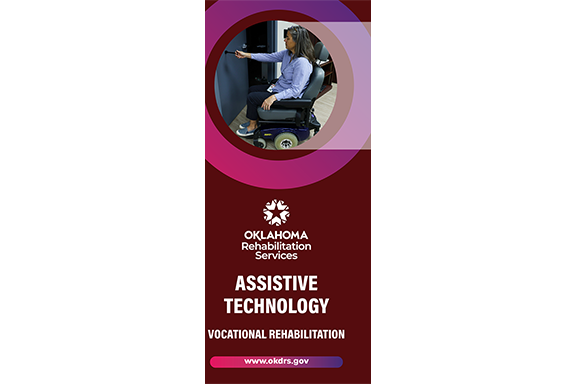
A new Vocational Rehabilitation Assistive Technology brochure is now available for ordering from the DRS brochure order form.
The brochure can be reviewed at our website.”
Courtesy of Oklahoma State Department of Health
OKLAHOMA CITY – Oklahoma State Department of Health data show from 2013 to 2022, there were 141 heat-related deaths in Oklahoma, with more than 85% occurring from June to August.
However, heat can be impactful any time of year, especially if the temperature outside is nearing 90°F.
Heat-related deaths and illnesses are preventable, so it is important to keep safe while enjoying the outdoors.
Stay Cool:
- Wear lightweight, loose-fitting clothing to allow your body to breathe and regulate its temperature.
- Plan outdoor activities during the cooler parts of the day, such as morning or evening.
- Pace yourself outdoors, especially if you're not used to working or exercising in the heat.
- Listen to your body; if you start feeling lightheaded, confused, weak, or faint, take a break in a cool or shaded area, resting until you feel better.
Stay Hydrated:
- Drink plenty of fluids and try to avoid sugary or alcoholic drinks, as these can contribute to dehydration.
- Drink cool or room temperature beverages; very cold drinks can cause stomach cramps.
- Replenish salt and minerals lost from your body after prolonged or heavy sweating.
Stay Informed:
The impact of heat can vary depending on the person and other personal health factors. For example, individuals with a heart condition are more susceptible to heat illness than individuals who don’t have a heart condition.
“You want me to speak to the whole group about the whole agency?”
Have no fear, we've got you covered. The Communications Office has created a new presentation for staff to use when they need some visual aids for public speaking. The presentation has updated the information used in the previous versions.
Here are the links:
The DRS’ updated letterhead for your office is on iDRS.
It has the new Commissioners listed. Please replace your current letterhead.
 Macular degeneration threatened Oklahoma woman's independence
Taken from a submitted DRS Client Success story
Sapulpa’s Anna Benson turned to DRS after macular degeneration led her to suffer vision loss.
Services Benson received included:
- Training/education
- Counseling and guidance
- Telecommunications and adaptive equipment
- Information and referral
- Independent living services
- Library for the Blind and Physically Handicapped services
- Orientation and mobility training
- Technology services
- Braille skills
Benson said if DRS had not been there to assist her, she does not know how she would have adapted to the vision loss.
“First, thank God for providing me these services and others in my area (Creek County),” she wrote. “These services have given me the knowledge and resources to have the proper adaptive equipment and skills to be independent in my home and daily living.”
DRS staff who assisted her were Rehabilitation of the Blind Specialists Jenifer Harris and Jane Lansaw.
|