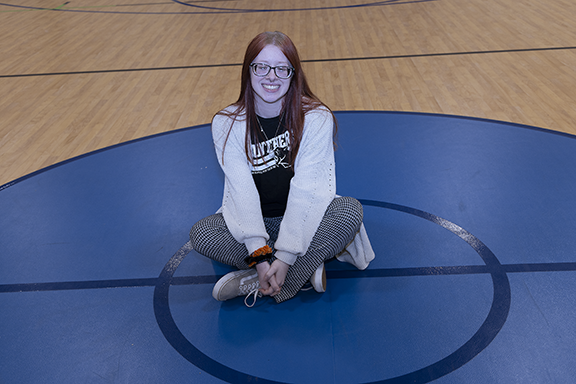
Emileigh Jackson found herself shy and uncomfortable while attending public schools in Tulsa.
Jackson, 17, felt separated from other students because she is legally blind and has Nystagmus, which causes her eyes to shake, often giving her headaches.
Emileigh’s mother learned about the Oklahoma School for the Blind in Muskogee. Halfway through her daughter’s 7th-grade year in 2019, the two traveled to the school to learn more. She began attending OSB soon afterwards.
“My old school would not give me the things I needed,” Emileigh said. “Like, I needed to be closer to the board. I needed things in large print. They wouldn’t accommodate me. My mom hears about this school, and we were like ‘let’s go see and find out if they will give me what I need.’ They would, so I came here.”
Emileigh has blossomed at OSB and serves as the school’s cheerleading squad captain.
“When I was at my old school, I was really shy,” she said. “I was uncomfortable. I didn’t know how to do a lot of things. This school (OSB) has helped me know how to live normally with my disability and how to advocate for myself. It helped me a lot in the real world.”
Emileigh stays at the school during the week but goes home on Thursday and returns to OSB on Sunday. She has a weekend part-time job at Chuy’s Tex-Mex restaurant in Tulsa.
OSB staff provide Emileigh with direct interactions with teachers along with all accommodations she needs to be a successful student and young adult.
“Here I get a lot more one-on-one time with teachers than I ever got in my public school,” Emileigh Jackson said. “At my public school, it was 20 students in a class. I didn’t learn near as much because every other kid was also getting help. The (OSB) teachers are helpful in general, not just with what they are teaching but with anything else I need. They are willing to help no matter what.”
“Here I get a lot more one-on-one time with teachers than I ever got in my public school,” she said. “At my public school, it was 20 students in a class. I didn’t learn near as much because every other kid was also getting help. The (OSB) teachers are helpful in general, not just with what they are teaching but with anything else I need. They are willing to help no matter what.”
At OSB, she has enjoyed the English classes she has taken, the Jazz Band she performs in as a keyboardist and as a senior leading the cheer team.
“At a public school, I wouldn’t be able to do cheer because my vision — sometimes it lags,” she said. “Here, everybody is able to do what they want. I think that one of my favorite parts about this school is that everyone is involved, no matter what.”
Emileigh said she believes OSB can help Oklahoma youth with a vision disability grow into independent and well-rounded adults.
“I feel like this school, not even with just the school aspect but with the life aspect as well, teaches you how to live life independently,” she said. “This school helps with all of that and teaches your child to be successful and not to be scared.”
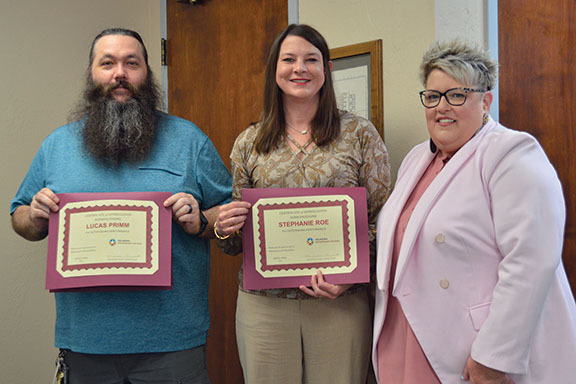 From left, Lucas Primm, Stephanie Roe and DRS Executive Director Melinda Fruendt.
DRS' Lucas Prim and Stephanie Roe were recognized for their hard work in coordination of and setup for the several weeks of logistics in hosting a three day meeting with Vocational Rehabilitation Quality Management Technical Center staff.
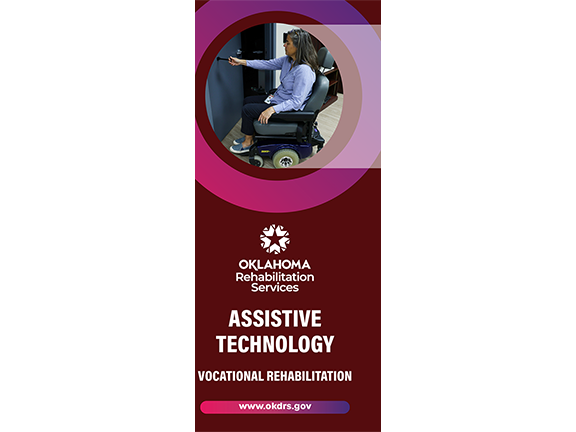
An updated Vocational Rehabilitation Assistive Technology trifold is now available on the DRS’ brochure order form.
The VR AT can be found at our website.

Here are some of the new people you may meet soon at an upcoming event. Take some time to welcome the following to their new positions and see who's retired.
New hires or new jobs:
OSB – Construction/Maintenance Technician Michael Wiedel began the new job on April 1.
OSB – Construction/Maintenance Technician Christopher Jacob began the new job on April 1.
OSB – Independent Living Instructor Lynnette Cooper began the new job on April 1.
OSD – Direct Care Specialist Militsa Embaugh began the new job on April 1.
OSD – Teacher Pamela Fylstra began the new job on April 1.
VR – Secretary Judy McIntosh began the new job on April 15.
VR – Vocational Rehabilitation Specialist Gordon Xiong began the new job on April 23.
VR – Vocational Rehabilitation Specialist Kayla McKelvin began the new job on April 1.
VR – Rehabilitation Technician Sharon Hultgren began the new job on April 1.
SBVI – Vocational Rehabilitation Specialist Deitra Woody began the new job on April 1.
SBVI – Assistive Technology Specialist Alan Helmer began the new job on April 22.
 Future is bright for Oklahoman who turned to DRS for help in reaching her career goals
Taken from a client submitted success story:
McAlester’s Kendall Young-Blocks turned to DRS for support in pursuing her dreams of joining Oklahoma’s workforce.
Young-Blocks, who has scoliosis, turned to DRS in her junior year of high school.
Services she received from Vocational Rehabilitation staff included:
- Training/education
- Counseling and guidance
- Telecommunications and adaptive equipment
- Information and referral
Young-Blocks attended the University of Oklahoma, earning a master’s degree in Social Work.
“I currently have a provisional license but hope to continue testing to obtain my LMSW (Licensed Master Social Worker) and then continue to obtain my LCSW (Licensed Clinical Social Worker),” Young-Blocks said.
She was able to leave school with a degree and without the burden of student debt.
I truly am forever grateful for the support and privilege of having been a student of DRS,” Young-Blocks wrote. “I cannot thank this program enough for pushing me to success.”

From the DRS News Archives
Courtesy from the Tulsa World
Dated: June 9, 2016
When Jose and LaDonna Rodriguez’s son Joseph got a headache, they weren’t sure what to make of it.
It turned out that Joseph, now 13, had a brain tumor.
His optical nerves were damaged, and as of last year, he is blind.
After undergoing bouts of radiation and chemotherapy, Joseph has been cancer-free for nearly four years.
That’s the good news.
The bad news is that Joseph, once an enthusiastic young artist, largely gave up the hobby of drawing and using his favorite pastels.
“We’re trying to show him there’s stuff out there you can do still,” Jose Rodriguez said.
Enter John Bramblitt, an artist from Denton, Texas, whose work has graced national news outlets, magazines and major film productions.
Bramblitt is blind. He lost his sight in 2001 due to complications from epilepsy and Lyme disease.
As a coping mechanism, Bramblitt started painting.
He’s done portraits of celebrities, landscapes, his own creations — and there’s no way anyone who looks at his work could know it was the doing of a blind man.
Bramblitt uses a variety of methods — there’s an FAQ on his website — but he mainly makes his compositions through touch. In his own words, all eyes really do for an artist is show where things are placed and which colors to use.
By feeling lines on the canvas and using Braille to identify his paints, Bramblitt’s sense of touch has replaced his eyesight.
On Wednesday, Bramblitt conducted a downtown workshop at Tulsa Community College’s Center for Creativity for students at the Oklahoma School for the Blind, NewView Oklahoma, TCC and members of the public.
The event was free. Eyesight and artistic talent were not required.
For Joseph Rodriguez, the experience was a chance to get back into art. Painting’s not really his thing, but after meeting Bramblitt the night before the workshop, Joseph is considering picking up those pastels he used to love.
“It’s cool that he’s getting out and experimenting with art and stuff,” Joseph said of Bramblitt.
At the workshop, the people who had eyesight wore blindfolds. Everyone had an embossed, blank image of a flower placed in front of them. They felt their way around the flower and dipped their fingers into the paints.
Each color had varying sizes of granules — yellow had big, thick ones, for example.
In a second exercise, the painters basically got to do whatever they wanted while music played in the background.
Amanda Wood, a TCC student taking a Drawing I class, was having some difficulty with the blindfold on.
“I don’t know how he (Bramblitt) does it,” she said. “I give him kudos, because it’s really hard.”
The important thing to remember is that there are varying levels of blindness, and everyone’s way to cope with it is different. Sierra Rankin, 16, of Sulphur, was diagnosed with a brain tumor in 2010, and her vision decreased rapidly.
She can still see facial features and fuzzy outlines of things, but it’s been an adjustment, Rankin said. An artist herself, she dabbles in charcoals, pastels and pencils.
Art is a refuge for when Rankin has bad days, she said.
“There is nothing you can’t do,” Rankin said. “Blindness can’t stop you from doing anything. Maybe driving.”
Tai-Yauri Thomas, 15, of Oklahoma City, and Nicholas Morrison, 15, of Muskogee, have taken art classes before — but it was with someone telling them which colors were what.
“You can be a little more independent,” Morrison said of Wednesday’s workshop.
Morrison painted a bird during the free-range portion of the workshop.
“I just use my imagination from what I used to see,” said
Morrison, who lost his sight at the age of 5 after a car hit him while he was riding his bicycle.
For Thomas, as she gets older, dealing with blindness makes art more difficult.
“I still try to do it,” said “Tai-Tai,” as people call her.

 Riddle Me This: Heavyweight challenger
This edition's question:
Forward, I am heavy; backward, I am not. What am I?
The answer:
???
Send us your answer
Last edition’s question:
Paul's height is six feet, he's an assistant at a butcher's shop, and wears size 9 shoes. What does he weigh?
The answer:
Meat
Those getting it right included:
- Victoria Drake
- Dayna Jarman
- Maggie Mattox
- Tiffany Davis
- Darlene Carnahan
- Bernadette Ishmael
- David Goff
- Cyndi Loughner
- Kristy O’Neal-Nelms
- Jane Lansaw
- Gayle Lee
- Laura Rees
- Kimberly Veron
- Jody Harlan
|