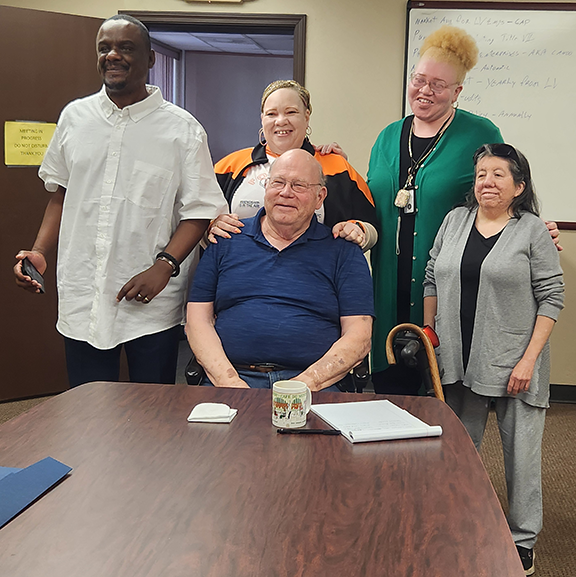
 DRS’ Jim Kettler, seated, is surrounded by members of the Spring 2024 Business Enterprise Program class.
By Jim Kettler
BEP Training Officer
The first 2024 training class for the Business Enterprise Program has graduated. The class started Jan. 8 and ended April 19..
The class included Marie Martin of Oklahoma City, Alexis McLaughlin of Oklahoma City, Donnavan Parker of Stroud and Travetta Powell of Lawton.
The class included 10 weeks of online training provided through the Chicago Lighthouse Forsythe Entrepreneurial Center. This part of the training included intensive study, review, quizzes and exams. Each of 12 modules’ exams had to be passed before moving on to the next one, ending with a final overall exam.
The final five weeks included four weeks of hands-on training with four different licensed vendors from the BEP community, hosting the trainees to give them real-life experience with vending machine servicing as well as snack bar tasks. Also, the final week was spent in study of Oklahoma-specific topics and ending with graduation.
Attending the graduation event were DRS’ BEP staff including Greg Nelson, Tyler Harbison, Stacey McGhee and Jim Kettler. Brian Montgomery, Deitra Woody, Teresa McDermott, Allison Freeman, and Lara Rees attended from the field. McDermott presented the new licensed vendors with certificates to show that they have successfully completed their training.
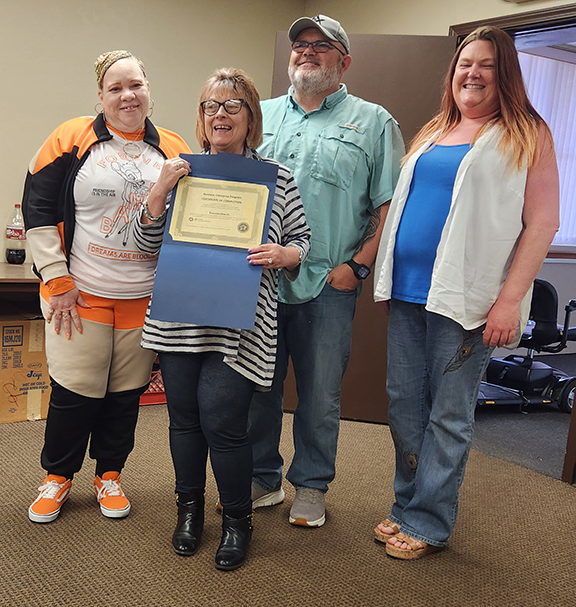 DRS' Teresa McDermott holds a certificate of BEP course completion for Travetta Powell. Also pictured is Brian Montgomery and Lara Rees.
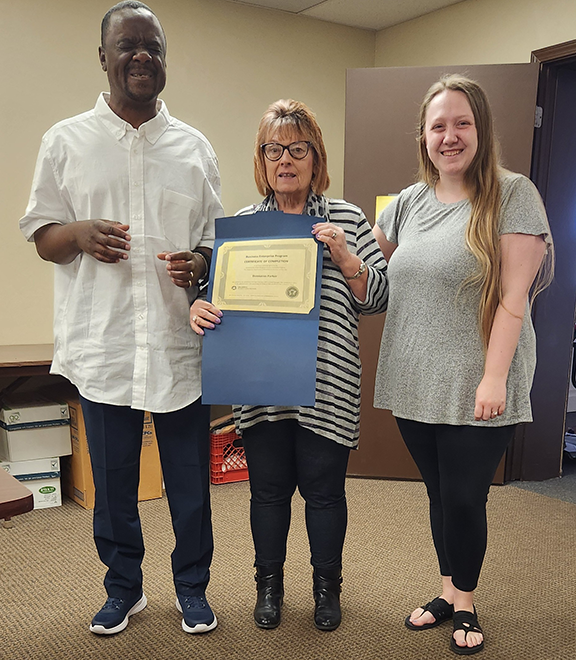 McDermott holds a certificate of BEP course completion for Donnavan Parker. Also pictured is Allison Freeman.
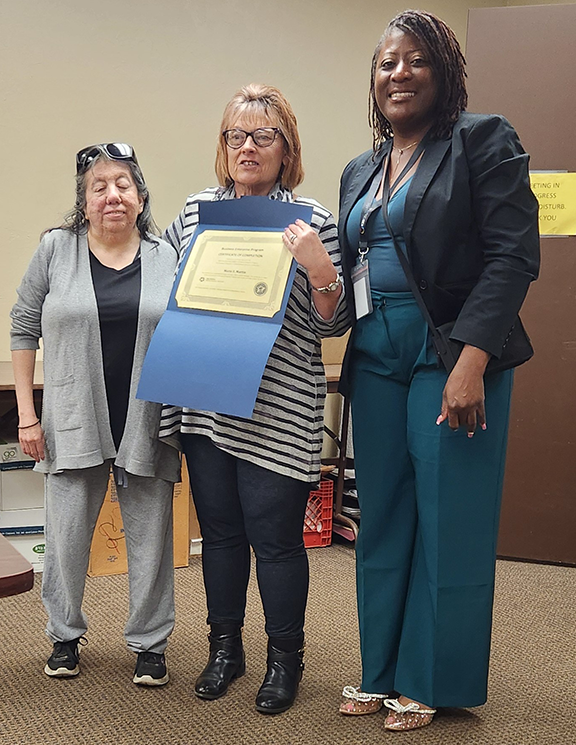 McDermott holds a certificate of BEP course completion for Marie Martin. Also pictured is DRS’ Deitra Woody.
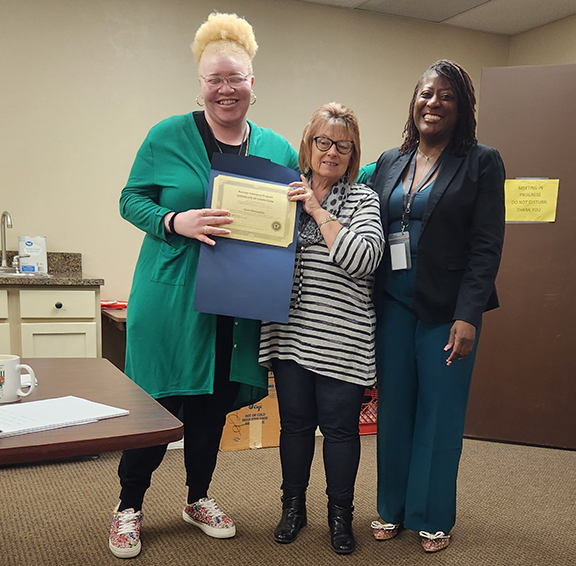 Alexis McLaughlin holds her certificate of completion with help from McDermott. Woody looks on.
OKLAHOMA CITY – DRS Transition staff will guide more than 400 youth with disabilities through free summer training, which is being offered in 24 rural and urban communities.
DRS Transition staff serve more than 3,000 students, ages 16 to 21, during the school year through employment programs offered by DRS’ Vocational Rehabilitation and Services for the Blind and Visually Impaired.
“What an exciting time in Oklahoma for students to have opportunities to help students make decisions about their future careers,” DRS Transition Coordinator Renee Sansom Briscoe said.
BEST STEP
BEST STEP (Building Employment Skills for Today and Summer Transition Employment Program) is a five-week, two-part career planning and paid on-the-job training program for students with disabilities, ages 16 and older. Participants must be returning to high school in August 2024.
BEST students complete workforce readiness and career exploration experiences followed by STEP, where they earn paychecks in part-time, paid internships in their communities. For more information, email Renee Briscoe at Rsansom@okdrs.gov or phone 405-212-7789.
“BEST STEP can change lives,” Briscoe said. “From day one of BEST to the end of the week, friendships are made, skills are stronger and hope is alive. They take those skills and hope with them to STEP and become employees in the community where they gain experience, knowledge and a sense of value.”
BEST STEP is funded by DRS with training and services delivered in partnership with OU National Center for Disability Education and Training’s Pre-ETS program.
“This summer program could not be possible without the support NCDET and the University of Oklahoma Pre-ETS, Central Oklahoma Workforce Innovation Board, Southern Workforce Board, work skills trainers across the state and DRS counselors and rehabilitation technicians,” Briscoe added.
STEM CAMPS
Tech now STEM Camps are open to Oklahoma students, ages 14-21, with documented physical, mental or cognitive disabilities. Students learn to effectively use computers, software and related technologies to design and create Power Racer dragsters, High Tech (HT) powered racers, shirts, hats, mouse pads, bracelets and pin-back buttons.
This summer, Tech Now is partnering with DRS Transition to offer STEM camps in Ada, Atoka, Davis, Lawton, Skiatook and Tulsa in June and July. Click here for a list of locations and dates. Contact Renee Briscoe at Rsansom@okdrs.gov or phone 405-212-7789 with questions.
SUMMER 2024 VIBE
Transition VIBE (Visually Impaired and Blindness Empowerment) offers assessment and career or higher education exploration for students with visual disabilities. Students strengthen skills through customized training in independent living, interviewing, communication, technology use, team building, and travel and transportation. VIBE takes place June 23 through 28 at DRS’ Oklahoma School for the Blind in Muskogee.
VIBE is offered by DRS Services for the Blind and Visually Impaired. Applications are required. To sign up or get more information, click here to download the VIBE flier or phone Dietra Woody at 405-522-3410 or Magan Rowan at 405-522-3380.
News From SVBI
Debbie Eagle, a rehabilitation teacher in the SBVI Tulsa office supervised by Julie Bailey, has passed the Certified Vision Rehabilitation Therapist exam under the Academy for Certification of Vision Rehabilitation and Education Professionals.
The CVRT, commonly known as a rehabilitation teacher, instructs persons with vision impairments in the use of compensatory skills and assistive technology that will enable them to live safe, productive, and interdependent lives. These specialists work in areas that enhance vocational opportunities, independent living, and the educational development of persons with vision loss, and may include working in center based or itinerant settings.
In developing the certifications, ACVREP adheres to the best practice standards of the national organization that accredits certifications, the National Commission for Certifying Agencies and to the international standards of ISO 17024, meaning the certification meets internationally recognized standards and global best practices. To develop and maintain a certification, ACVREP assembles a committee of subject matter experts in the area of specialization who establish the certification standards and work with an outside professional psychometric firm to create a rigorous certification exam. All certificate holders are bound by a strong code of ethics.
"We’re proud to have Eagle on the SBVI team." SBVI Administrator Tracy Brigham said.
Sarah Wiggins, who is a rehabilitation teacher in the Ada office, has been working on her master's degree in Vision Rehabilitation Therapy at the University of Massachusetts -Boston.
Wiggins was recently awarded the Academic Award in Excellence in Vision Rehabilitation Therapy Award for 2024. This award recognizes the high quality of work a student demonstrates in their studies and internship.
Wiggins was highly recommended for the recognition by Cheryl Snow (on-site internship supervisor), as well as by Dan Norris, the VRT Program Coordinator for UMASS Boston Vision Studies Program who oversees the academics and also came on-site to observe Sarah in-person.
“I am thrilled to have such a passionate and knowledgeable person on the SBVI Team,” SBVI Administrator Tracy Brigham said.
Oklahoma School for the Deaf reported on April 30 that two OSD employees lost their homes and 11 employers and one OSD interpreter have significant damage to homes and vehicles. Three retired or former OSD employees lost their homes and five saw homes suffer significant damage. One student’s family lost a vehicle and has damage.
OSD buildings are OK but some have more flooding damage than originally thought. A disaster has been declared. They will have virtual school through the end of year.
DRS Executive Director Melinda Fruendt reached out through Executive Team to find out if other DRS employees were impacted by the tornadoes. No one has come forward at this time. Please email Melinda at mfruendt@okdrs.gov and me jharlan@okdrs.gov of someone who needs help.
If you would like to help OSD victims, please mail Walmart or generic gift cards to OSD Business Manager Lynn Hickman at 317 E. Wynnewood, Sulphur, OK, 73086. This address is available when OSD is closed. If employees from other divisions are impacted too, we will adjust the plan. Participation is optional. We are not able to accept cash.
OSD high school students in both Junior National Association of the Deaf and OSD Student Body Government designed t-shirts. Proceeds will be collected for the Deaf and OSD community affected by Sulphur tornadoes. More information #sulphurstrong
You can show your support by purchasing a T-shirt here.
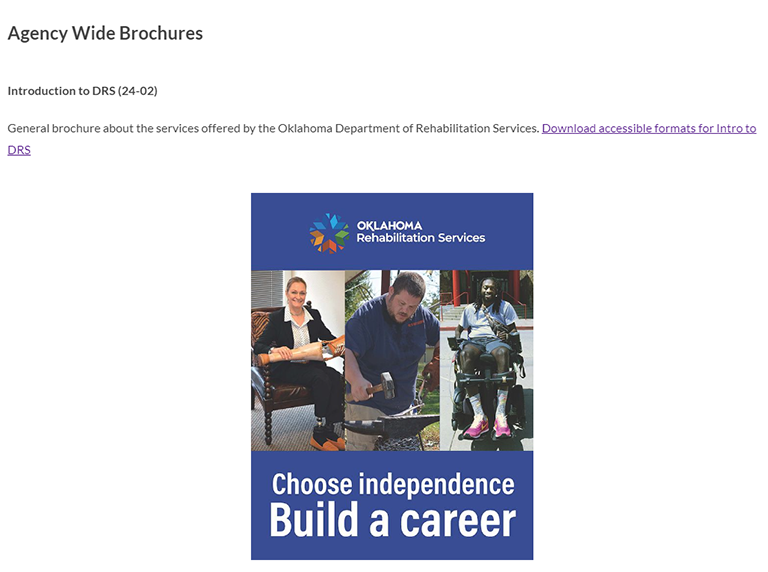
DRS has a new brochure and promotional material order form for staff to use.
The order form change comes as more online state agency functions move to the Adobe Experience Manager content management system platform.
Staff is asked to use the order form when seeking brochures or special promotional materials because some quantities require division administrator's approval,
Please bookmark the new order form in your browser to make accessing it easier.

After bringing up service animals last month, I’ve received a few comments, leading me to explore the issue of disability and animals again. This time, I want to focus on emotional support animals. I heard someone say emotional support animals aren’t associated with disabilities. That’s wrong. They are.
Just because the regulations implementing the ADA doesn’t mention emotional support animals, beyond stating, in the definition of a service animal, “the provision of emotional support, well-being, comfort, or companionship do not constitute work or tasks for the purposes of this definition.” This phrase is found in both the Title II and Title III definitions. Being trained to do work or tasks for an individual with a disability is the hallmark of a service animal.
However, the concept of an emotional support animal is one which is almost universally relevant to individuals with disabilities. The Fair Housing Act permits the presence of ESA’s because they do provide “emotional support that alleviates one or more of the identified symptoms or effects of a person's existing disability.” The FHA uses the term “assistance animals” because it includes both service animals and emotional support animals.
The Department of Transportation also allows ESA’s on busses, trains and airplanes because of their utility to individuals with disabilities. However, a few years ago, large numbers of people started designating their pets as ESA’s to avoid having to pay for their transport. Since an ESA does not have to be trained, in any way, the resulting chaos of lizards, rats, chickens and even peacocks became utterly unmanageable. Now, even the DOT will only allow service animals to ride, unrestricted, in passenger areas.
Adequate training is only one reason why only service animals are allowed in public spaces. There’s also the consideration of persons’ needs. Service animals perform essential tasks for people with disabilities, and an emotional support animal really doesn’t. The view is an individual will only be in a public space for a somewhat limited period of time, and a person who utilizes an ESA would be able to manage in the meanwhile.
On the other hand, a person spends a significant amount of their lives in their homes and needs the comfort their animal provides them. So, it’s wrong to think an emotional support animal is not associated with individuals with disabilities. They absolutely are. It is just they are much harder to identify service animals. When questioned, a person with a service animal can articulate exactly what the animal does for them. Not so with an ESA.
This is why the Fair Housing Act permits housing providers to require documentation from a medical health professional stating the need a person has for the animal and what impairments the animal alleviates.
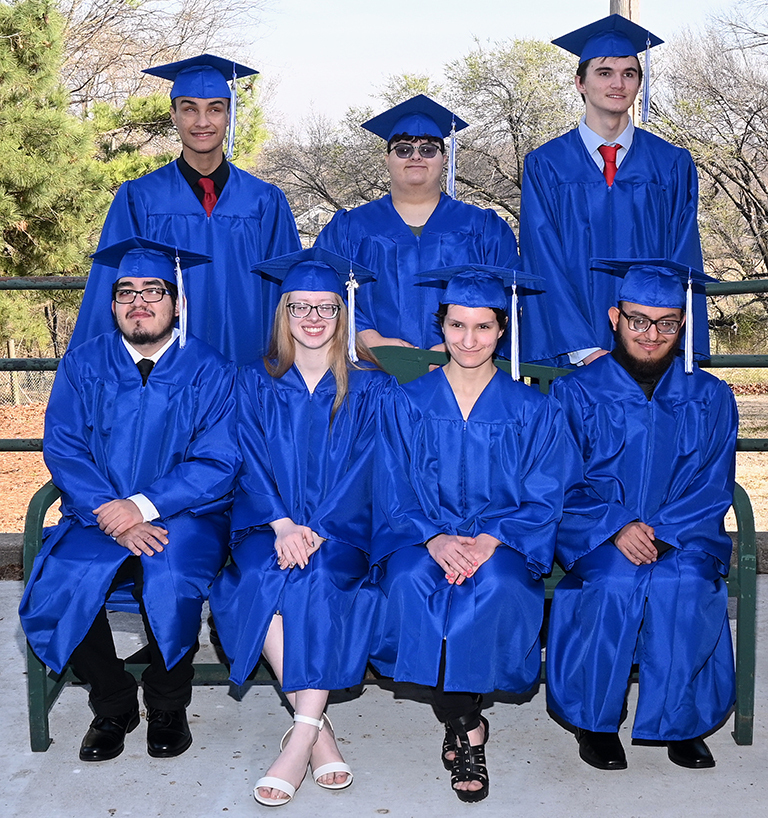 Members of the Oklahoma School for the Blind 2024 graduating class includes back row, from left, Mykel Eagle, Lorie Cox and Scott Moore. Front row, from left, Adan Duran Gonzalez, Emileigh Jackson, Katelynn Zampella and Gerardo Rodriguez.
MUSKOGEE — Seven seniors will graduate May 16 from the Oklahoma School for the Blind during a commencement ceremony that will begin at 1:30 p.m. in the school’s auditorium.
OSB is located at 3300 Gibson Street in Muskogee.
The OSB 2024 graduating class includes Adan Duran Gonzalez of Coweta, Lorie Cox of Lawton, Mykel Eagle of Stilwell, Emileigh Jackson of Verdigris, Scott Moore of Norman, Gerardo Rodriguez of Oklahoma City and Katelynn Zampella of Muskogee.
“These students have excelled both inside and outside the classroom,” DRS Executive Director Melinda Fruendt said. “They will always be an important part of our OSB family, and I know each is on a path to a great, independent life.”
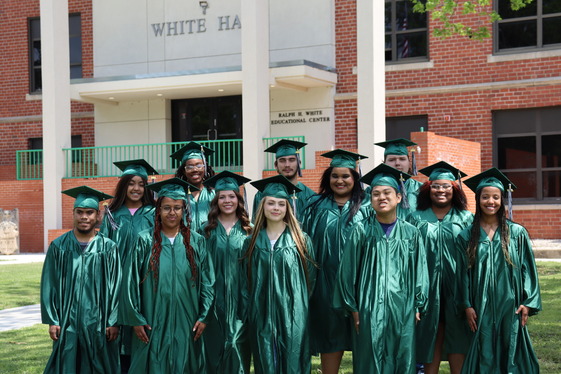 OSD graduating seniors.
SULPHUR — The Senior Class of 2024 will graduate from the Oklahoma School for the Deaf at 1 p.m. on May 21 at 1100 E. Oklahoma St., Sulphur in the OSD Gymnasium.
“I am so proud of this year’s seniors. I have no doubt that they will go forward an accomplish many great things in the world,” OSD superintendent Heather Laine said. “I wish them every success as they venture out to next chapter of their lives.”
Leading the class is Valedictorian RyJan Reininger.
This year’s graduating class includes Joshua Bryce Cain of Ada, MaKenna Jane Fleshman of Greenfield, Caden Gail Gardea of Mustang, Christopher James (CJ) Huberty of Sulphur, Kreshunna Jamelle Johnson of Glenpool, Frankie Lokeijak of Enid, Elijah James McKenna of Maud, Janesse Lashae Palmer of Lone Grove, RyJan Dax Reininger of Midwest City, Katherine Shasteen of Tulsa, Ruby Shasteen of Tulsa, Shakayla DeAnn Simmons of Lawton and Sasha Marie Traver of Woodward.
 DRS made it possible for woman to stay independent, take care of spouse
Taken from DRS client submitted success story:
Owasso’s Linda Klein is living independently with the assistance of DRS after suffering a reaction to medication that left her legally blind.
Services received included:
- Training and education,
- Counseling and guidance,
- Telecommunications and adaptive equipment,
- Information and referral,
- Independent living services,
- Library for the Blind and Physically Handicapped,
- Orientation and mobility skills, technology services
“The services provided to me are valuable so that I can be independent in my home: the kitchen, traveling in and outside my house, the ability to learn new software and use adaptive technology,” Klein wrote. “(It) allows me to read my mail and other written information, make doctor appointments, care for my pets and take care of my husband in our house. I am in the process of typing again with the new software. This has been an invaluable, emotional and social benefit for me.”
|