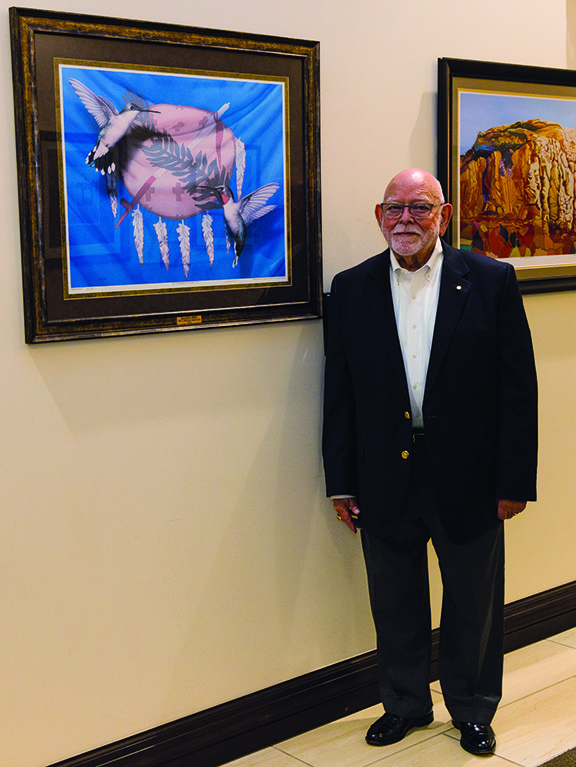
A fellow singer saw potential in Larry Duffy, calling him one day to say he wanted to pick him up and give him a few tests.
Reviewing the results, Jerry Gunkle, a former vocational rehabilitation staff member, told Duffy, “Larry we need to get you into school. You have too much to offer to be working on an hourly wage basis.”
Duffy, now 79, had been born with congenital cataracts, limiting his vision.
“My dad was a smoker like many people were back then,” Duffy said. “Mother would hand me a bottle, but I wouldn’t reach for it. A baby will reach for things. My dad noticed that when he lit a match my eyes would follow the match.”
His parents contacted their family doctor who diagnosed the cataracts. The family turned to an Oklahoma City surgeon who was willing to do the surgery that was experimental for an infant.
“Back then, they used needles to go in and attempt to lift the cataracts off the eye,” Duffy said. “Doctors have told me it was like he left trash. I have been wearing glasses since I was 6-months-old. I never really broke my glasses or did without them because I was so grateful that I could see.”
A few years later, Duffy was working at a funeral home in Altus, which had a company within it that built granite headstones for the Veteran’s Administration. They produced 25,000 a year. Duffy said it was a good job, but it only paid an hourly wage. He had a wife and two small children.
“I was very fortunate that vocational rehab reached out to me at a time where I needed help and gave me the opportunity to get my education,” he said.
DRS’ support made it possible for Duffy to earn an associate’s degree in arts from WOSC, and a bachelor’s degree in music education and a master’s degree in music from Southwestern Oklahoma State University.
“They (DRS) were supportive all the way through my master’s program,” he said.
His first job would be at Western Oklahoma State College in Altus where he was tasked to build a music department.
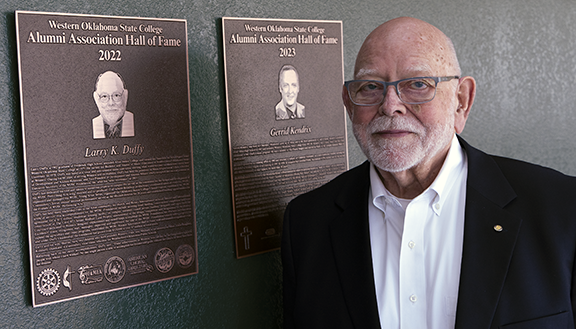 “My first job here at the college was to build the music department here,” he said. “I was teaching vocal music, choir and voice. But I also started a pep band for the basketball games.”
Two decades later he would move into development for the college before retiring 10 years ago. The school would ask him to return to help lead the school’s foundation
“I thought it would be just a couple of years but that was 2013,” he said. “I work three days a week. My wife says I am down to 40 hours a week.”
Duffy was inducted into the Western Oklahoma State College Alumni Association Hall of Fame in April 2022 and Oklahoma Higher Education Hall of Fame in November 2022.
“I’ve had a wonderful, wonderful career,” he said. “I’ve had the opportunity to help a lot of students and be a part of their lives. But really, I look back at it and it was that helping hand (from DRS) that provided funding for me to go back to school.”
Duffy recommends DRS to others because of the potential Gunkle saw in him and the services the agency was able to provide.
SBVI Administrator Tracy Brigham said, “It is always incredible when one of our clients succeeds and thrives, but it’s even more extraordinary when they can make their job a lifelong career. That’s what SBVI aims for and wants for our clients.”
 Four of the medal-winners at Oklahoma School for the Blind’s regional Braille Challenge® are from Muskogee: (clockwise from top left) Kesslee Travis, Avery Dollar, Gabriella Henderson and Jaylee Burnside.
MUSKOGEE –– OSB staff watched as 33 Oklahoma students competed at Oklahoma School for the Blind for medals and prizes in the regional Braille Challenge competition sponsored by Braille Institute of America in the United States and Canada.
The basic Braille unit is an arrangement of six raised dots, two across and three down, that resembles the number six domino. Each dot or combination of dots represents letters of the print alphabet. Braille dots are designed to be read with the fingertips, but can be written by hand, on computers or portable electronic note takers.
“Braille literacy is essential to future successes and employment,” Faye Miller, Oklahoma School for the Blind’s orientation and mobility specialist, said. “The Oklahoma Braille Challenge motivates contestants to practice their Braille skills because they want to win medals and improve their performances from last year.”
Miller has coordinated the annual academic competition hosted by OSB for 22 years.
“Contestants also are building a community with other people who read and write braille as they celebrate their Braille skills and make lasting memories,” she said.
The regional Braille Challenge award winners are:
Apprentice Transition Middle School/High School
Gold Medal: Kesslee Travis, Muskogee
Silver Medal: Genevieve Owens, Claremore
Bronze Medal: Jaden Brown, Broken Arrow
Apprentice
Gold Medal: Neal Summerlin, Watts
Silver Medal: Khup Tuang, Tulsa
Bronze Medal: Nina Cutler, Cushing
Freshman Transition Middle School
Gold Medal: Austyn Lawler, Walters
Silver Medal: Avery Dollar, Muskogee
Bronze Medal: Audree (Elli) Montgomery, Shady Point
Freshman Transition Grade 9
Gold Medal: Piper Conner, Perkins
Silver Medal: Nathaniel Hiatt, Park Hill
Bronze Medal: Jaylee Burnside, Muskogee
Freshman Transition Grades 10-11
Gold Medal: Erikson Lopez, Owasso
Silver Medal: Maria Komers, Noble
Bronze Medal: Angel Cozort, Ketchum
Freshman
Gold Medal: Jayda Magers, Ponca City
Silver Medal: Kaos Davis, Alva
Bronze Medal: Justus Hoover, Alva
Sophomore Transition Middle School/High School
Gold Medal: Kolten Pennington, Roff
Silver Medal: Lilith Pedersen, Anadarko
Bronze Medal: Delilah Howell, Westville
Sophomore
Gold Medal: Kye Shrum, Perry
Silver Medal: Kennedy Sullivan, Morris
Bronze Medal: Gabriella Henderson, Muskogee
Junior Varsity
Gold Medal: Stephanie Glynn, Tulsa
Varsity
Gold Medal: Anna Suarez, Sand Springs
Contestants in the apprentice, freshman and transition categories were tested on spelling, reading comprehension and proofreading.
Sophomore, junior varsity and varsity contestants were scored on charts and graphs, reading comprehension and proofreading. They also listened and transcribed passages into Braille.
OSB graduates, retired OSB teachers, teachers of visually impaired and other Braille experts proctored and scored tests. Long-time supporters Sherry Holder and Jeanne Meyer have volunteered every year at OSB’s Braille Challenge for 22 years.
The Braille Institute will invite the top 50 finalists from the United States and Canada to compete in the National Braille Challenge in Los Angeles in June. Oklahoma competitors have advanced to the national finals 28 times since 2003.
“We are proud to host the annual Braille Challenge,” OSB Superintendent Rita Echelle said. “This challenging competition gives our OSB students and those attending other schools the chance to demonstrate and improve their Braille competency skills.”
Every competitor selected a prize this year and received Braille Challenge T-shirts donated by Frank Dirksen. Students also picked up goodie bags with items purchased with donations.
Braille Challenge contestants will receive brailed certificates and general performance feedback to help improve their skills.
Braille Challenge sponsors are Oklahoma School for the Blind, Braille Institute, Bud Holder and George Isbell memorial donations, Frank Dirksen, Jeri’s House, Inc., Liberty Braille, Nano Pac, NewView Oklahoma and Oklahoma Association for the Education and Rehabilitation of Blind and Visually Impaired.
Sponsors include OSU High Obesity Program, Pre-Employment Transition Services at OU National Center for Disability Education and Training, Ruth Kelly Studios, Transcribing Mariners and Tulsa Downtown Lions Club.
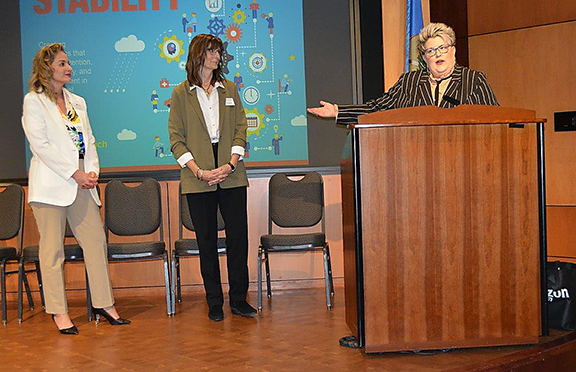
DRS Executive Director Melinda Fruendt speaks to attendees of the Disability at Work: Thrive Forum 2024.
Oklahoma City – “Disability at Work: Thrive Forum 2024" was the theme for the Business Summit held on March 28 at Oklahoma History Center in Oklahoma City.
The event was hosted by Oklahoma Inclusive Postsecondary Education Alliance, Oklahoma Rehabilitation Services' Business Services Program and the Autism Foundation of Oklahoma.
The event began with an opening ceremony hosted by DRS Executive Director Melinda Fruendt, OKIPSE Alliance Director Julie Lackey and AFO Executive Director Emily Scott.
Michael Bowling with Crowe & Dunlevy was the keynote speaker during lunch.
DRS’ Jonathon Cook served as master of ceremonies for the event, and Yasmin Avila, and business services coordinator gave the closing remarks.
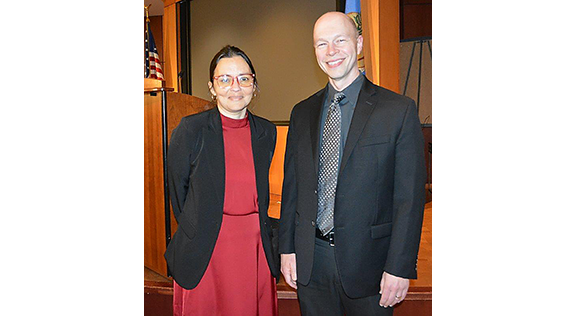 From left, Yasmin Avila Guillen, DRS’ business services coordinator and Michael Bowling, the Business Summit’s keynote speaker.

It’s been a while since I’ve talked about service animals in this column. Service animals are a fascinating subject, and whenever the issue comes up during training sessions or conversations, there’s usually lots of questions, stories and interest. So, let’s review a recent Colorado court case concerning a gentleman and his service animal at a state university, shall we?
The young man at the center of this case had some psychological disabilities, namely PTSD, anxiety and depression. He wanted a dog who might help him with his mental health and his parents found an emotional support dog and purchased the animal for him.
Let’s review the terminology commonly used for dogs, as they relate to mental health and disabilities. A “therapy” dog is used in group situations. If someone or some organization brings in a dog or dogs to interact with children, adults, or seniors as a group, it’s a therapy animal. An “emotional support” dog is one used by an individual to provide help for psychiatric disabilities. Such a dog isn’t trained to do anything, it’s mere presence alone provides comfort for the person.
A true service animal is a trained dog, and only a dog. They can be guide dogs and alert dogs for people with hearing loss, diabetes, or seizure disorders. They can provide balance support, pick up and retrieve dropped items for an individual, remind people to take medications, etc. Only service animals are mentioned and have legal protections in the ADA.
So, this man got an emotional support animal. However, he took the time tor train it, relying on videos he watched on how to do it. Eventually, the dog had been trained to remind him to take his medications, remove him from stressful situations, and provide pressure therapy. It is absolutely a person’s right to train their own service animal.
What he didn’t know was the terminology around these dogs. He thought an emotional support animal was, essentially, a service animal in training. When he was asked, at the college he started attending, if the dog was a service dog, he said it was an emotional support dog because he was still doing some training. However, at the time he could have truthfully said it was his service animal.
Of course, the college, on hearing it was an emotional support dog, prohibited the man from taking the dog with him to class or around the campus. He sued and that’s what prompted the courts to get involved. He did win his case on appeal.
What this shows is the necessity of knowing the proper terminology and being able to articulate exactly what tasks a service dog does when one is asked. To make sure an individual is given all the rights bestowed by the ADA, we should be educating our consumers about how to ensure they aren’t tripped up when trying to bring their service dog into a public place.
|